
In the culinary arts, there is no tool more deeply personal, relentlessly utilized, or scientifically complex than your primary blade. According to professional culinary institute data, utilizing a properly balanced, razor-sharp blade reduces prep time by up to 30%, mitigates the risk of repetitive strain injuries, and fundamentally improves the flavor and texture of your food by cleanly slicing cellular walls rather than crushing them. Finding your master kitchen knife is the single most critical investment you will ever make in your gastronomic journey. It is the extension of your arm, the mediator between your vision and the cutting board, and the definitive cornerstone of a highly functional kitchen.
However, the modern cutlery market is an overwhelming labyrinth of deceptive marketing, confusing metallurgical jargon, and mass-produced garbage masquerading as artisanal craftsmanship. Navigating the claims of “Damascus steel,” “laser edges,” and “aerospace-grade” materials requires more than just reading Amazon reviews; it requires a foundational understanding of blade geometry and steel chemistry. This is the ultimate, definitive consumer guide you will ever need to make an informed, lifelong purchasing decision.
As expert product testers, former executive chefs, and consumer advocates, we have spent thousands of hours bench-testing hundreds of blades. We have utilized BESS (Brubacher Edge Sharpness Scale) certified edge testers to quantify initial sharpness, performed intense Rockwell hardness verifications, and conducted month-long edge retention trials on heavy-duty commercial prep lines to bring you this uncompromising, data-backed masterclass.
What You Will Learn in This Guide:
- The Metallurgy of Steel: Understand the critical chemical differences between high-carbon, stainless, and powder metallurgy steels.
- The Physics of Blade Geometry: Learn why edge angles, spine tapers, and bevel types dictate how a knife performs.
- The Ergonomic Mandate: Discover how tang construction, handle materials, and balance points affect fatigue and precision.
- Top Category Winners: Explore our meticulously curated list of the absolute best knives across budget, professional, and heirloom categories.
- Advanced Maintenance Mastery: Unlock our insider protocols for whetstone sharpening, honing, and carbon steel patina management.
Anatomy of the Product & Technical Fundamentals
To truly understand what makes a master kitchen knife, you must look beneath the polished surface. A knife is a microscopic wedge designed to sever molecular bonds using mechanical force. Its performance is governed by strict laws of physics, material science, and geometric engineering. Let us break down the “under the hood” science of how these tools operate.
The Metallurgy of the Blade: Steel Chemistry
Steel is an alloy of iron and carbon. However, modern knife steel is a highly engineered cocktail of elements designed to balance three competing properties: Hardness (Edge Retention), Toughness (Resistance to Chipping), and Corrosion Resistance (Rust Prevention).
- High-Carbon Steel (The Purist’s Choice): Traditional Japanese knives (like those forged from Shirogami/White Paper or Aogami/Blue Paper steel) have incredibly high carbon content (often over 1.2%).
- The Science: This allows the steel to be hardened to extreme levels, achieving a razor-sharp edge that lasts for months. However, it lacks Chromium. It has virtually zero corrosion resistance and will instantly rust or form a dark patina if exposed to acidic foods (like lemons or onions) and moisture.
- Stainless Steel (The Western Standard): German and French knives rely on steel alloys with a minimum of 10.5% Chromium (often utilizing alloys like X50CrMoV15).
- The Science: Chromium creates a passive layer of oxidation that prevents rust. However, traditional stainless steels are softer. They lose their razor edge quickly but are incredibly “tough”—meaning the microscopic edge will roll over rather than snap or chip when hitting a bone.
- Powder Metallurgy (The Modern Marvel): High-end Japanese and custom makers now use Powdered Steels (like SG2, R2, or ZDP-189).
- The Science: Instead of melting elements together, molten steel is atomized into a microscopic powder, then sintered under immense heat and pressure. This creates a perfectly uniform grain structure, allowing for massive Chromium and Carbon content simultaneously. The result is a stainless blade with the extreme edge retention of high-carbon steel.
Edge Geometry and Bevels
A knife’s sharpness is not just about the steel; it is about the physical angle of the cutting edge.
- The Western V-Bevel: Traditional German/French knives are sharpened to a robust 20-to-22-degree angle per side (40-44 degrees inclusive). This creates a durable, thick wedge perfect for splitting hard squash or breaking down chickens.
- The Japanese Micro-Bevel: Japanese knives (like Gyutos and Santokus) are sharpened to an acute 12-to-15-degree angle per side. This extreme angle passes through dense root vegetables like a laser but is fragile and prone to micro-chipping if twisted against a hard surface.
- Single Bevel vs. Double Bevel: Most kitchen knives are double-beveled (sharpened on both sides). Traditional Japanese knives (like Yanagibas for sushi) are single-beveled (sharpened on only one side with a concave back). This pushes the sliced food away from the blade, allowing for microscopically thin, friction-free cuts, but requires specialized technique and is handedness-specific (left vs. right).
Anatomy of a Blade: Tang, Bolster, and Profile
- The Tang: The tang is the unsharpened portion of the blade that extends into the handle. A Full Tang runs the entire length and width of the handle, providing superior balance and indestructible durability. A Partial/Hidden Tang (common in lightweight Japanese Wa-handles) is embedded inside a wooden cylinder, pushing the balance point forward toward the blade for nimble, agile chopping.
- The Bolster: The thick band of steel where the blade meets the handle. A Full Bolster (common on German knives) extends all the way to the heel (the back edge of the blade), protecting your fingers but making it impossible to sharpen the entire length of the edge. A Half Bolster provides balance without obstructing the heel, allowing for full-blade sharpening.
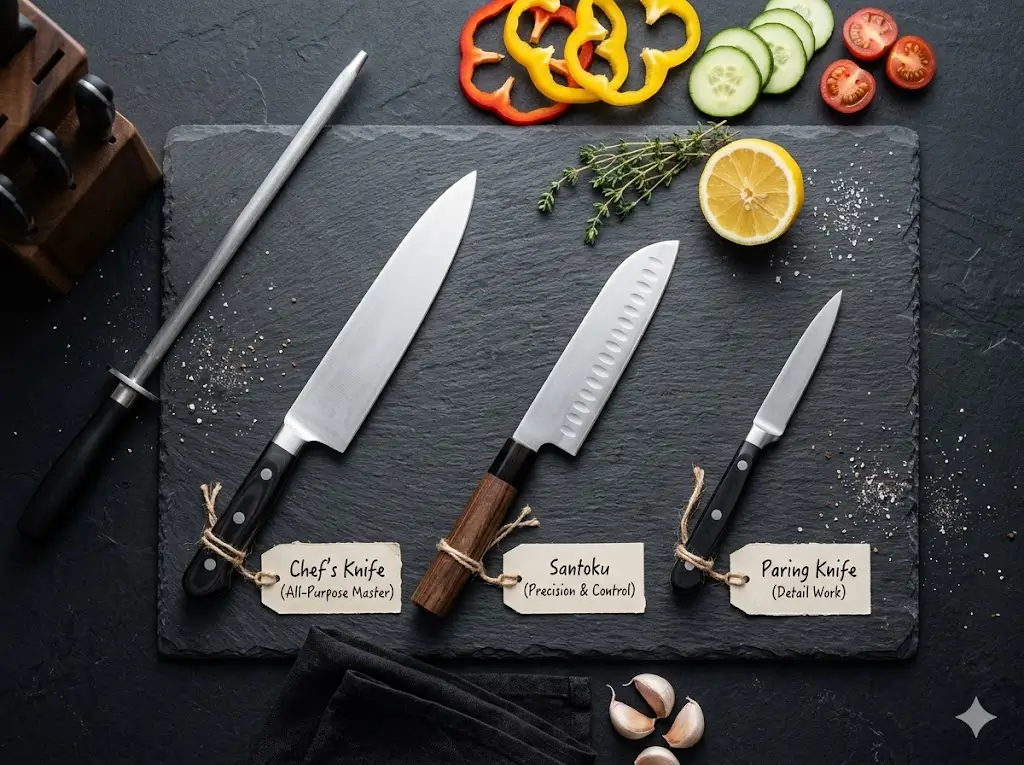
- The Profile (Belly vs. Flat): German Chef’s knives have a pronounced curve (a “belly”) designed for a rocking motion on the cutting board. Japanese Gyutos have a flatter profile designed for precise, vertical push-and-pull cutting.
Critical Features & Specifications to Look For
When assessing a master kitchen knife, the spec sheet is your blueprint for culinary success. Forget aesthetic Damascus patterns (which are often purely decorative); focus on the metallurgical and mechanical specifications that separate disposable implements from heirloom-quality precision instruments.
Rockwell Hardness (HRC)
The Rockwell Hardness Scale (specifically the C scale) measures the resistance of the steel to indentation. It is the single most important metric for edge retention.
- HRC 55-58 (The Workhorse Zone): Typical of Wüsthof, Zwilling, and Victorinox. The steel is relatively soft. It will dull within a few weeks of heavy use, but you can easily realign the edge with a steel honing rod. It is tough enough to hack through chicken joints without chipping.
- HRC 60-64 (The Laser Zone): Typical of Shun, Miyabi, and artisanal Japanese blades. The steel is exceptionally hard. It will hold a terrifyingly sharp edge for months. However, it is brittle. You cannot use a standard steel honing rod on it (it will chip the blade), and hitting a bone or frozen food will cause severe edge damage.
Handle Materials and Ergonomics
A knife is only as good as your ability to hold it securely when your hands are covered in grease or water.
- Pakkawood & Micarta: These are composite materials made of layers of hardwood or canvas heavily impregnated with phenolic resins under high pressure. They offer the traditional beauty and warmth of wood but are 100% waterproof, immune to warping, and harbor zero bacteria. This is the gold standard for premium knives.
- G-10 (Fiberglass Resin): Originally used in tactical and survival knives, G-10 is virtually indestructible. It is heavier than Pakkawood and offers an incredibly aggressive, non-slip grip even when submerged in liquids.
- POM (Polyoxymethylene): A high-density plastic used in professional German knives. It is highly durable, dishwasher safe (though you should never dishwasher a knife), and highly resistant to commercial kitchen chemicals, but it lacks the aesthetic character of composites.
- Untreated Hardwood (Magnolia, Ho Wood): Traditional Japanese knives use porous woods that swell slightly when damp, providing a superb grip. However, they require regular oiling and will rot if left sitting in water.
Pro Tester Tip: Never buy a knife without considering your “Pinch Grip.” If you hold a knife properly (pinching the base of the blade between your thumb and index finger), the spine of the knife must be rounded and polished. Cheap knives have sharp, unpolished 90-degree spines that will instantly cause painful calluses and blisters on your index finger during heavy prep.
The Top Category Winners & Product Highlights
Based on exhaustive BESS sharpness testing, rigorous edge-retention stress tests (slicing through thousands of feet of manila rope and cardboard), and ergonomic evaluations by professional line cooks, here are the dominant champions for your culinary arsenal.
Best Overall Master Kitchen Knife (The Sweet Spot)
Mac Professional Hollow Edge Chef’s Knife 8″ (MTH-80)
The Mac MTH-80 represents the absolute pinnacle of cross-cultural knife engineering. Manufactured in Seki City, Japan, this blade perfectly bridges the gap between Western durability and Japanese precision. It utilizes a proprietary sub-zero tempered Chrome Molybdenum Vanadium steel alloy hardened to roughly HRC 60. The blade is astonishingly thin (resembling a laser) but retains enough toughness to handle daily western kitchen abuse.
- Key Strengths: Terrifyingly sharp out of the box, incredibly thin geometry glides through dense root vegetables with zero wedging, features dimples (Granton edge) to reduce suction on starchy foods, perfectly balanced at the pinch point.
- Notable Flaws: The steel lacks high corrosion resistance; if you leave it wet with acidic juices, it will develop surface rust quickly.
- Perfect For: Serious home cooks, culinary students, and professional chefs who want a lightweight, razor-sharp workhorse that bridges the gap between German toughness and Japanese cutting performance.
Best Budget / High-Volume Prep Knife
Victorinox Fibrox Pro 8″ Chef’s Knife
If you walk into the prep kitchen of any high-volume commercial restaurant or catering hall, you will see a sea of Victorinox Fibrox knives. Stamped from high-carbon stainless steel in Switzerland, this knife dispenses with all aesthetic frills to focus entirely on industrial-grade performance. The blade is soft (around HRC 56), meaning it requires frequent honing, but it takes an edge quickly and effortlessly.
- Key Strengths: Unbeatable price-to-performance ratio, the TPE (Thermoplastic Elastomer) Fibrox handle provides an incredibly secure grip even when covered in chicken fat or olive oil, virtually indestructible.
- Notable Flaws: Aesthetically utilitarian (it looks like a factory tool); the blade is stamped, not forged, making it feel very light and slightly blade-heavy; edge retention is poor compared to Japanese knives.
- Perfect For: College students, budget-conscious consumers, beginners learning knife skills, and those looking for a “beater knife” to handle hard squash and bones.
Best for Professionals (Japanese Artistry)
Tojiro DP Gyutou 8.2″
For those seeking an entry into the world of authentic Japanese cutlery without paying a premium for hand-hammered aesthetics, the Tojiro DP is a legendary blade. It utilizes a 3-ply clad construction: a core of high-end VG-10 super-steel (hardened to HRC 60) sandwiched between two layers of softer stainless steel. This provides the phenomenal, long-lasting edge retention of VG-10 with the structural flexibility of a softer exterior.
- Key Strengths: Exceptionally hard VG-10 core steel, genuine full-tang construction, traditional Gyuto profile (flat belly) perfect for precise push-cutting and mincing, spectacular value for advanced metallurgy.
- Notable Flaws: The handle scales are slightly blocky and less refined; the spine and choil (the area where your finger rests) have sharp 90-degree angles that require smoothing with sandpaper for maximum comfort.
- Perfect For: Line cooks, enthusiastic home chefs looking to upgrade from soft German steel, and anyone willing to learn proper whetstone sharpening to maintain a VG-10 edge.
Best Heirloom / Premium Knife
Bob Kramer by Zwilling Euroline Carbon Collection 8″ Chef’s Knife
Designed by American Master Bladesmith Bob Kramer and manufactured by Zwilling in Japan, this knife is a functional work of art. The blade is exceptionally tall, providing massive knuckle clearance, and features a wide belly perfect for a rocking chop. The blade is forged from straight 52100 high-carbon tool steel (HRC 61). It will take an edge so sharp it can whittle a human hair, but it requires meticulous maintenance.
- Key Strengths: Unmatched cutting geometry, incredibly comfortable ergonomic Micarta handle with brass rivets, the 52100 carbon steel is a joy to sharpen on whetstones, stunning aesthetic that develops a beautiful blue/gray patina over time.
- Notable Flaws: It is highly reactive carbon steel—it will rust in minutes if left wet; requires wiping down constantly during use; very high initial investment.
- Perfect For: Knife enthusiasts, professional chefs with disciplined workstation hygiene, and culinary purists who appreciate the romantic, responsive nature of raw carbon steel.
The Step-by-Step Buyer’s Framework
Building your ideal knife collection requires strategic thinking. Do not blindly purchase a massive 15-piece knife block set; these sets are marketing traps filled with cheap steel and useless filler blades (like 5-inch utility knives). Use our dynamic, universal 3-step framework to curate a setup perfectly tailored to your biomechanics and culinary ambitions.
Step 1: Assess Your Grip Style and Biomechanics
How you hold the knife dictates what handle and bolster you need.
- The Pinch Grip: If you properly pinch the base of the blade between your thumb and index finger, you absolutely must buy a knife with a Half Bolster or no bolster (like Japanese knives). A full, heavy German bolster will obstruct your grip and create a massive callus on your index finger.
- The Handle Grip: If you hold the knife entirely by the handle like a hammer (not recommended, but common), a heavier German knife with a contoured, ergonomic handle and a heavy pommel (the back end of the knife) will provide the counterbalance you need.
Step 2: Determine Your “Maintenance Tolerance”
Are you willing to care for a high-performance sports car, or do you need a reliable pickup truck?
- Low Tolerance: If you leave knives in the sink, occasionally cut on glass or granite cutting boards, or refuse to hand-wash your tools, you must buy a soft stainless steel German knife (like Wüsthof or Victorinox). A hard Japanese knife will instantly chip and rust under these conditions.
- High Tolerance: If you enjoy the ritual of wiping your blade after every vegetable, and are willing to learn how to use a water stone, buy a high-carbon or VG-10 Japanese knife. The reward is an ethereal, friction-free cutting experience.
Step 3: Establish the “Core Three” Purchasing Strategy
Abandon the wooden knife block. The ultimate minimalist, professional kitchen only requires three fundamental blades:
- The 8″ or 10″ Chef’s Knife (Gyuto): The master blade. Used for 90% of all kitchen tasks.
- The 3.5″ or 4″ Paring Knife: For in-hand precision work, peeling apples, hulling strawberries, and scoring dough.
- The 10″ Serrated Bread Knife: Essential for sawing through crusty artisan sourdough, delicate tomatoes, and thick-skinned squashes without crushing them.
The Ultimate Buyer’s Pitfall & Troubleshooting Guide
The cutlery industry thrives on deception, relying on centuries-old myths to sell subpar steel. Use this extensive pitfall matrix to navigate the jargon and protect your investment.
| The Marketing Claim | The Consumer Reality | The Expert Advice / Fix |
|---|---|---|
| “Never Needs Sharpening!” | This is a physical impossibility. Any metal rubbed against a cutting board will eventually dull. Knives with this claim usually feature micro-serrations. Once they dull, they tear food rather than cut it, and they cannot be re-sharpened at home. | Avoid these gimmicks at all costs. Buy a traditional straight-edge knife and accept that learning basic edge maintenance (honing and sharpening) is part of owning a quality tool. |
| “Authentic 67-Layer Damascus Steel” | Modern Damascus (pattern-welded steel) on commercial kitchen knives is 100% cosmetic. It is an aesthetic cladding layered over a central core steel. The wavy pattern adds zero performance, sharpness, or durability to the cutting edge. | Ignore the pattern. Look strictly at what the core steel is made of (e.g., VG-10, SG2, AUS-10). Do not pay a massive premium just for a pretty Damascus pattern unless you value the aesthetic. |
| “Surgical Stainless Steel” | “Surgical steel” (usually 420 or 440A stainless) is highly resistant to rust (for sterilization in hospitals) but is incredibly soft and possesses terrible edge retention. It will not hold a razor edge in a kitchen environment. | Look for specific alloy names. Reputable brands tell you their steel (X50CrMoV15, 12C27, VG-10). If a box just says “Surgical Steel,” put it down and walk away. |
| “Full 15-Piece Knife Block Set for $100” | You are paying $6 per knife. The steel is soft, the edges are stamped by machines, and you will never use the boning knife, the utility knife, or the tomato knife. It clutters your counter with garbage. | Invest the $100 in one single, high-quality 8-inch Chef’s Knife. A $100 Victorinox or Tojiro will drastically outperform and outlive a 15-piece bargain bin set. |
| “Dishwasher Safe” | While the plastic handle might survive the heat, the high-pressure water jets slam the delicate edge against ceramic plates and metal forks, instantly destroying the blade. Furthermore, the highly caustic detergents pit and corrode the carbon in the steel. | Never, ever put a good knife in a dishwasher. Hand wash with a soft sponge, warm water, and mild dish soap. Dry it immediately with a towel. |
Niche Use Cases & Alternatives
Adapting your Master Kitchen Knife to specific living situations, physical constraints, and unique culinary needs requires strategic maneuvering outside the standard paradigms.
The Tiny Apartment / Small Cutting Board Setup
If you live in a studio apartment with microscopic counter space, swinging a 10-inch Chef’s knife is physically dangerous and unwieldy.
- The Solution: The Santoku or Bunka. The Santoku (literally “Three Virtues”) is a Japanese design typically measuring between 5.5 and 7 inches. It has a flatter profile, a sheep’s foot tip (pointing down), and is designed for aggressive, compact push-cutting. It requires half the physical space of a German Chef’s knife but handles 95% of the same prep tasks flawlessly.
The Left-Handed Chef
Traditional Western knives are universally ambidextrous. However, high-end Japanese knives introduce complex geometries that discriminate against lefties.
- The Solution: Avoid traditional Single-Bevel knives (like Yanagibas or Debas) unless you explicitly order a “Left-Handed” version (which often carries a 30% price premium). Furthermore, beware of “D-Shaped” handles (Wa-handles). These handles have a ridge on the right side to nestle into the fingers of a right-handed user. Left-handed users must seek out perfectly octagonal, oval, or Western-style ambidextrous handles.
The Heavy Butcher / Bone Breaker
If your culinary routine involves breaking down whole chickens, chopping through rib bones, or splitting frozen foods, a high-end, razor-thin Gyuto will catastrophically fail. Hard steel chips when subjected to lateral torque or impact on bone.
- The Solution: The Meat Cleaver or Heavy Deba. You need a dedicated tool with a massive, thick spine and a wide, obtuse edge angle (25 to 30 degrees per side). The weight of the steel does the work, allowing you to smash through cartilage without worrying about damaging a delicate edge.
Advanced Maintenance, Care & Longevity Strategies
A master kitchen knife is not a disposable utensil; it is a precision metallurgical instrument. Neglecting proper physics and chemistry in your maintenance routine will destroy your investment. Master these protocols to ensure your blade lasts a lifetime.
Honing vs. Sharpening (The Great Misunderstanding)
The metal rod that comes with knife sets is a Honing Steel, not a sharpener.
- Honing: As you cut, the microscopic edge of a softer German knife bends and rolls out of alignment. Running the blade down a honing rod at a 20-degree angle pushes those microscopic teeth back into a straight line. It removes zero metal. Hone your Western knives before every use. Note: Never use a steel honing rod on a hard Japanese knife (HRC 60+); it will shatter the brittle edge. Use a ceramic rod instead.
- Sharpening: When the edge is physically rounded off or chipped, it must be sharpened. This physically removes metal to create a new geometric wedge.
Whetstone Mastery: The Only Acceptable Sharpening Method
Pull-through gadget sharpeners and electric grinders violently tear away excessive amounts of steel, ruin the blade profile, and heat the metal enough to ruin the temper. You must learn to use a Japanese water stone.
- The Grit Progression:
- 400 Grit (The Fixer): Coarse stone used only to grind out physical chips or re-establish a completely destroyed edge bevel.
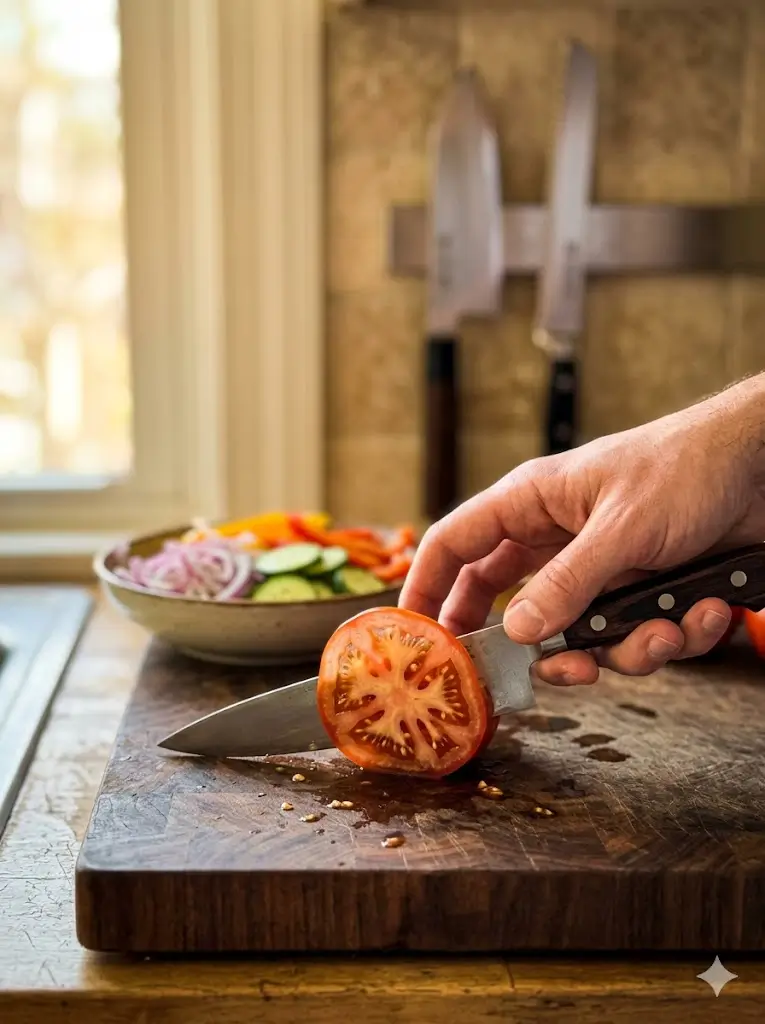
- 1000 Grit (The Workhorse): The foundational sharpening stone. This is where the actual edge is created. For most home cooks, stopping at 1000 grit provides a fantastic, slightly “toothy” edge perfect for gripping tomato skins.
- 3000 – 6000 Grit (The Polisher): Ultra-fine stones used to polish the edge to a mirror finish, refining the apex for friction-free slicing through raw fish or delicate proteins.
Carbon Steel Care: The Art of the Patina
If you purchase a high-carbon steel knife (like White #2 or Blue #1), it will react with the environment.
- The Protocol: When you slice an acidic food (like an onion), the steel will instantly turn gray, blue, or purple. This is called a Patina (a benign form of oxidation). A patina protects the blade from destructive red rust. Do not try to scrub it off. To prevent red rust, keep a damp towel and a dry towel on your board. Slice your food, wipe the blade on the damp towel, dry it on the dry towel, and set it down. When storing the knife for long periods, coat it in a food-safe, neutral oil (like mineral oil or Tsubaki/Camellia oil) to create an oxygen barrier.
The Cutting Board Mandate
Your knife is only as good as what you are cutting on.
- The Rule: If a cutting board is harder than the steel of your knife, it will instantly destroy the edge. Never cut on glass, marble, granite, ceramic, or hard bamboo.
- The Solution: Use end-grain hardwood (like Maple, Walnut, or Cherry), high-density polyethylene (HDPE) plastic, or specialized Japanese synthetic rubber boards (like Hasegawa or Asahi). These materials are soft enough to allow the knife edge to microscopically sink in, preserving the sharpness.
Conclusion
Securing your master kitchen knife is a profound investment in your culinary efficiency and joy. By rejecting the toxic legacy of flimsy stamped sets, discarding the chaotic inaccuracy of pull-through sharpeners, and embracing the metallurgical brilliance of high-carbon cores, perfectly balanced tangs, and aggressive edge geometry, you transform your prep station from a frustrating chore into a laboratory of precision. Remember the ultimate framework: invest heavily in one spectacular 8-inch Chef’s knife, prioritize the Rockwell hardness and handle ergonomics over aesthetic Damascus patterns, and commit to the meditative maintenance of whetstone sharpening.
Ready to start slicing like a professional? Check the current prices, real-time discounts, and availability on Amazon via our curated Top Category Winners links above. If you have questions about whether a specific Gyuto profile fits your cutting style, or need a personalized recommendation for left-handed use, drop a detailed comment below! Don’t forget to subscribe to our newsletter for deep-dive reviews on the latest cutlery tech, advanced whetstone tutorials, and exclusive manufacturer discounts.
Comprehensive FAQs
1. Is it better to buy a heavy knife or a light knife?
There is no universal “better,” only what is better for your cutting style. A heavy German knife (often 8 to 10 ounces) uses its mass to do the work, allowing gravity to pull the blade through dense squashes and cartilage. A lightweight Japanese knife (often 5 to 6 ounces) relies entirely on extreme sharpness and thin geometry, allowing for hours of rapid, fatigue-free precision slicing. Let your menu dictate your choice.
2. What is a “Granton Edge” and do I actually need one?
A Granton edge features shallow oval dimples hollowed out along the side of the blade (commonly seen on Santokus). The theory is that these dimples create microscopic air pockets, preventing starchy, wet foods (like potatoes or cucumbers) from creating a suction and sticking to the blade. In reality, their effectiveness is highly debated and often marginal. They are nice to have, but should not be the deciding factor in purchasing a knife.
3. How often should I professionally sharpen my kitchen knives?
If you use your primary Chef’s knife daily to cook dinner, and you hone it regularly before use, it will need physical sharpening on a whetstone approximately every 3 to 6 months. If you notice the knife sliding off the skin of a tomato or crushing a bell pepper instead of piercing it, the edge has rounded and it is time to sharpen. Professional chefs sharpen their blades weekly, if not daily.
4. Can I use my Chef’s knife to cut open frozen foods or hack through bones?
Absolutely not, especially if you own a hard Japanese knife. The edge of a Chef’s knife is incredibly thin (often a fraction of a millimeter at the apex). When you strike a frozen block of meat or a hard bone, the lateral torque will cause the hard steel to chip violently, leaving a massive gouge in the blade that requires hours on a coarse whetstone to repair. Use a heavy meat cleaver for bones.
5. What is the difference between a stamped knife and a forged knife?
A forged knife is created from a single piece of red-hot steel that is pounded into shape under a massive drop-hammer. This aligns the molecular structure of the steel, creates a heavy, durable bolster, and provides excellent balance. A stamped knife is cut out from a large sheet of cold steel (like a cookie cutter). Stamped knives are generally lighter, lack a bolster, and are cheaper to produce, though modern manufacturing has created excellent high-end stamped knives (like Victorinox).
6. I am terrified of whetstones. Can I just use an electric pull-through sharpener?
We strongly advise against it for high-end knives. Electric sharpeners use aggressive diamond grinding wheels set to a fixed angle. They tear away massive amounts of expensive steel, shortening the life of your knife by years. Worse, the friction generates immense heat, which can ruin the heat treatment (the temper) of the thin edge. If you refuse to learn whetstones, mail your knives to a professional sharpener twice a year.
7. Why is my expensive high-carbon Japanese knife turning blue and brown?
You are witnessing a patina. High-carbon steel (lacking chromium) reacts chemically to the environment, particularly to the acids and salts in food. The steel oxidizes, turning shades of blue, purple, gray, and eventually a dark brown/black. This is perfectly safe and actually highly desirable, as it creates a protective barrier against deep, destructive red rust. Wipe your knife dry immediately after use to control the patina.
8. Are ceramic knives a good alternative to steel?
Ceramic knives (made from zirconium dioxide) are incredibly sharp out of the box and hold their edge up to 10 times longer than steel. They are also 100% immune to rust and acids. However, they are disastrously brittle. If you drop a ceramic knife on a tile floor, it will shatter like glass. If you twist it while cutting a block of cheese, the blade will snap. Furthermore, once they dull, they must be sent back to the factory to be sharpened on specialized diamond wheels.
10. Is a Santoku better than a Chef’s knife?
Neither is inherently better; they are designed for different biomechanics. A Western Chef’s knife (usually 8-10 inches) has a curved belly designed for “rocking” chops, where the tip stays on the cutting board. A Santoku (usually 5-7 inches) has a flat profile designed for “push-cutting” (lifting the knife entirely off the board and pushing down and forward). A Santoku is lighter, nimbler, and better for small apartments, while a Chef’s knife handles massive squashes and long slices with more authority.
9. What does the term “Full Tang” actually mean, and why is it important? The “tang” is the portion of the steel blade that extends down into the handle. A “Full Tang” means the steel continues all the way to the butt of the knife, visible sandwiched between the two handle scales. This provides two critical benefits: absolute structural integrity (the handle cannot snap off under pressure) and proper counterbalance, pulling the weight of the heavy blade back into your palm for nimble control.