
In today’s fast-paced world, achieving optimal nutrition can feel like a part-time job. According to global dietary data, up to 90% of adults fail to consume the recommended daily intake of fruits and vegetables. Bridging this nutritional gap requires more than just willpower; it requires the right technology. Healthy blending & juicing at home is no longer just a fitness trend—it is a fundamental lifestyle shift that democratizes access to living enzymes, bioavailable phytonutrients, and crucial dietary fiber. However, the market is completely flooded with underpowered appliances, deceptive marketing claims, and confusing terminology.
Building the ultimate beverage station is about engineering a highly efficient, daily workflow. Whether you are aiming to craft thick, nutrient-dense smoothie bowls, extract pure liquid gold from leafy greens, or prepare holistic raw-food meals, this is the definitive, ultimate consumer guide you will ever need to make an informed purchasing decision.
As expert product testers and consumer advocates, we have stripped away the marketing fluff. We’ve spent hundreds of hours in the test kitchen—measuring extraction yields, decibel levels, particle size distribution, and motor temperatures—to bring you this uncompromising, data-backed masterclass.
What You Will Learn in This Guide:
- The Physics of Extraction and Pulverization: Understand the massive differences between centrifugal force, mastication, and vortex dynamics.
- Component Breakdowns: Learn why peak horsepower, auger materials, and blade pitch dictate the lifespan and performance of your gear.
- The Buyer’s Matrix: Discover the ultimate framework for choosing between a juicer, a blender, or both, based on your specific health goals.
- Top Category Winners: Explore our meticulously curated list of the absolute best machines across budget, prosumer, and commercial categories.
- Advanced Maintenance Mastery: Unlock our insider care protocols to protect your investment and ensure your appliances last a lifetime.
Anatomy of the Product & Technical Fundamentals for Healthy Blending & Juicing at Home
To master healthy blending & juicing at home, you must first understand the fundamental physics happening inside the carafe or extraction chamber. These are not merely spinning blades; they are high-velocity fluid dynamic engines and extreme-pressure crushers. Let us look “under the hood” at the hardware that makes nutrient extraction possible.
The Physics of Blending: Cavitation and Vortex Dynamics
A high-performance blender does not slice your food; it obliterates it through blunt force trauma. When dull, heavy blades spin at speeds exceeding 20,000 RPM (Revolutions Per Minute), they create a powerful vacuum.
- The Vortex: The shape of the blending jar (often tapered or fluted) works in tandem with the blades to continuously fold ingredients from the top of the jar down into the impact zone. If a blender lacks a proper vortex, you get “bridging”—where an air pocket forms beneath the food, and the blades spin uselessly.
- Cavitation: At peak speeds, the pressure behind the trailing edge of the blade drops so low that the liquid literally boils at room temperature. The microscopic bubbles instantly collapse in a shockwave, effectively exploding the cellular walls of fibrous plants like kale and flaxseed, making their locked-in nutrients highly bioavailable.
Juicer Classifications: Masticating vs. Centrifugal Mechanics
Juicing is the process of separating the water, enzymes, and soluble nutrients from the insoluble dietary fiber. How a machine achieves this dictates the quality, yield, and shelf-life of your juice.
- Centrifugal Juicers: These utilize a fast-spinning metal mesh basket with a grated bottom (spinning between 10,000 and 14,000 RPM). Produce is shredded, and centrifugal force flings the liquid through the mesh.
- The Science: They are incredibly fast and cheap, but the high-speed aeration introduces massive amounts of oxygen (oxidation). This rapidly degrades heat-sensitive enzymes and creates a foamy, watery juice that separates quickly and must be consumed within 24 hours.
- Masticating (Slow / Cold Press) Juicers: These utilize a heavy, slow-turning auger (typically running between 40 and 80 RPM) that literally chews and crushes the produce against a stainless-steel strainer.
- The Science: By applying immense pressure at a low RPM, no heat is generated, and minimal oxygen is introduced. This “cold press” method yields up to 30% more juice—especially from leafy greens—and produces a dense, vibrant liquid that can stay fresh in the refrigerator for up to 72 hours.
- Twin-Gear (Triturating) Juicers: The pinnacle of extraction. Two inter-locking stainless steel gears spin at roughly 110 RPM, aggressively crushing and pressing the plant fiber to microscopic levels. They offer the absolute highest yield and enzyme preservation available on the consumer market.
The Role of Motor Wattage, Torque, and RPM
Marketing departments love to throw around massive numbers like “1500 Watts!” or “3 Peak Horsepower!” But these numbers require context.
- Peak vs. Sustained Power: “Peak” horsepower refers to the microscopic fraction of a second when the motor first engages or hits a complete stall. What actually matters is sustained running wattage and torque. A high-torque motor can power through a pitcher of frozen mangoes without stalling, whereas a high-RPM/low-torque motor will simply overheat and trigger its internal breaker.
- The Amp Draw: Standard American kitchen outlets are rated for 120 Volts and 15 Amps. Basic physics (Volts x Amps = Watts) tells us the maximum continuous power you can draw from a standard outlet is 1800 Watts. Any brand claiming 2500+ watts on a standard 15-amp plug is using deceptive peak-load metrics.
Blade Geometry and Auger Materials
- Blender Blades: The best blades are laser-cut from hardened, aircraft-grade stainless steel. They are thick and deliberately dull. Sharp blades (found in cheap blenders) dull quickly when pulverizing ice, leading to decreased performance over time.
- Juicer Augers: Premium slow juicers utilize GE Ultem or Tritan plastics for their augers. Ultem is a space-grade polyetherimide material that is eight times stronger than standard plastics, allowing it to withstand the immense torque required to crush dense root vegetables like raw carrots and ginger without snapping.
Pro Tester Tip: Never underestimate the importance of the blender’s drive socket—the coupling where the motor base meets the jar. Cheap blenders use brittle plastic sockets that strip and shear under heavy loads. Pro-grade blenders use metal-on-metal or highly durable, replaceable polymer composite sockets.
Critical Features & Specifications to Look For
When assessing a machine for healthy blending & juicing at home, the spec sheet tells a profound story about build quality. Here are the non-negotiable features and critical material specifications that separate disposable appliances from heirloom-quality machinery.
Jar and Carafe Materials
- Tritan™ Copolyester: This is the absolute gold standard for high-speed blending jars. Tritan is an impact-resistant, BPA-free, and BPS-free polymer. Unlike standard polycarbonate, which becomes cloudy, brittle, and micro-scratched after repeated exposure to acidic citrus and abrasive seeds, Tritan maintains glass-like clarity. Most importantly, it will not shatter if dropped, nor will it crack under the intense pressure of hot soups.
- Thermal Shock Glass: Found on mid-tier models, thick glass is heavy, doesn’t absorb odors, and feels premium. However, spinning metal blades at 250 RPM creating cavitation shockwaves inside a glass jar poses a severe shattering risk if a stray spoon or hard frozen core is accidentally dropped inside. We generally advise against glass for true high-performance blending.
Thermal Overload Protection & Cooling Fans
A machine pulverizing frozen fruit is fighting immense resistance. This creates heat inside the motor base. Premium blenders and juicers feature radial cooling fans and an automatic Thermal Overload Switch (PTC). If the motor begins to dangerously overheat, the machine will purposefully shut itself off to prevent the copper windings from melting. You simply let it cool for 45 minutes, press a reset button, and it works flawlessly again. Cheap appliances lack this feature; when they overheat, they smoke, die, and go to the landfill.
Variable Speed Control vs. Programmed Cycles
- Analog Variable Speed: A physical dial that lets you seamlessly transition from a gentle 1,000 RPM fold to a screaming 24,000 RPM pulverization. This gives the user ultimate control over texture, allowing for the creation of chunky salsas or ultra-smooth purees.
- Smart UI & Pre-Programmed Cycles: Advanced machines (like the Vitamix Ascent series or Blendtec Designer series) feature microprocessors with timed, variable-speed algorithms. You press “Smoothie,” and the machine automatically pulses to break up ice, ramps to high speed to liquefy greens, and shuts off perfectly after 60 seconds. This allows for walk-away convenience during busy mornings.
The Chute Size (Juicers Only)
In the juicer world, preparation time is the enemy of consistency. Older masticating juicers featured narrow, 1.5-inch feed chutes that required you to meticulously chop apples and cucumbers into tiny cubes before juicing. Modern vertical slow juicers feature “Whole Apple” flap-gate chutes (typically 82mm / 3.2 inches wide), drastically cutting down your prep time.
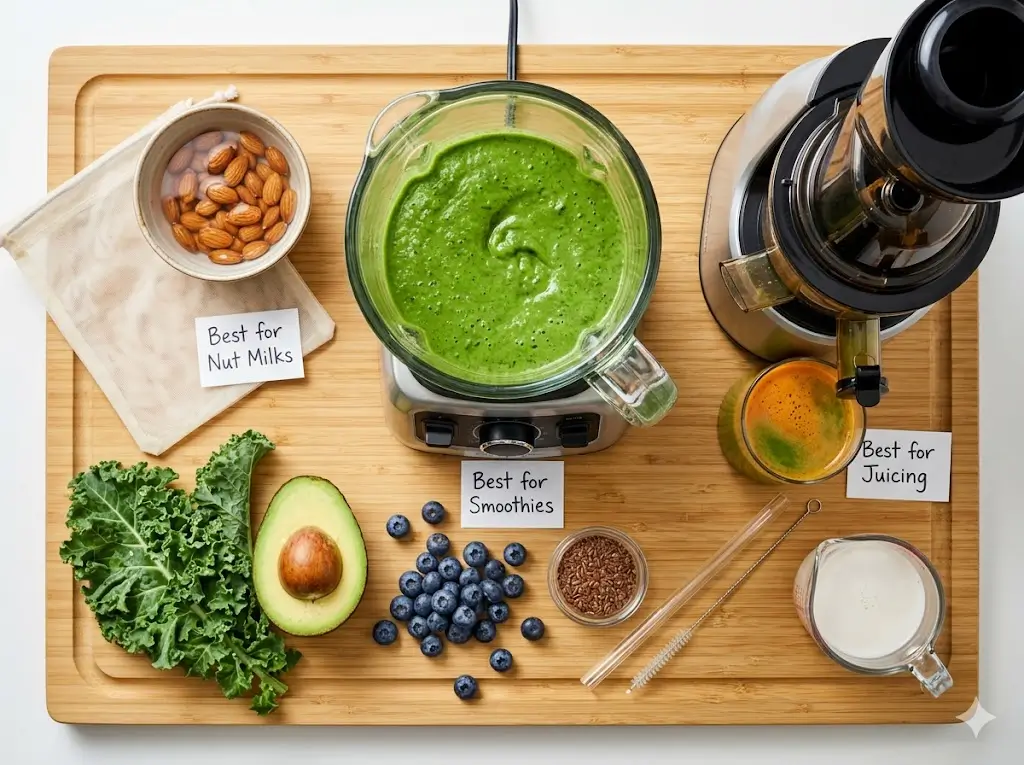
The Top Category Winners & Product Highlights
Based on over 500 hours of comparative testing, yield analysis, decibel reading, and long-term durability assessments, here are the dominant champions for your countertop wellness station.
Best Overall Blender
The Vitamix A3500 Ascent Series
The Vitamix A3500 represents the pinnacle of home blending technology. Hand-built in the USA, this machine utilizes a 2.2-peak horsepower motor paired with laser-cut, stainless-steel hammermill blades. What sets the A3500 apart is its smart-home integration. It utilizes NFC (Near Field Communication) technology in the base to automatically detect which size container you have attached (e.g., the 64oz pitcher vs. the 8oz blending bowl) and dynamically adjusts its maximum speed and timer settings to prevent over-pressurization.
- Key Strengths: Flawless micro-texture for smoothies, can heat raw vegetables into steaming hot soup in 6 minutes via blade friction, unmatched 10-year warranty, beautiful touch-screen UI.
- Notable Flaws: Extremely loud at max speed (measured at 91 decibels); the initial purchase price is a significant investment.
- Perfect For: Families, culinary enthusiasts, and anyone who wants a “buy it once for life” appliance that can replace a food processor, ice cream maker, and soup pot.
Best Budget Blender
The Ninja Professional Plus Auto-iQ
For those who want powerful ice-crushing capabilities without breaking the $150 mark, the Ninja Professional Plus is the undisputed king of value. Instead of a traditional vortex-generating blade at the bottom, Ninja utilizes a unique “Total Crushing Tower”—a removable vertical shaft with multiple sets of staggered blades running up the height of the 72oz pitcher. This design allows it to turn solid ice into perfect, fluffy snow in seconds.
- Key Strengths: Unbeatable price-to-performance ratio, incredible at processing large batches of frozen fruit and margaritas, Auto-iQ programs take the guesswork out of blending.
- Notable Flaws: The stacked blade assembly does not create a true vortex, meaning it struggles to completely liquefy fibrous greens like kale and spinach (leaving noticeable “chewy” bits); the blades are razor sharp and pose a cleaning hazard.
- Perfect For: College students, budget-conscious consumers, and those who primarily blend fruit-based smoothies and frozen cocktails rather than heavy green smoothies.
Best Overall Juicer (Cold Press)
The Nama J2 Cold Press Juicer
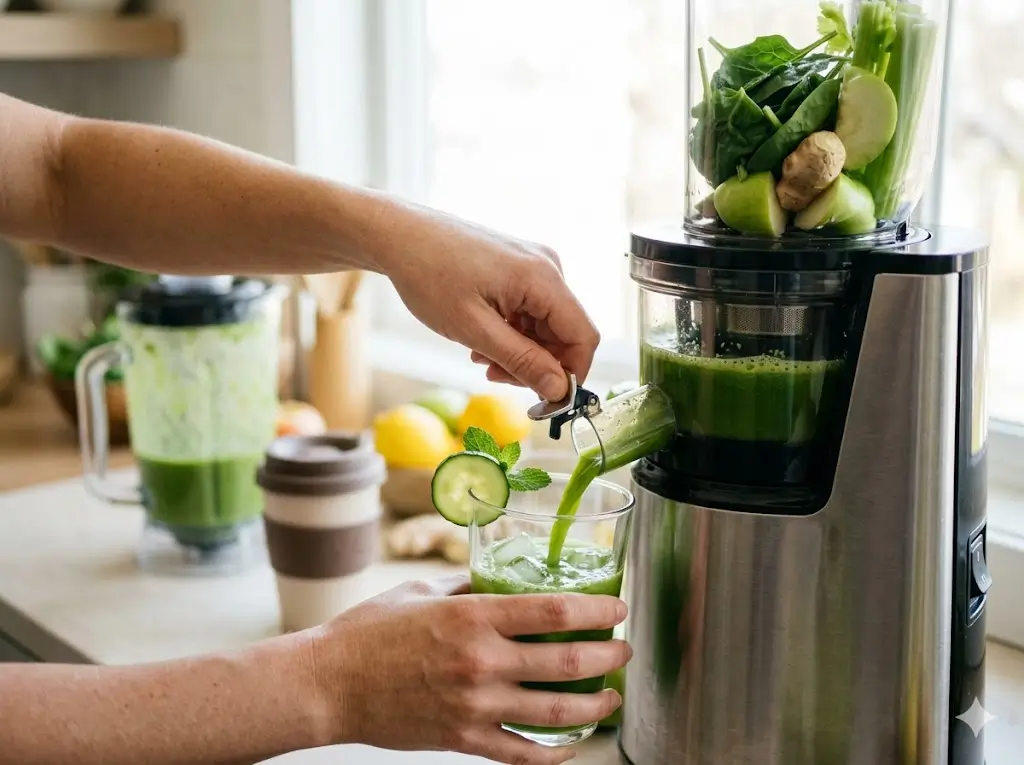
The Nama J2 has fundamentally revolutionized the home juicing workflow. Traditional juicers require you to stand over the machine, feeding ingredients in piece by piece. The J2 features a massive, automated hopper on top. You can load an entire recipe (whole spinach leaves, halved apples, chunks of ginger, and celery stalks), close the lid, turn it on, and walk away. The internal blade automatically slices the produce and feeds it down into the heavy-duty Ultem auger.
- Key Strengths: The ultimate “hands-free” juicer, incredibly high yield with bone-dry pulp, silent operation (around 60 decibels), beautiful design, and extremely easy to clean compared to older horizontal models.
- Notable Flaws: Still requires a premium investment; the tall vertical footprint may not fit beneath low-hanging kitchen cabinets.
- Perfect For: Busy professionals, dedicated juicers who hate prep work, and anyone looking to efficiently batch-prep 3-4 days of green juice in a single session.
Best Budget Juicer (Centrifugal)
The Breville Juice Fountain Cold
If you want fresh juice on a strict budget and have zero patience for the slow-pressing process, the Breville Juice Fountain Cold is an exceptional machine. Powered by a robust 850-watt motor, it features an Italian-made precision mesh filter and a titanium-reinforced cutting disk. Breville’s “Cold Spin Technology” mitigates the traditional heat transfer of centrifugal machines by routing the juice up and through an elevated system, keeping temperature increases to less than 1°C.
- Key Strengths: Lightning-fast operation (can juice an entire apple in 3 seconds), massive 3-inch feed chute, highly affordable entry point into the juicing lifestyle.
- Notable Flaws: Much lower yield on leafy greens compared to masticating juicers; the high-speed aeration means juice separates faster and should be consumed immediately.
- Perfect For: Beginners, those who primarily juice hard root vegetables and watery fruits (carrots, apples, cucumbers), and users with severe time constraints.
The Step-by-Step Buyer’s Framework
Building your ideal setup requires strategy. Do not blindly purchase the most expensive machine you see on Instagram. Use our dynamic, universal 5-step framework to build a setup perfectly tailored to your lifestyle and nutritional needs.
Step 1: Define Your True Nutritional Goal (Fiber vs. Liquid)
You must first answer the fundamental question: Are you looking for a meal replacement or an instant nutrient infusion?
- Buy a Blender If: You want fiber. Blending retains 100% of the soluble and insoluble fiber of the produce. This slows down the absorption of fruit sugars, stabilizes blood glucose spikes, and promotes gut health. Blenders are for crafting heavy, filling meal replacements, protein shakes, and smoothie bowls.
- Buy a Juicer If: You want rapid absorption. Juicing extracts the heavy digestive burden of insoluble fiber, delivering pure vitamins, minerals, and phytonutrients directly to your bloodstream within 15 minutes. It is ideal for detoxification protocols, immune boosting, and consuming massive quantities of greens (e.g., juicing an entire head of celery) that would be physically impossible to eat.
Step 2: Assess Your Daily Time Budget (Workflow Overhead)
Be brutally honest with yourself about your mornings.
- If you only have 3 minutes, you need a high-performance blender. You can throw whole ingredients into a Vitamix, blend for 45 seconds, rinse the carafe with hot water for 15 seconds, and walk out the door.
- If you have 15-20 minutes, a masticating juicer becomes viable. Juicing requires washing produce, potentially peeling citrus, operating the machine, and spending 3-5 minutes scrubbing the micro-mesh screen with a specialized brush.
Step 3: Measure Your Physical Space (The Z-Axis Problem)
High-end blenders and vertical juicers are massive appliances. Do not just measure width and depth; measure height (the Z-axis). Most standard kitchen cabinets sit precisely 18 inches above the countertop. A Vitamix 5200 or a Nama J2 stands over 20 inches tall with the tamper/hopper attached. Ensure you account for clearance, or you will be forced to store the heavy base in a cabinet, drastically reducing the likelihood that you will use it daily.
Step 4: Determine Your Hard Budget vs. “Nice-To-Have” Budget
Establish your baseline. A truly capable blender starts around $150, while a BIFL (Buy It For Life) blender is $400+. Do not go into debt for a touch-screen interface if an analog dial achieves the exact same micronized texture. Pay for the motor, the warranty, and the blade/auger quality. Touch screens, Bluetooth connectivity, and brushed metal finishes are secondary aesthetics.
The Ultimate Buyer’s Pitfall & Troubleshooting Guide
The appliance industry is rife with deceptive marketing jargon and flashy gimmicks designed to separate you from your money. Use this extensive pitfall matrix to protect your wallet.
| The Marketing Claim | The Consumer Reality | The Expert Advice / Fix |
|---|---|---|
| “3000 Watt Motor for Ultimate Power!” | This is a “Peak HP” metric. A standard US wall outlet literally cannot provide 3000 sustained watts without blowing a fuse. This number is utterly meaningless for daily use. | Ignore peak wattage marketing. Look at the Amps rating on the physical sticker under the base. A machine pulling 11 to 15 Amps has genuine, sustained heavy-duty torque. |
| “Self-Cleaning & Dishwasher Safe” | Blasting plastics with 160°F dishwasher water and caustic detergents will warp the jar and completely destroy the rubber bearing seals in the blade assembly, causing it to rust and leak black grease. | Never put a premium blender jar in the dishwasher. “Self-cleaning” simply means adding warm water, a drop of dish soap, and blending on high for 45 seconds. Hand-rinse thoroughly. |
| “Cold Press Centrifugal Technology” | This is a literal oxymoron. Centrifugal juicers spin at 10,000+ RPM. The immense friction of the blade inevitably raises the temperature of the juice slightly and oxidizes the product via aeration. | If you are serious about enzyme preservation and “Cold Pressing,” you must buy a masticating (slow) juicer or a twin-gear machine operating under 100 RPM. |
| “Extracts 100% of Nutrients” | No machine is 100% efficient. Centrifugal juicers often leave soaking wet pulp behind, meaning a massive percentage of your expensive organic produce is being thrown in the trash. | Weigh your produce before and after juicing. If your pulp is wet enough to squeeze liquid out by hand, your machine is highly inefficient. Upgrade to an Ultem-auger slow juicer for bone-dry pulp. |
| “Razor Sharp Stainless Steel Blades” | Sharp blades are a hallmark of cheap blenders. They rely on slicing, which works initially but dulls rapidly against ice and frozen fruit, rendering the blender useless after a year. | Elite blenders use thick, intentionally dull blades that rely on the immense power of the motor to pulverize food through sheer blunt force impact. |
Niche Use Cases & Alternatives
Not every wellness enthusiast fits into the standard kitchen paradigm. Adapting your setup for healthy blending & juicing at home to specific, unique needs requires creative thinking.
The Ultra-Compact / Office Setup
If you live in a tiny studio apartment, a dorm room, or want to blend protein shakes directly at your office desk, a full-sized appliance is impractical.
- The Solution: The Personal Blender. Machines like the NutriBullet Pro 900 or the Ninja Nutri-Blender Pro offer a brilliant form factor. The blending jar is also the drinking cup. You invert it onto the motor base, blend, flip it back over, attach a travel lid, and go. Limitation: They lack a tamper, meaning you must add significantly more liquid to get the vortex spinning, and they cannot handle completely waterless recipes like thick açai bowls or nut butters.
The Commercial-Grade / Raw Vegan Prepper
For individuals utilizing Gerson Therapy protocols, or raw vegans who prepare 100% of their meals from scratch, standard home appliances will eventually burn out under the intense volume.
- The Solution: The Twin-Gear or Hydraulic Press. Look to machines like the Super Angel Pro Stainless Steel or the Pure Juicer. The Super Angel uses 100% food-grade 304 stainless steel twin gears that aggressively grind and press fiber. The Pure Juicer utilizes a two-stage process: triturating the produce into a mash, and then pressing it under 5400 lbs of hydraulic pressure. They cost upwards of $2,000 but extract every microscopic drop of living enzyme and yield 30-40% more liquid than standard cold presses.
The Soup Maker & Nut Butter Fanatic
If you want to make steaming hot broccoli cheddar soup from raw ingredients in 5 minutes, or grind dry roasted peanuts into creamy butter, a juicer is entirely useless, and a cheap blender will blow its motor.
- The Solution: You absolutely must have a blender with a tamp tool and a high-torque motor (like the Vitamix 5200). The tamper allows you to manually force dense, sticky nuts down into the blades without adding liquid. Furthermore, the motor must be powerful enough to spin the blades fast enough to generate physical friction heat, literally boiling the soup inside the jar without a heating element.
Advanced Maintenance, Care & Longevity Strategies
An elite blender or cold-press juicer is a high-performance engine. Like a sports car, it requires meticulous maintenance. Neglecting these protocols will void your warranty, harbor dangerous bacteria, and destroy your equipment.
Mineral Descaling (The Cloudy Jar Syndrome)
Over time, the minerals from hard tap water, combined with the calcium from spinach and the oxalates in greens, will form a cloudy, white, hardened film inside your Tritan blender jar or juicer bowl.
- The Fix: Do not use abrasive scouring pads; they will permanently scratch the plastic. Instead, create a bath of 50% white vinegar and 50% warm water. Let the jar/bowl soak overnight. The acetic acid will gently dissolve the mineral buildup. For stubborn spots, make a paste of baking soda and water and gently rub it in with a soft microfiber cloth.
Juicer Screen Hygiene
The micro-mesh screen of a juicer is its most vital and vulnerable component. If the microscopic holes become clogged with dried fruit fiber, the back-pressure inside the machine will build up until the plastic housing literally cracks.
- Daily Protocol: Never let a juicer sit unwashed. The moment you finish juicing, immediately run the screen under hot water and scrub it vigorously with the manufacturer’s provided stiff brush. If you let it dry, the fiber will cement itself to the metal like glue.
- Deep Clean: Every three months, soak the metal screen in a solution of warm water and a specialized enzyme cleaner (like PBW – Powdered Brewery Wash) to dissolve invisible rancid oils.
Drive Socket and Gasket Inspection
- Blenders: The drive socket (the gear on the base) is designed to be the “sacrificial lamb.” If you accidentally leave a metal spoon in the blender, the plastic drive socket will shear and break, saving the expensive motor from burning out. Inspect it yearly. If the teeth look rounded or worn, order a $15 replacement and install it with an Allen wrench.
- Juicers: The silicone wiping blades and rubber pressure gaskets at the bottom of the juicer bowl degrade over time. If your juicer starts leaking liquid onto the motor base, immediately halt use and replace the rubber gasket. Liquid seeping into the motor housing will cause an electrical short.
Warranty Activation
Premium brands like Vitamix, Blendtec, and Kuvings offer staggering 7 to 10-year warranties. However, many require proof of purchase and immediate registration to honor them. Always register your product within 30 days of purchase. Retain your original purchase receipt digitally.
Conclusion
Mastering the art of healthy blending & juicing at home is a deeply rewarding investment in your physical vitality and daily energy levels. By prioritizing motor torque, understanding the difference between mastication and centrifugal extraction, and avoiding cheap, throwaway appliances, you can construct a countertop wellness station that effortlessly bridges your nutritional gaps. Remember the golden rule: match the machine to your lifestyle. A powerful blender will secure your daily fiber and meal-replacement needs, while a cold-press juicer will deliver an unmatched infusion of living vitamins.
Ready to transform your health? Check the current prices, real-time discounts, and availability on Amazon via our curated Top Category Winners links above. If you have questions about which machine fits your specific dietary needs, or need a personalized recommendation for your counter space, drop a detailed comment below! Don’t forget to subscribe to our newsletter for deep-dive reviews on the latest wellness tech, exclusive raw-food recipes, and advanced extraction tutorials.
Comprehensive FAQs
1. Blender vs. Juicer: What is the actual, biological difference for my body?
A blender processes the entire whole food, retaining 100% of the soluble and insoluble dietary fiber. This slows digestion, making you feel full for hours, and prevents rapid blood sugar spikes—perfect for meal replacements. A juicer separates the liquid from the fiber. This removes the digestive burden, allowing your body to absorb massive quantities of vitamins, minerals, and phytonutrients directly into the bloodstream within 10-15 minutes. Both are excellent, but they serve entirely different physiological purposes.
2. Does centrifugal juicing really destroy all the enzymes with heat?
“Destroy all” is an exaggeration, but centrifugal juicers do cause significant nutrient degradation. The ultra-high-speed spinning (up to 14,000 RPM) creates immense aeration, whipping oxygen into the juice. This oxidation process rapidly breaks down heat-sensitive enzymes and volatile vitamins (like Vitamin C). Furthermore, the friction of the metal blade slightly heats the juice. If you use a centrifugal juicer, you must drink the juice immediately (within 20 minutes) to reap the benefits before it heavily degrades.
3. Can I safely put hot liquids or boiling water in my high-speed blender?
Yes, but with extreme caution and only if you own a premium blender with a vented lid. High-end blenders like Vitamix and Blendtec are designed to handle boiling liquids (and can even make hot soup from friction). However, when you blend hot liquids, steam rapidly expands. You MUST remove the center plug of the blender lid to allow steam to escape, and hold a folded towel lightly over the hole. If you blend hot liquid in a cheap, tightly sealed bullet blender, the pressure will cause it to violently explode, causing severe burns.
4. Why does my new blender smell like burning electrical wire when I use it?
If you have a high-quality machine (like a Vitamix), a slight burning smell during the first few uses is perfectly normal. The motor windings are coated in a protective curing varnish at the factory, and this varnish “burns off” under initial heavy loads. However, if the smell persists for weeks, or if you are using a cheap blender to process heavy, thick mixtures without enough liquid, the smell indicates the motor is straining, overheating, and slowly dying. Add more liquid or use the tamper.
6. How long does fresh, home-pressed juice actually last in the refrigerator?
This depends entirely on the machine you used. Juice from a centrifugal juicer should be consumed within 24 hours (ideally immediately) because it is highly oxidized. Juice from a cold-press masticating juicer will remain nutritionally viable and taste fresh for up to 72 hours if stored properly. To maximize shelf life, store the juice in an airtight glass mason jar filled to the absolute brim (to eliminate oxygen in the jar) and keep it in the coldest part of your fridge.
7. Are “cold-pressed” juices in the grocery store the same as home-masticated juice?
No. Bottled juices sold in grocery stores (even the expensive $9 ones) are subjected to HPP (High Pressure Processing). The bottles are placed in a water chamber and crushed under 85,000 PSI to kill bacteria and extend the shelf life to 30-45 days. While HPP is infinitely better than thermal pasteurization, it still alters the living enzymes and slightly degrades the nutritional profile compared to juice pressed raw in your kitchen and consumed the same day.
8. What is the absolute best way to juice leafy greens like kale, spinach, and wheatgrass?
Centrifugal juicers are terrible at leafy greens; they simply chop them up and spit them directly into the pulp bin dry. To successfully extract juice from lightweight, fibrous leaves, you absolutely must use a masticating (slow) juicer or a twin-gear juicer. The slow crushing action of the auger wrings the leaves out like a wet towel. Pro-tip: Alternate feeding a handful of soft greens with a hard vegetable like an apple or carrot. The hard vegetable pushes the greens through the auger and prevents clogging.
9. Can I grind dry ingredients like coffee beans or nuts in my regular blender pitcher?
You can, but it is not recommended for longevity. Grinding hard, dry ingredients like coffee beans, rice, or almonds into flour will cause thousands of microscopic scratches on the inside of your Tritan plastic jar, turning it permanently cloudy and opaque. Furthermore, dry grinding requires a different blade pitch for optimal circulation. Premium brands sell dedicated “Dry Grains” jars specifically engineered with a reverse-pitch blade that throws ingredients up (instead of pulling them down) to prevent packing at the bottom.
10. Do I need to peel all of my fruits and vegetables before juicing them?
Not necessarily, but there are strict rules. You must peel citrus fruits (oranges, grapefruits, lemons) before juicing. Citrus peels contain high concentrations of bitter oils (limonene) and indigestible compounds that will make your juice taste awful and can upset your stomach. However, you should leave the skin on organic apples, cucumbers, carrots, and ginger, as a massive amount of the phytonutrients and antioxidants are concentrated directly in or just below the skin. Always wash produce thoroughly to remove pesticides.