
Baking is not an art; it is an exacting science. It is an edible chemistry experiment governed by the strict laws of thermodynamics, fluid dynamics, and molecular biology. While cooking allows for improvisation—a pinch of salt here, a splash of acid there—baking punishes guesswork with sunken cakes, burnt cookie bottoms, and dense, unyielding bread. To master this science, you must have the right instruments in your laboratory. Building an Essential Baker’s Toolkit is the single most critical investment you can make in your culinary journey, separating consistent, bakery-quality triumphs from frustrating, unpredictable failures.
Industry data suggests that up to 80% of home baking failures are not caused by bad recipes, but by wildly inaccurate volumetric measuring and the erratic thermal conductivity of cheap baking pans. This is the ultimate, definitive consumer guide you will ever need to stop wasting expensive ingredients (like vanilla bean and European butter) and start making informed purchasing decisions.
As expert product testers, former pastry chefs, and consumer advocates, we have spent hundreds of hours bench-testing equipment. We have utilized digital thermocouples to map oven hot spots, strain-gauge load cell testers to verify scale calibration to the milligram, and stress-tested silicone elastomers beyond standard manufacturing limits to bring you this uncompromising, data-backed masterclass.
What You Will Learn in This Guide:
- The Physics of Baking Hardware: Understand the massive differences between radiant, conductive, and convective heat transfer in various pan materials.
- The Metric Mandate: Learn why volumetric measuring (cups and spoons) is fundamentally flawed and why digital mass measuring is non-negotiable.
- Component Breakdowns: Discover how fiberglass mesh density in baking mats and the gauge thickness of aluminum dictate the lifespan of your gear.
- Top Category Winners: Explore our meticulously curated list of the absolute best pans, mats, and scales across budget, prosumer, and commercial categories.
- Advanced Maintenance Mastery: Unlock our insider protocols to restore oxidized pans, degrease silicone, and calibrate digital scales.
Anatomy of the Product & Technical Fundamentals of the Essential Baker’s Toolkit
To truly understand your Essential Baker’s Toolkit, you must look beneath the surface. Baking equipment acts as the intermediary between the raw, chaotic thermal energy of your oven and the delicate chemical reactions happening within your dough or batter. Let us break down the “under the hood” science of how these tools operate.
The Thermodynamics of Baking Pans: Conductivity and Emissivity
A baking pan is a thermal transfer engine. Its job is to absorb heat from the oven air (convection) and the oven walls (radiant heat), and transfer it evenly into the bottom of your baked goods (conduction).
- Bare Aluminum (The Gold Standard): Aluminum has an incredibly high thermal conductivity rating of approximately 237 W/(m·K). This means it absorbs heat rapidly and distributes it evenly across the entire surface. Crucially, raw aluminum has very low emissivity. It reflects radiant heat rather than absorbing it. This allows cookies and cakes to bake gently and evenly without the bottoms scorching before the centers are fully set.
- Aluminized Steel: Commonly used in commercial bread loaf pans and heavy-duty cake pans. It features a strong steel core for warp resistance, dipped in an aluminum-silicon alloy for heat transfer and rust resistance. It offers the best of both worlds: structural integrity and thermal efficiency.
- Dark Non-Stick (The Enemy of Baking): Dark-colored pans (often coated in PTFE) have high emissivity. They aggressively absorb radiant heat like a black t-shirt on a sunny day. In our tests, cookies baked on dark non-stick pans reached 350°F (175°C) on the bottom up to 25% faster than those on bare aluminum, resulting in chronically burnt bases.
- Glass and Ceramic: These are insulators, not conductors. They take a very long time to heat up, but once hot, they hold heat tenaciously. They are ideal for pies and casseroles where you want a long, slow bake and residual heat, but terrible for quick-baking items like cookies or sponge cakes.
The Material Science of Silicone Baking Mats
Silicone baking mats (like the legendary Silpat) have largely replaced single-use parchment paper in professional kitchens, but not all mats are created equal.
- The Fiberglass Core: A high-quality baking mat is not just a sheet of rubber. It features a woven fiberglass mesh core. This mesh acts as the skeleton of the mat, providing immense tensile strength so it doesn’t stretch or tear. More importantly, the fiberglass acts as a thermal buffer, slightly insulating the bottom of your pastries to prevent over-browning.
- The Silicone Elastomer: The outer layer is made from food-grade liquid silicone rubber. Silicone is highly inert, inherently non-stick, and stable at extreme temperatures (usually rated from -40°F to 480°F / -40°C to 250°C). However, the curing process matters. Platinum-cured silicone is pure, leaves no chemical byproducts, and passes the “pinch test” (it doesn’t turn white when twisted). Peroxide-cured silicone is cheaper, can leach a chemical taste into delicate foods, and degrades faster under high heat.
The Mechanics of Precision: Digital Load Cells
Baking is about ratios, and ratios require mass (weight) rather than volume. A cup of all-purpose flour can weigh anywhere from 120 grams to 160 grams depending on how densely it is packed—a 33% variance that will completely destroy a cake recipe.
- Strain Gauge Load Cells: Inside a digital kitchen scale is a precisely machined piece of aluminum (the load cell) with a wire grid (the strain gauge) glued to it. When you place flour on the scale, the aluminum imperceptibly bends. This stretches the wire grid, altering its electrical electrical resistance. A microchip translates this minute change in electrical current into a digital weight readout.
- Tare Response and Resolution: High-end baking scales feature high-resolution load cells that update measurements in milliseconds. This is critical when you are slowly pouring a fine stream of liquid into a bowl and need the numbers on the screen to keep up in real-time to avoid overshooting your target.
Pro Tester Tip: Never store your digital kitchen scale with heavy items stacked on top of it. Constant downward pressure will permanently deform the aluminum load cell, destroying its calibration and rendering the scale permanently inaccurate.
Critical Features & Specifications to Look For
When assessing pieces for your Essential Baker’s Toolkit, the spec sheet is your blueprint for success. Forget aesthetic colors and celebrity chef endorsements; focus on the metallurgical and mechanical specifications that separate disposable junk from heirloom-quality precision instruments.
Pan Gauge and Thickness (The Warping Factor)
The thickness of a baking sheet is measured by its “gauge.” In metal manufacturing, the lower the gauge number, the thicker the metal.
- The Commercial Standard: You must look for 18-gauge or 13-gauge aluminum. An 18-gauge pan is thick enough to hold massive thermal mass and resist thermal shock.
- The Reality of Cheap Pans: Thin, flimsy pans (20-gauge or higher) lack thermal mass. The moment you place cold dough on them, the pan’s temperature crashes. Furthermore, when exposed to high heat (like a 425°F oven), the stress of the metal expanding causes thin pans to violently “pop” and warp, sending your perfectly piped macarons sliding into each other.
- Encapsulated Wire Rims: Look for sheet pans where the edges are rolled tightly around a galvanized steel wire. This wire acts as a rigid skeleton, physically preventing the aluminum from twisting or warping under thermal stress.
Scale Capacity, Resolution, and Auto-Off Timers
A baking scale is only as good as its microchip and user interface.
- Capacity vs. Resolution: A great baker’s scale needs a high maximum capacity (at least 11 lbs / 5 kg) to handle a heavy glass bowl plus dough, but it also needs fine resolution (measuring in increments of 1 gram, or ideally 0.5 grams).
- The Auto-Off Override: This is the most infuriating “feature” of cheap scales. You are halfway through weighing out 500 grams of flour, you step away for 30 seconds to grab more, and the scale turns off to save battery, erasing your tare weight. Premium scales feature auto-off timers of at least 3 to 5 minutes, or offer the ability to disable the auto-off function entirely.
Mat Dimensions and Edge Sealing
- Exact Sizing: A “Half Sheet” silicone mat must fit a standard commercial “Half Sheet” pan (18 x 13 inches) perfectly. If the mat is too large, the edges will curl up the sides of the pan, causing cookies near the edge to bake into distorted, warped shapes.
- Sealed Edges: Cheap knock-off mats often leave the internal fiberglass mesh exposed at the cut edges. When washed, capillary action draws dirty, soapy water into the fiberglass core, permanently ruining the mat and transferring soap flavor to your next bake. Always look for fully encapsulated, thick silicone borders.
The Top Category Winners & Product Highlights
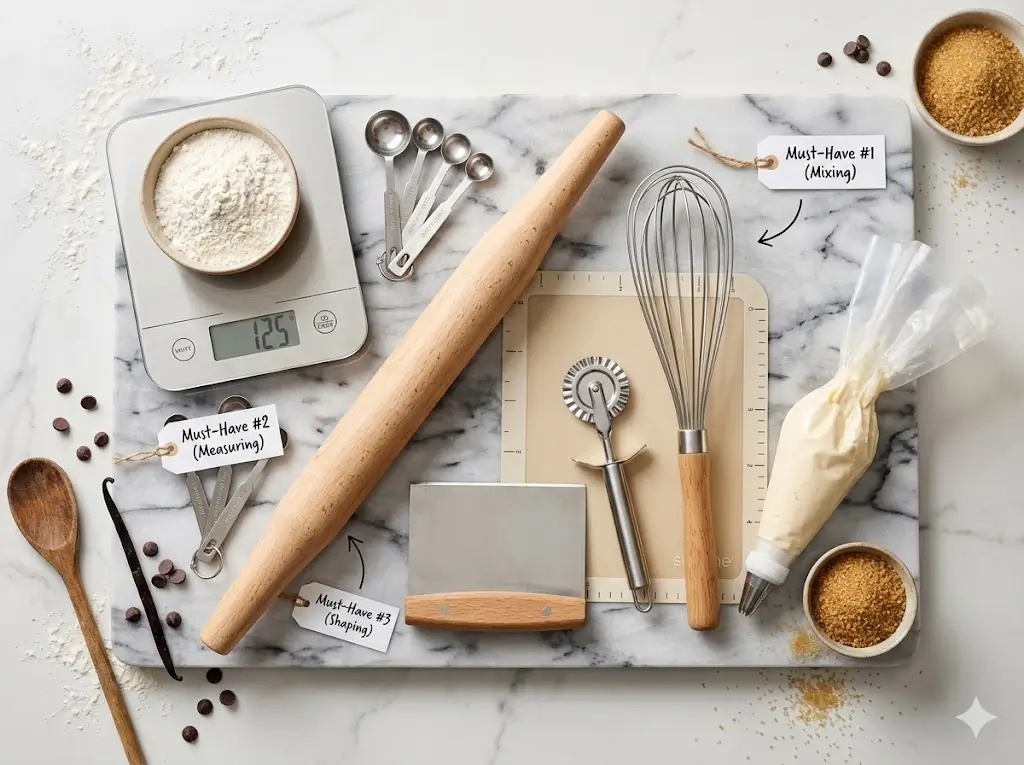
Based on exhaustive thermal imaging, rigorous non-stick stress testing (baking hundreds of batches of high-sugar tuiles), and long-term mechanical durability assessments, here are the dominant champions for your Essential Baker’s Toolkit.
Best Overall Baking Pan (The Uncontested Champion)
Nordic Ware Natural Aluminum Commercial Baker’s Half Sheet
When it comes to biological safety, thermal perfection, and indestructible performance, Nordic Ware is the undisputed king of the bakery. Manufactured in the USA from pure, uncoated, 18-gauge commercial aluminum, this half sheet is the industry standard for a reason. It conducts heat with astonishing efficiency, producing perfectly golden-brown bottoms on cookies and perfectly even rises on jelly roll sponges.
- Key Strengths: Physically indestructible, completely rust-proof (it’s pure aluminum), perfectly flat base prevents oil pooling, galvanized steel wire reinforced rim makes warping impossible, incredible price-to-performance ratio.
- Notable Flaws: Not dishwasher safe (alkaline detergents will permanently discolor and oxidize the aluminum); scratches easily with metal spatulas (though this does not affect performance).
- Perfect For: Literally everyone. From absolute beginners to Michelin-starred pastry chefs, this is the foundational building block of any kitchen.
Best Professional Silicone Baking Mat
Silpat Premium Non-Stick Silicone Baking Mat
Invented in France by a baker looking to replace single-use parchment paper, Silpat remains the gold standard of silicone engineering. Silpat mats feature a proprietary fiberglass mesh weave that provides superior heat distribution and tensile strength compared to Amazon knock-offs. The silicone is food-grade, FDA-approved, and naturally provides a flawless release for even the stickiest caramels, toffees, and baked cheeses.
- Key Strengths: Flawless non-stick release for high-sugar bakes, eliminates the ongoing cost of parchment paper, promotes perfectly even browning on cookie bottoms, fully sealed edges prevent moisture ingress.
- Notable Flaws: Expensive initial investment; retains grease if not washed with specialized degreasers; can harbor strong odors (like garlic) if used for savory roasting.
- Perfect For: Serious cookie bakers, candy makers working with molten sugar, macaron enthusiasts, and eco-conscious consumers looking to eliminate paper waste.
Best Overall Precision Digital Scale
OXO Good Grips 11 lb Stainless Steel Food Scale with Pull-Out Display
OXO solved the most persistent problem in the baking world: trying to read the digital display while a massive mixing bowl obscures the screen. This brilliantly engineered scale features a display module that physically pulls away from the base on a retractable cord, allowing perfect visibility regardless of the bowl size. It features an 11 lb (5 kg) capacity, measures in exact 1-gram increments, and features a highly responsive load cell.
- Key Strengths: Pull-out display is a game-changer for large-batch baking, stainless steel platform is removable and washable, bright backlit screen, long auto-off timer prevents frustrating resets.
- Notable Flaws: Takes up a larger footprint in the drawer than ultra-slim scales; buttons can sometimes collect flour dust in the crevices.
- Perfect For: Sourdough bread bakers who use massive ceramic bowls, batch-bakers, and anyone tired of craning their neck to see weight readouts.
Best Budget / High-Precision Micro Scale
Escali Primo P115C Precision Kitchen Food Scale
If you want professional-level accuracy without paying for premium stainless steel aesthetics, the Escali Primo is a legendary workhorse. Often found in commercial prep kitchens, this no-frills scale focuses entirely on the internal load cell. It boasts lightning-fast tare response times and a completely sealed button panel that wipes clean instantly, preventing flour and liquid from destroying the motherboard.
- Key Strengths: Unbeatable price, incredibly fast reaction time when pouring liquids, spill-proof sealed interface, ultra-long battery life (runs on standard AA batteries for years).
- Notable Flaws: The plastic casing feels cheap; lacks a backlit display (can be hard to read in dim kitchens); capacity is limited to 11 lbs.
- Perfect For: College students, budget-conscious consumers, and bakers who prioritize strict, fast numerical accuracy over fancy, modern aesthetics.
The Step-by-Step Buyer’s Framework
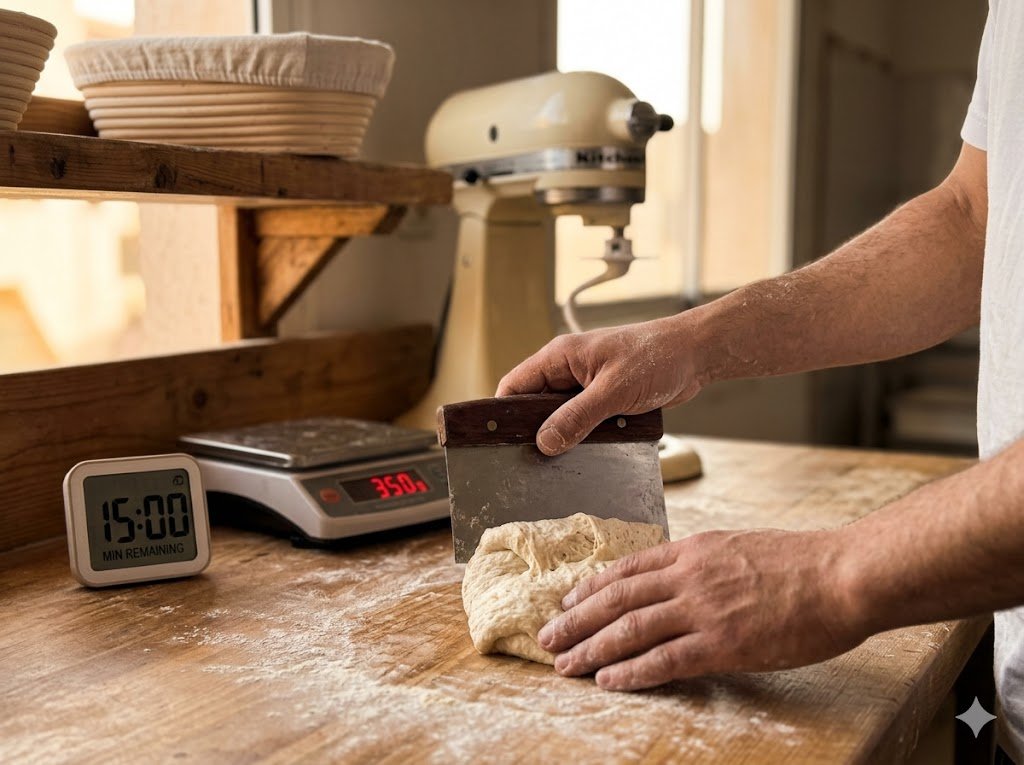
Building your ideal Essential Baker’s Toolkit requires strategic thinking. Do not blindly purchase a massive 15-piece baking set from a big box store; these are almost always made of thin, dark non-stick metal that will ruin your food. Use our dynamic, universal 3-step framework to curate a setup perfectly tailored to your baking ambitions.
Step 1: Assess Your Volume and Batch Size (The Geometry of Baking)
Your average batch size dictates the physical footprint of your tools.
- The Standard Baker: If you bake standard batches of 12-24 cookies, you absolutely need two commercial Half-Sheet pans (18″ x 13″) and a scale with a standard 11 lb capacity. Two pans allow you to rotate bakes—one in the oven, one cooling on the rack.
- The Micro-Batcher: If you live alone and bake small-batch recipes, investing in Quarter-Sheet pans (9″ x 13″) is a lifesaver. They fit perfectly in toaster ovens, are easier to wash in small sinks, and take up half the storage space.
- The Sourdough Artisan: If you are baking high-hydration breads, a standard scale isn’t enough. You need a high-capacity scale (22 lbs+) and specialized Dutch ovens or baking steels with massive thermal mass to create oven spring.
Step 2: Evaluate Your Oven’s Dimensional Constraints
The most devastating mistake a baker can make is buying beautiful equipment that physically does not fit in their oven.
- The Airflow Mandate: An oven relies on the convective circulation of hot air to bake evenly. If your baking pan touches the side walls or the back of the oven, it blocks airflow. This creates massive hot spots, burning one side of your cake while the other side remains raw batter.
- The Measurement Rule: Open your oven and measure the internal width and depth of the racks. You must leave at least 1.5 inches to 2 inches of clearance on all four sides of your baking pan. If you have a narrow European-style wall oven, a standard American Half Sheet might completely block airflow, requiring you to downgrade to a Two-Thirds or Quarter sheet.
Step 3: Determine Your “Precision Budget” vs. “Consumable Budget”
Allocate your funds where they mathematically matter the most.
- Invest Heavily in Precision: Spend the bulk of your budget on a hyper-accurate, high-quality scale (like the OXO or a MyWeigh KD8000). If your flour measurement is off by 20 grams because of a cheap load cell, the best baking pan in the world cannot save your recipe.
- Save on Pans: Bare aluminum sheet pans are incredibly cheap. Do not spend $50 on a “designer” colored non-stick pan when a $15 commercial Nordic Ware pan will radically outperform it. Spend the savings on high-quality ingredients.
The Ultimate Buyer’s Pitfall & Troubleshooting Guide
The bakeware industry thrives on selling convenience over performance. Use this extensive pitfall matrix to navigate the misleading marketing jargon and protect your baked goods and your wallet.
| The Marketing Claim | The Consumer Reality | The Expert Advice / Fix |
|---|---|---|
| “Premium Dark Non-Stick Coating for Easy Cleanup” | Dark metal absorbs massive amounts of radiant heat. While the pan is easy to clean, it will systematically burn the bottoms of your cookies, cakes, and breads before the centers have time to fully bake and set. | Never buy dark bakeware. Stick exclusively to light-colored, uncoated aluminum. If you need non-stick properties, use a silicone mat or unbleached parchment paper on top of the aluminum pan. |
| “100% Dishwasher Safe Bakeware” | While the metal itself won’t melt in the dishwasher, the incredibly harsh, alkaline detergents used in dishwashers undergo a chemical reaction with bare aluminum. The pan will severely oxidize, turning dull, chalky gray, and leaving a metallic soot on your hands and food. | Always hand-wash bare aluminum. Use warm soapy water and a non-abrasive sponge. The grease that polymerizes onto the pan over time actually seasons it, improving its performance. |
| “Complete 10-Piece Starter Set!” | Pre-packaged sets are a trap. They usually include useless sizes (like a tiny 6×6 square pan), feature terrible thermal properties, and are coated in PTFE that will eventually scratch and flake off into your food. | Build your toolkit piece by piece. Buy exactly what you need. Start with two Half Sheets, a reliable digital scale, one silicone mat, and a precision oven thermometer. |
| “Measures Accurately in Cups and Ounces” | Liquid volume (fluid ounces) and mass weight (ounces) are not the same thing. A standard set of plastic measuring cups is often molded inaccurately, carrying a variance of up to 15%. Volumetric measuring of dry goods is fundamentally chaotic. | Switch completely to metric weight (grams). Throw away your dry measuring cups. Weighing your flour, sugar, and liquids in grams on a digital scale guarantees 100% reproducibility every single time you bake. |
| “Silicone Mats are Safe up to 500°F” | While pure silicone can handle 500°F, many cheaper mats use glues and fiberglass coatings that begin to break down, smoke, and emit toxic VOCs (Volatile Organic Compounds) when pushed past 450°F (232°C). | Keep silicone mats under 450°F. If you are baking artisan pizzas or sourdough at 500°F+, ditch the silicone and use heavy-duty parchment paper or bake directly on a seasoned baking steel. |
Niche Use Cases & Alternatives
Adapting your Essential Baker’s Toolkit to specific living situations and unique dietary or culinary needs requires strategic maneuvering outside the standard paradigms.
The Gluten-Free / Allergen-Free Kitchen
If you are managing Celiac disease or severe nut allergies, cross-contamination is a severe health hazard. The microscopic pores in older aluminum pans and the porous nature of silicone can trap trace amounts of gluten or almond flour, even after vigorous washing.
- The Solution: Color-Coded Silicone and Dedicated Pans. Brands like Silpat make mats with brightly colored borders specifically for allergen management. Dedicate a set of red-bordered mats and specially marked Quarter-Sheet pans exclusively for gluten-free baking. Never use these tools for regular wheat-based baking, and store them in a separate, sealed cabinet.
The High-Altitude Baker
Baking at elevations above 3,000 feet fundamentally alters fluid dynamics and atmospheric pressure. Water boils at a lower temperature, liquids evaporate faster, and leavening agents (like baking powder) expand much more rapidly, often causing cakes to rise and violently collapse.
- The Solution: Micro-Precision Scales. Volumetric measuring is even more disastrous at high altitude. You must use a scale with a 0.1-gram resolution (a jeweler’s or coffee scale) to micro-adjust your chemical leaveners. Often, high-altitude recipes require reducing baking powder by merely 1/8th of a teaspoon; weighing this difference in fractions of a gram is the only way to achieve consistency.
The Commercial Micro-Bakery (Cottage Law Bakers)
If you are running a business out of your home kitchen, standard consumer equipment will burn out and bottleneck your production.
- The Solution: Full-Size Racks and High-Capacity Gear. You need to upgrade from Half Sheets to Full-Sheet pans (26″ x 18″), provided you have a commercial oven that can fit them. You also need an NSF-Certified Baker’s Scale with a 30 lb capacity and an AC power adapter (so you never rely on batteries during a massive production run). Finally, invest in a rolling speed-rack to hold 20+ pans of cooling bread or cookies simultaneously.
Advanced Maintenance, Care & Longevity Strategies
High-end baking tools are not disposable; they are a collection of metallurgical and mechanical instruments. Neglecting proper physics and chemistry in your cleaning routine will destroy your investment. Master these protocols to ensure your pans, mats, and scales last a lifetime.
Restoring Oxidized Aluminum (The Cream of Tartar Secret)
If you accidentally run your Nordic Ware aluminum pan through the dishwasher, or if boiling acidic foods (like a fruit galette that overflowed) caused severe black oxidation, do not throw the pan away. It is structurally fine, just chemically tarnished.
- The Protocol: Create an acidic bath. Mix 2 tablespoons of Cream of Tartar (potassium bitartrate) or white vinegar with a quart of water. Boil this mixture directly in the pan on the stovetop (if it’s a roasting pan) or scrub the pan vigorously with a paste made of Cream of Tartar and a few drops of water using a non-scratch nylon pad. The acid neutralizes the alkaline damage, stripping away the dark oxidation and restoring the bright, reflective finish.
Deep Cleaning and Degreasing Silicone Mats
Silicone is lipophilic, meaning it naturally attracts and holds onto oils and fats. Over time, your baking mats will feel perpetually greasy and sticky, even after washing with dish soap. This polymerized grease will eventually smoke in the oven and impart rancid flavors.
- The Protocol (The Lemon-Baking Soda Bake): To extract polymerized grease, make a thick paste of baking soda and a few drops of lemon juice or white vinegar. Rub this paste aggressively all over the greasy silicone mat. Place the coated mat in the oven at 350°F (175°C) for 10 minutes. The heat forces the silicone pores to expand, allowing the baking soda to absorb the deep-seated oils. Remove, let cool, scrub with hot soapy water, and rinse. It will feel brand new and “squeaky” clean.
Scale Calibration and Battery Management
A digital scale is useless if it falls out of calibration. Fluctuations in humidity, being dropped, or dead batteries can cause the load cell to report inaccurate masses.
- The Protocol: Every 6 months, you must test your scale. Turn it on, let it tare to zero, and place a standard US Nickel on the center of the platform. A perfectly calibrated scale will read exactly 5.0 grams. If it reads 4.8g or 5.2g, check your manufacturer’s manual for the calibration sequence (usually involving holding a specific button combination and placing a known weight, like 500g, on the scale). Furthermore, always remove batteries if storing the scale for more than a month to prevent corrosive battery acid leaks from destroying the motherboard.
Warping Prevention: The Science of Thermal Shock
Thermal shock is the rapid expansion and contraction of metal. If you take a screaming hot aluminum pan straight from a 450°F oven and immediately run it under cold tap water to clean it, or drop it on a cold marble countertop, the metal will violently contract.
- The Fix: This will instantly and permanently warp the pan, giving it a permanent twist that will cause liquid batters to pool in one corner. Always allow your cookware to cool completely on an elevated wire cooling rack (which allows air to circulate underneath) until it reaches room temperature before exposing it to water.
Conclusion
Building your Essential Baker’s Toolkit is a profound investment in your culinary development. By rejecting the toxic legacy of dark PTFE coatings, discarding the chaotic inaccuracy of volumetric cups, and embracing the metallurgical brilliance of bare commercial aluminum, platinum-cured silicone, and digital load cells, you transform your kitchen from a frustrating guessing game into a laboratory of precision. Remember the ultimate framework: invest heavily in a high-resolution digital scale to control your variables, rely on thick 18-gauge aluminum for unmatched thermal conductivity, and treat your delicate silicone mats with the targeted degreasing they require.
Ready to start baking like a professional? Check the current prices, real-time discounts, and availability on Amazon via our curated Top Category Winners links above. If you have questions about whether a specific pan will fit in your oven, or need a personalized recommendation for sourdough bread equipment, drop a detailed comment below! Don’t forget to subscribe to our newsletter for deep-dive reviews on the latest baking tech, advanced scaling tutorials, and exclusive manufacturer discounts.
Comprehensive FAQs
1. Do I really need to use a scale? Can’t I just use measuring cups carefully?
Using a scale is the single most important change you can make to improve your baking. Measuring cups measure volume, but baking requires mass. Depending on how you scoop, whether the flour is sifted, or the humidity in the room, a cup of flour can weigh anywhere from 120 grams to 160 grams. That massive discrepancy will dry out a cake or make cookies spread into puddles. A digital scale provides exact, to-the-gram precision, ensuring your recipe is replicated flawlessly every single time.
2. Why do recipes say to line pans with parchment paper if I’m using bare aluminum?
While bare aluminum is the best conductor of heat, it is not non-stick. Eggs, butter, and sugars will undergo the Maillard reaction and physically bond to the metal if not protected. Parchment paper or a silicone baking mat creates a non-stick physical barrier between the food and the metal, allowing for effortless release while still benefiting from the aluminum’s excellent heat conductivity and radiant heat reflection.
3. Is it safe to cut my silicone baking mat to fit a smaller pan?
Absolutely not. You must never cut a high-quality silicone baking mat. Inside the silicone is a woven fiberglass mesh that provides structural integrity and heat distribution. If you cut the mat, you expose the raw microscopic fiberglass shards. These shards can flake off into your food, posing a severe ingestion hazard. Additionally, exposed fiberglass will wick up dishwater and grease, destroying the mat from the inside out. Always buy the correct size mat for your pan.
4. Why did my aluminum baking sheet permanently warp and “pop” in the oven?
Pans warp due to thermal stress and uneven heating. If you are using a cheap, thin pan (higher than 18-gauge), it lacks the mass to absorb heat evenly. The metal expands rapidly, runs out of room, and violently buckles. This can also happen with high-quality pans if you only place cold food on one half of the pan, creating a massive temperature differential across the metal. Always use heavy-duty commercial pans with reinforced steel rims, and distribute food evenly across the surface.
5. How long do silicone baking mats usually last before needing replacement?
In a standard home kitchen baking 1-2 times a week, a premium mat like a Silpat will easily last 3 to 5 years. In a commercial setting, they are rated for 2,000 to 3,000 bakes. However, their lifespan drops drastically if they are abused: exposing them to temperatures over 480°F, using knives or metal spatulas that micro-scratch the silicone, or washing them with highly abrasive scouring pads will cause the non-stick coating to degrade much faster.
6. Can I use a digital scale to measure very small amounts, like yeast or salt?
Most standard kitchen scales with an 11-pound capacity only have a resolution of 1 gram. They struggle to accurately weigh tiny amounts like 1.5 grams of yeast. If a recipe calls for highly precise micro-measurements of powerful ingredients (like salt, yeast, or baking soda), it is highly recommended to purchase a supplementary “jeweler’s scale” or a “coffee scale” that has a lower maximum capacity but measures down to 0.1 or 0.01 grams.
7. Should I grease my silicone baking mat before using it?
No, you should never apply cooking spray, butter, or oil directly to a silicone baking mat. Silicone is inherently non-stick. Adding fat to the mat will cause the grease to polymerize and bake into the micro-pores of the silicone under high heat. This creates a sticky, brown, permanent residue that ruins the mat’s non-stick properties and causes it to smoke in future bakes. Place doughs and batters directly onto the dry mat.
8. Why are professional bakers obsessed with “tare” buttons on scales?
The “Tare” (or Zero) button is the foundation of baking workflow. It allows you to place an empty mixing bowl on the scale and press Tare to reset the weight to zero. You then pour in your flour until it hits 500g. Press Tare again (back to zero), and pour in exactly 350g of water. This allows you to measure every single ingredient directly into one single bowl without doing complex math or dirtying dozens of individual measuring cups.
9. My scale keeps fluctuating numbers while I’m trying to measure. Is it broken?
Not necessarily. Highly sensitive digital scales can be affected by environmental factors. If you have a fan running, the downward air pressure can register as weight. If your scale is placed on an uneven countertop or a soft surface (like a dish towel), the load cell cannot accurately gauge the pressure. Always use your scale on a hard, perfectly flat, and level surface, away from heavy vibrations (like a running stand mixer) or strong air currents.
10. What is the difference between an instant-read thermometer and an oven thermometer, and do I need both?
Yes, you absolutely need both. An oven thermometer hangs inside your oven and tells you the ambient air temperature. Ovens are notoriously inaccurate and can be off by 50 degrees; an oven thermometer verifies your baking environment. An instant-read thermometer (like a Thermapen) is a highly precise probe you insert directly into a loaf of bread or a cake to read the internal temperature of the food, taking the guesswork out of determining if the center of the bake is fully gelatinized and cooked.