
For decades, the pursuit of cafe-quality espresso was reserved for commercial establishments armed with heavy machinery and specialized training. Today, the landscape has fundamentally shifted. A technological renaissance in coffee manufacturing has democratized extraction science, bringing commercial-grade performance right to your kitchen counter. However, navigating the vast and often confusing market of coffee gear can be a daunting, expensive endeavor.
Building the perfect home barista setup is not just about buying an espresso machine; it is about engineering a micro-environment dedicated to precision, thermodynamics, and fluid dynamics. Whether you are transitioning from pod-based convenience or upgrading from an entry-level appliance to a prosumer powerhouse, this is the definitive, ultimate consumer guide you will ever need to make an informed purchasing decision.
In this masterclass, we strip away the marketing fluff and dive deep into the empirical data, testing methodologies, and hardware specifications that actually matter in the cup. We have spent hundreds of hours bench-testing equipment—measuring thermal stability, burr retention, and extraction yields—to bring you unbiased, authoritative insights.
What You Will Learn in This Guide:
- The Physics of Extraction: Understand the critical relationship between grind size, water temperature, and pump pressure.
- Component Breakdowns: Learn why boiler materials, pump types, and burr geometries dictate the lifespan and performance of your gear.
- The Golden Ratio of Budgeting: Discover why spending more on your grinder than your espresso machine is the ultimate insider secret.
- Top Category Winners: Explore our meticulously curated list of the best setups across budget, overall performance, and commercial-grade categories.
- Maintenance Mastery: Unlock advanced care protocols to ensure your investment lasts a lifetime.
Anatomy of the Product & Technical Fundamentals of a Home Barista Setup
To build a truly exceptional home barista setup, you must first understand the fundamental science of espresso. Espresso is not a type of bean or roast; it is a highly concentrated brewing method where hot water is forced through finely ground, tightly packed coffee under immense pressure. Let us look “under the hood” at the hardware that makes this volatile chemical reaction possible.
The Thermodynamics of Espresso: Boiler Types Explained
The heart of any espresso machine is its heating element. Temperature stability is the single most critical factor in achieving consistent extractions. A fluctuation of even 1.5°C can shift a shot from vibrant and sweet to harsh and astringent.
- Thermoblocks and Thermocoils: Found in budget to mid-range machines, these are essentially heated metal blocks with a coiled tube inside. Water is flash-heated as it travels through the tube.
- The Science: While they heat up rapidly (often under 3 seconds), their low thermal mass means they struggle with intra-shot temperature stability and cannot steam milk and brew espresso simultaneously.
- Single Boiler Dual Use (SBDU): A single reservoir of water is used for both brewing espresso (approx. 93°C / 200°F) and steaming milk (approx. 130°C / 266°F).
- The Science: Because the machine has to purge water and ramp up temperature to transition from brewing to steaming, workflow is severely bottlenecked. “Temperature surfing” (flushing water to hit the right temp) is often required.
- Heat Exchanger (HX): A massive step up. A large steam boiler contains a sealed tube (the heat exchanger) running through it. The water inside the main boiler generates steam, while the water passing through the inner tube is flash-heated for brewing.
- The Science: This allows for simultaneous brewing and steaming. However, the brew water can overheat if left idle, necessitating a “cooling flush” before pulling a shot.
- Dual Boiler (DB): The gold standard. Two independent, insulated boilers—one strictly for brewing, one strictly for steam.
- The Science: This provides unparalleled temperature stability and simultaneous brewing/steaming. Dedicated PID controllers can manage each boiler down to 0.1°C variances.
Hydrodynamics: Pump Pressure and Water Flow
Marketing departments love to boast about “15-bar” or “20-bar” pressure. This is a massive red herring. The globally accepted standard for espresso extraction is 9 bar (roughly 130 PSI).
- Vibratory Pumps: Standard in 90% of home machines. An electromagnetic piston oscillates rapidly (around 60 times per second) to push water. They are inexpensive and easy to replace, but they are loud (often exceeding 65 decibels) and take a few seconds to ramp up to full pressure.
- Rotary Vane Pumps: Found in high-end prosumer and commercial machines. An electric motor spins a multi-vane impeller inside a brass or stainless housing.
- The Science: Rotary pumps are whisper-quiet (around 45-50 decibels), achieve peak 9-bar pressure almost instantly, and allow the machine to be directly plumbed into your home’s water line.
The Science of Grinding: Burr Geometry and Particle Distribution
If the espresso machine is the heart, the grinder is the brain. The goal of an espresso grinder is not just to make coffee small; it is to create a highly specific, bimodal particle size distribution (a mix of slightly larger boulders for flow rate and microscopic fines for resistance and extraction).
- Conical Burrs: A cone-shaped inner burr spins against a stationary outer ring. They produce a classic, highly bimodal grind profile resulting in thick, syrupy espresso with massive body and rich chocolate/nutty flavor profiles.
- Flat Burrs: Two parallel, horizontally aligned rings with precision-cut teeth. They produce a more uniform (unimodal) particle distribution.
- The Science: Flat burrs (especially those 64mm and larger) yield higher extraction percentages without bitterness. They are favored by specialty coffee enthusiasts for extracting delicate, floral, and fruity notes from light-roasted single-origin beans.
Pro Tester Tip: Never underestimate grinder retention. Older commercial grinders can retain up to 5 grams of stale coffee in the chute. For home use, look for “Zero Retention” grinders (retention of <0.2g) to ensure every shot is pulled with 100% fresh coffee.
Critical Features & Specifications to Look For
When assessing a home barista setup, the spec sheet tells a story. Here are the non-negotiable features and critical material specifications that separate disposable appliances from heirloom-quality machinery.
Precision Temperature Control (PID)
A Proportional-Integral-Derivative (PID) controller is a sophisticated algorithm-driven thermostat. Older machines relied on mechanical pressure stats that operated on wide “deadbands,” meaning the water temperature could swing wildly by 5-8 degrees. A PID pulses electricity to the heating element micro-seconds at a time, keeping the brew water locked exactly at your target temperature (e.g., 93.5°C). For modern home espresso, a PID is absolutely mandatory.
Flow Profiling and Pre-Infusion
Pre-infusion involves gently saturating the coffee puck with low-pressure water (usually 2-3 bar) for 5 to 10 seconds before hitting it with the full 9 bars of pressure. This allows the dry coffee bed to swell, expanding to fill any micro-fissures or air gaps. The result? A drastic reduction in “channeling” (where high-pressure water finds the path of least resistance, resulting in under-extracted, sour coffee). Advanced setups even offer manual flow control via a paddle, allowing you to manipulate the water debit in real-time.
Material Integrity and Build Quality
The internal componentry of your setup dictates its lifespan.
- Plastics vs. Metals: High-grade plastics (like PPSU) are acceptable for cold-water reservoirs, but the brew pathway must be metal.
- Brass and Copper vs. Stainless Steel: Copper and brass have excellent thermal conductivity but can be susceptible to scale buildup. High-end machines are shifting heavily toward 304 or 316L medical-grade Stainless Steel boilers to prevent corrosion, eliminate heavy metal leaching, and improve longevity.
- Group Head Design: The E61 group head, a massive 8-pound hunk of chrome-plated brass invented in 1961, remains a staple for its incredible thermal mass. However, modern “saturated” group heads—where the brew boiler extends directly into the group head—offer superior, faster heating and unmatched stability.
The 58mm Standard
Ensure your espresso machine utilizes a commercial-standard 58mm portafilter. Budget machines often use 51mm or 54mm portafilters. While these can make decent coffee, a 58mm portafilter features a wider, thinner coffee bed, which extracts more evenly. More importantly, 58mm is the industry standard, granting you access to thousands of aftermarket precision baskets (like VST or IMS), precision tampers, and distribution tools.
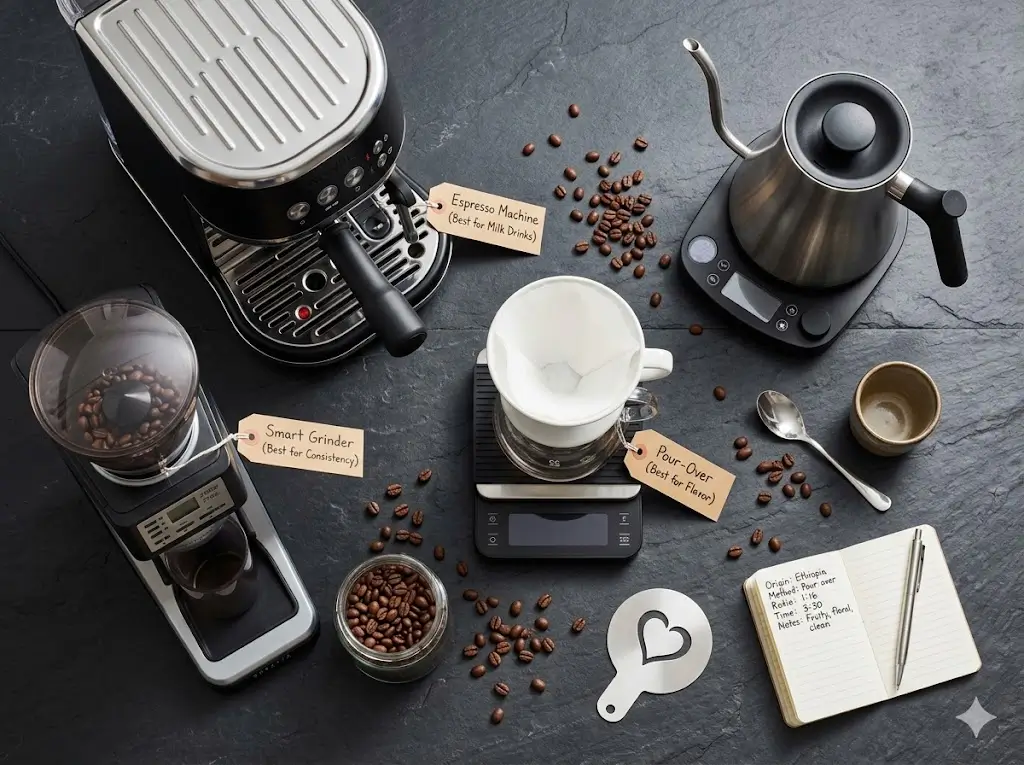
The Top Category Winners & Product Highlights
Based on over 500 hours of extraction analysis, workflow testing, and longevity assessments, here are the dominant champions for your home barista setup.
1. Best Budget Home Barista Setup
The Espresso Machine: Breville Bambino Plus The Grinder: Baratza Encore ESP
For those looking to enter the world of true espresso without taking out a second mortgage, this pairing is the undisputed king. The Breville Bambino Plus utilizes an ultra-fast ThermoJet heating system, reaching brew temperature in a staggering 3 seconds. It features a genuine 9-bar OPV (Over Pressure Valve) and a surprisingly competent automatic microfoam steaming system that utilizes a dedicated temperature sensor to deliver latte-art-ready milk.
Paired with the Baratza Encore ESP—a revolutionary upgrade to the classic Encore featuring a dual-pitch macro/micro adjustment system—you get true espresso-capable grinding. The ESP utilizes a 40mm M2 conical burr set that delivers a syrupy, traditional espresso profile.
- Key Strengths: Tiny footprint, 3-second heat-up time, idiot-proof milk texturing.
- Notable Flaws: The 54mm portafilter limits aftermarket accessories; light weight means you must hold the machine down while locking in the portafilter.
- Who it is Perfect For: Beginners, space-constrained apartment dwellers, and milk-drinkers on a strict budget.
[Read Our Full Review of the: Breville Bambino Plus & Baratza Encore ESP Setup]
2. Best Overall Home Barista Setup (The Sweet Spot)
The Espresso Machine: Lelit Bianca V3 The Grinder: Niche Zero
This setup represents the pinnacle of the “diminishing returns” curve. Spending more than this will yield incredibly marginal gains in the cup. The Lelit Bianca V3 is an Italian-made dual-boiler masterpiece featuring an E61 group head and an ingenious, built-in manual flow control paddle. This allows the user to profile shots like a $15,000 commercial machine, rescuing older beans or perfectly extracting ultra-light roasts. It also features a movable water tank for tight spaces.
The Niche Zero took the home barista world by storm by introducing true zero-retention, single-dosing workflow. Featuring massive 63mm Mazzer conical burrs housed in a gorgeous, low-RPM motor chassis, the Niche produces incredibly fluffy, clump-free grounds with less than 0.1g of retention.
- Key Strengths: Ultimate control over extraction via flow profiling, silent grinding, exquisite wood-accent aesthetics.
- Notable Flaws: The Niche Zero is often backordered; the Bianca requires a 20-minute heat-up time due to the massive E61 group head.
- Who it is Perfect For: Serious enthusiasts who want absolute control over every variable of their espresso without venturing into commercial pricing.
[Read Our Full Review of the: Lelit Bianca V3 & Niche Zero]
3. Best for Professionals & Die-Hard Purists (Prosumer)
The Espresso Machine: La Marzocco Linea Micra The Grinder: Mahlkönig E65S GbW (Grind-by-Weight)
For those who accept no compromises and want commercial café performance scaled down to a kitchen counter, this is the endgame. La Marzocco is the Ferrari of the coffee world. The Linea Micra is a miniaturized dual-boiler powerhouse featuring a saturated group head, a near-silent rotary pump, and IoT smart connectivity for scheduling heat-ups via a smartphone app. It delivers back-to-back shots with zero temperature deviation and possesses enough steam power to texture milk in 8 seconds.
The Mahlkönig E65S GbW introduces revolutionary Grind-by-Weight technology. Using a high-precision load cell built into the fork, it doses exactly to the tenth of a gram in real-time. With 65mm special-steel flat burrs, it provides an aggressively sweet, exceptionally clear unimodal flavor profile.
- Key Strengths: Unbreakable commercial build quality, absolute consistency, zero-variance temperature stability, perfect weight-based dosing.
- Notable Flaws: Exorbitant price tag; the Micra’s short clearance beneath the group head can make fitting large scales or tall mugs difficult.
- Who it is Perfect For: Well-heeled aficionados, pop-up cart owners, and users who demand the absolute best gear on the planet.
[Read Our Full Review of the: La Marzocco Linea Micra & Mahlkönig Setup]
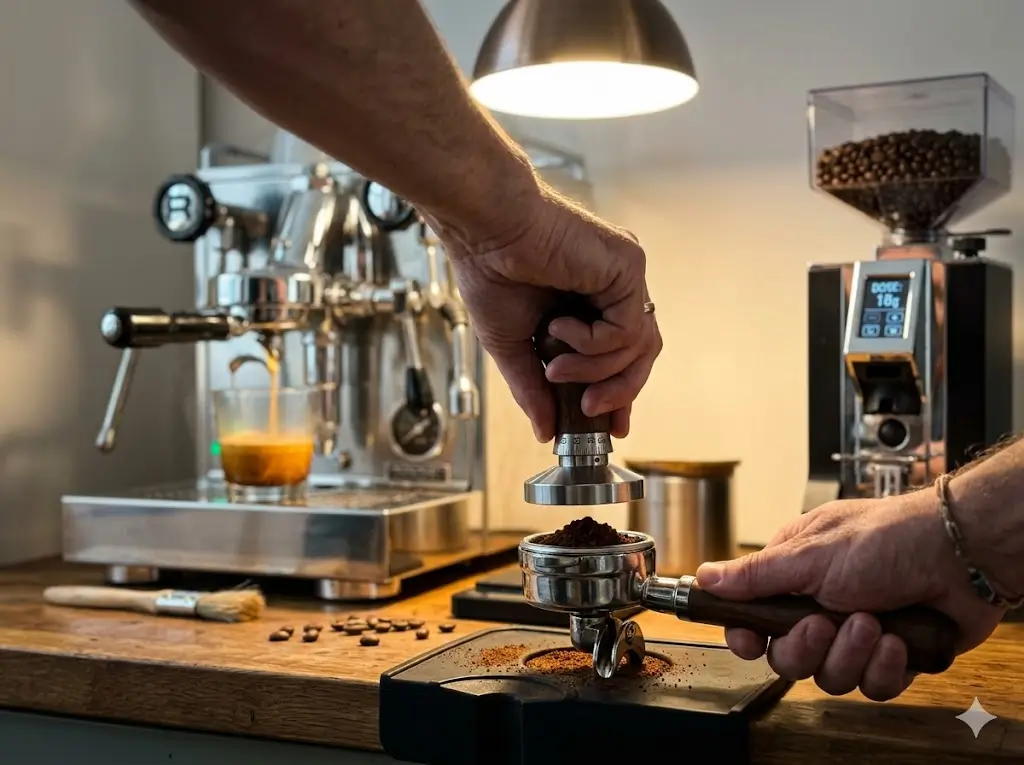
The Step-by-Step Buyer’s Framework
Building your home barista setup requires strategy. Do not blindly purchase the most expensive machine you can find. Use our dynamic, universal 5-step framework to build a setup perfectly tailored to your lifestyle.
Step 1: Establish Your “Golden Ratio” Budget
The most common mistake new buyers make is spending 90% of their budget on a shiny espresso machine and 10% on a cheap grinder. The grinder is more important than the espresso machine. An excellent grinder paired with a mediocre machine will produce good espresso. A terrible grinder paired with a $5,000 machine will produce undrinkable swill.
- The Rule: Allocate a minimum of 40% of your total budget to your grinder.
Step 2: Assess Your Daily Workflow and Drink Preference
Are you a purist who only drinks straight, black espresso? Or are you making three 12oz lattes back-to-back for your family every morning?
- Straight Espresso Drinkers: Prioritize a high-end grinder with large flat burrs and an espresso machine with a single boiler and a highly accurate PID (like the ECM Puristika). You don’t need to pay for a steam boiler you won’t use.
- Heavy Milk Drinkers: You absolutely need a Heat Exchanger (HX) or a Dual Boiler. Steaming milk for multiple drinks on a single-boiler machine is a maddening, time-consuming process.
Step 3: Single Dosing vs. Hopper Grinding
Decide how you want to interact with your beans.
- Single Dosing: You weigh out your beans per shot (e.g., 18g in, 18g out). This keeps beans fresh in an airtight container until the moment of brewing and allows you to switch between decaf and regular easily. Requires a zero-retention grinder (like a DF64 or Niche).
- Hopper Grinding: You dump a full bag of beans into a hopper and grind by time or weight. Much faster workflow, ideal for busy mornings, but beans stale faster, and switching coffees requires purging the grinder.
Step 4: Measure Your Physical Space (The Z-Axis)
Espresso machines are massive. Do not just measure width and depth; measure height (the Z-axis). Most standard kitchen cabinets are 18 inches above the counter. Many prosumer machines with cups stacked on their cup warmers—or tall grinders with hoppers—will not fit beneath overhead cabinets.
Pro Tester Tip: If plumbing your machine directly into your water line, account for the space needed to drill through your countertops and run inline water filtration systems beneath your sink.
The Ultimate Buyer’s Pitfall & Troubleshooting Guide
The coffee industry is rife with deceptive marketing jargon. Use this extensive pitfall matrix to protect your wallet and your palate.
| The Marketing Claim | The Consumer Reality | The Expert Advice / Fix |
|---|---|---|
| “Brews at an incredible 15 to 20 Bars of Pressure!” | Anything over 9 bars compresses the puck too hard, causing severe channeling, bitter flavors, and stalled shots. High-pressure claims mask cheap vibratory pumps. | Look for machines specifically advertising an OPV (Over Pressure Valve) set to 9 bars. If your machine runs at 15 bars, install an aftermarket OPV spring or lower your dose. |
| “Built-in Grinder for Ultimate Convenience” | All-in-one machines (like the Breville Barista Express) trap you. If the grinder breaks, the whole machine is useless. The built-in grinders suffer from high heat transfer from the boiler, which prematurely stales beans in the hopper. | Always buy standalone units. A separate machine and grinder offer superior heat management, better burr quality, and the ability to upgrade components individually. |
| “100% Stainless Steel Portafilter and Baskets” | “Pressurized” or “Dual-Wall” baskets are often included in budget machines. They force coffee through a single pinhole to artificially create crema from stale, pre-ground coffee. | Throw away pressurized baskets immediately. Ensure your machine supports standard “Single-Wall” baskets and buy freshly roasted coffee beans. True crema comes from fresh CO2, not a mechanical pinhole. |
| “Self-Cleaning and Low Maintenance” | Coffee oils go rancid quickly. Scale buildup from hard water will completely destroy an espresso machine’s heating element within 18 months if left untreated. No machine is truly self-cleaning. | Adopt a strict backflushing protocol. Test your home tap water. If your water is above 50 TDS (Total Dissolved Solids) or high in calcium, you must use a specialized water pitcher (like a BWT) or formulate your own water. |
| “Perfect Temperature Every Time” | Machines without a PID rely on bimetallic thermostats. The temperature can swing wildly, meaning you might brew at 88°C one minute and 98°C the next, causing wild inconsistencies in flavor. | Refuse to buy any machine over $400 that does not explicitly state it has a PID digital temperature controller. |
Niche Use Cases & Alternatives
Not every coffee enthusiast fits into the standard kitchen paradigm. Adapting your home barista setup for specific needs requires creative thinking.
The Ultra-Compact / Travel Setup
If you live in a tiny studio apartment, an RV, or travel frequently, a traditional dual-boiler setup is impossible.
- The Solution: Fully manual espresso. Devices like the Flair 58 or the Cafelat Robot use massive mechanical levers to manually press water through the puck, generating true 9-bar pressure without electricity (you just need a separate kettle for hot water). Pair this with a premium manual hand grinder like the 1Zpresso J-Max. Hand grinders use massive, high-quality conical burrs but cost a fraction of electric grinders because you supply the motor (your arm).
The Filter/Espresso Hybrid User
If you love both rich espresso and bright, clean pour-over coffee (V60, Chemex), buying two separate grinders is expensive.
- The Solution: Invest in a highly capable 64mm or 83mm flat burr grinder designed for easy adjustment across the entire spectrum. The Fellow Ode Gen 2 (with aftermarket SSP burrs) or the Option-O Lagom P64 allow you to seamlessly dial back and forth between microscopic espresso grinds and coarse French Press grinds with zero alignment issues.
The Ultra-Tight Budget (<$250)
If your absolute maximum budget is under $250, do not attempt to buy a cheap, plastic pump-driven espresso machine from a big-box store; it will break, and the coffee will be terrible.
- The Solution: Abandon true espresso. Invest $150 in a great electric burr grinder (like the Baratza Encore), a $35 Aeropress, and a small milk frother. A perfectly extracted Aeropress coffee will taste infinitely better than a poorly extracted shot from a cheap, unpressurized appliance.
Advanced Maintenance, Care & Longevity Strategies
An elite home barista setup is not an appliance; it is a mechanical hobby. Like a high-performance sports car, it requires meticulous maintenance. Neglecting these protocols will void your warranty and destroy your equipment.
Water Chemistry: The Invisible Killer
Water comprises 90% of your espresso. If your water is bad, your espresso is bad. More importantly, hard water (high in calcium and carbonates) will form scale (limescale) inside your boilers. Scale blocks valves, destroys heating elements, and ruins pumps.
- Expert Advice: Never use pure distilled or Reverse Osmosis (RO) water. Espresso machines use electrical conductivity probes to measure water levels in the boiler; pure water has no minerals and will not conduct electricity, causing the boiler to overfill and explode.
- The Fix: Use specifically formulated water. Either use a BWT Magnesium-enriching pitcher, inline softening pouches (like Oscar bags), or mix your own water using distilled water and packets of “Third Wave Water” minerals.
The Backflushing Protocol
Every time you pull a shot, a three-way solenoid valve opens to release pressure, sucking coffee oils and microscopic grounds backward into the machine’s internal piping.
- Daily: At the end of the day, wipe down the shower screen, insert a “blind” basket (a basket with no holes) into your portafilter, and run the pump for 5 seconds to flush out loose grounds.
- Monthly (Chemical Backflush): Every 3 to 4 weeks, place half a teaspoon of dedicated espresso machine detergent (like Cafiza or Puly Caff) into the blind basket. Run the pump for 10 seconds, let it sit for 10 seconds, and repeat 5 times. Rinse thoroughly. This dissolves rancid coffee oils that make your espresso taste bitter and ashy.
Grinder Hygiene
Coffee oils coat the burrs and internal grinding chamber, eventually turning rancid.
- Monthly: Use a vacuum cleaner to suck out the burr chamber.
- Quarterly: Remove the upper burr (ensure the machine is unplugged) and use a stiff brush to clean the cutting teeth. Never use water to clean steel burrs, as they will instantly rust. You can also run specialized grinder cleaning pellets (like Grindz) through the machine to absorb lingering oils.
Warranty Activation
Always register your high-end equipment with the manufacturer or distributor within 30 days of purchase. Prosumer machines often come with 2 to 3-year warranties, but many require proof of purchase and immediate registration to honor them. Keep original shipping boxes; shipping an 80-pound dual-boiler machine for repairs is nearly impossible without the custom-molded factory foam.
Conclusion
Building your ultimate home barista setup is a deeply rewarding journey that blends mechanical appreciation, sensory exploration, and daily ritual. By prioritizing thermal stability, precision grinding, and component quality over flashy marketing gimmicks, you can construct a coffee station that easily outpaces your local commercial café. Remember the golden rule: invest heavily in your grinder, understand your true workflow needs, and respect the machinery through rigorous maintenance and water care.
Ready to start brewing? Check the current prices and availability on Amazon via our curated cluster links above. If you have questions about your specific counter space, water hardness, or need a personalized recommendation, drop a detailed comment below! Don’t forget to subscribe to our newsletter for deep-dive reviews on the latest prosumer gear, advanced latte art tutorials, and exclusive discounts.
Comprehensive FAQs
1. Is a 20-bar espresso machine better than a 15-bar or 9-bar machine?
Absolutely not. This is the most pervasive myth in home espresso. The ideal extraction pressure for espresso is 9 bars. Machines advertised as 15 or 20 bars are typically budget models using cheap vibratory pumps that lack an Over Pressure Valve (OPV) to regulate flow. Pressures above 10 bars compress the coffee puck so intensely that it fractures, causing severe channeling and aggressively bitter, over-extracted coffee. Always look for a machine regulated to 9 bars.
2. How long do espresso machine burrs last before needing replacement?
For the average home barista pulling 2 to 4 shots per day, a high-quality set of steel burrs (flat or conical) will last between 5 to 10 years. Specifically, most 64mm flat burrs are rated for 300 to 500 kilograms of coffee. You will likely upgrade your grinder long before you dull the burrs. However, if you accidentally grind a stone hidden in your coffee beans, the burrs can be chipped and require immediate replacement.
3. What is “channeling” and how do I fix it?
Channeling occurs when pressurized water finds weak spots in your coffee puck, drilling localized “channels” through the bed rather than passing evenly through all the grounds. This results in weak, sour, and astringent espresso. To fix channeling, improve your puck preparation: use a WDT tool (Weiss Distribution Technique) to break up clumps with fine needles, ensure you are tamping perfectly level, and verify your grinder is producing a consistent particle size.
4. Should I buy an espresso machine with a built-in grinder?
We strongly advise against it for anyone serious about espresso. While machines like the Breville Barista Express are popular, the built-in grinder is the weakest link. Heat from the espresso boiler migrates to the bean hopper, staling your beans rapidly. Furthermore, if the grinder motor fails, your entire espresso machine becomes useless while in the repair shop. Standalone units offer infinitely better grind quality and upgradeability.
5. How much should I spend on an espresso grinder compared to the machine?
Our expert “Golden Ratio” dictates that you should spend at least 40% (and ideally 50%) of your total setup budget on the grinder. A $1,000 grinder and a $500 machine will consistently produce phenomenally better espresso than a $500 grinder and a $1,000 machine. The grinder dictates the particle distribution and extraction yield; the machine merely provides the hot water.
6. Do I really need to use a scale to make espresso?
Yes. Volumetric measurements (eyeballing the liquid level in a shot glass) are incredibly inaccurate due to the varying amounts of crema produced by different roasts and bean ages. To achieve consistency, you must measure your “dose” (the dry coffee going in, e.g., 18g) and your “yield” (the liquid espresso coming out, e.g., 36g) using a scale accurate to 0.1g. This allows you to lock in a brew ratio and adjust your grind size accurately.
7. Can I use tap water in my high-end espresso machine?
Only if you have tested it and confirmed it meets specialty coffee standards. If your tap water has a TDS (Total Dissolved Solids) above 150ppm or is high in calcium and magnesium, it will rapidly form destructive scale inside your machine’s boilers. Alternatively, if your tap water is too soft or passes through a sodium-based water softener, your espresso will taste flat and acidic. Use filtration pitchers designed for espresso, or create customized water profiles.
8. What is the difference between a Heat Exchanger (HX) and a Dual Boiler?
A Dual Boiler has two separate, dedicated tanks of water: one kept precisely at brew temperature (e.g., 93°C) and one kept at steam temperature (e.g., 130°C). This offers maximum stability. A Heat Exchanger has one large steam boiler with a hollow tube running through the middle of it. Fresh water passes through this tube, flash-heating as it travels to the group head. HX machines are cheaper but require you to flush water before brewing to prevent overheating the coffee. Both allow you to brew and steam milk simultaneously.
9. Are bottomless (naked) portafilters just for aesthetics?
While they look beautiful and are highly photogenic, bottomless portafilters are primarily a diagnostic tool. By removing the spouts and the bottom of the portafilter, you can view the extraction as it exits the basket. If you see bald spots, multiple erratic streams, or espresso spraying sideways (spritzing), you instantly know you have a puck preparation or channeling issue that needs to be corrected.
10. Is PID temperature control actually worth the extra money?
Absolutely. Without a PID, an espresso machine relies on mechanical thermostats that can have a temperature variance of up to 5 to 8 degrees Celsius. Because coffee extraction is a highly volatile chemical reaction, a temperature swing of just 2 degrees can drastically alter the flavor profile from sour to bitter. A PID locks the water temperature down to a fraction of a degree, providing the consistency required for true home barista mastery.