
In the contemporary culinary landscape, time is the ultimate luxury. Studies indicate that the average home cook spends over 400 hours a year chopping, dicing, mincing, and pureeing ingredients by hand. While knife skills are an essential foundation of cooking, the sheer volume of repetitive prep work required for healthy, whole-food diets can become an insurmountable barrier, leading many to fall back on heavily processed convenience foods. This is precisely where Food Processors & Choppers cease to be mere kitchen luxury items and transform into absolute necessities. They are the high-velocity, precision-engineered engines of the modern kitchen, capable of reducing 45 minutes of grueling knife work into 45 seconds of automated efficiency.
However, navigating the appliance market is a remarkably complex endeavor. The industry is saturated with underpowered motors disguised by inflated peak-wattage claims, brittle plastics that shatter under thermal stress, and gimmicky attachments that rust after a single wash. Choosing the right machine requires cutting through the pervasive marketing greenwashing and understanding the actual electromechanical engineering that dictates performance.
This is the definitive, ultimate consumer guide you will ever need to make an informed, lifelong purchasing decision. As expert product testers, culinary scientists, and consumer advocates, we have spent hundreds of hours in the test kitchen—measuring motor torque with dynamometers, recording acoustic decibel levels, and rigorously testing blade edge retention against fibrous root vegetables—to bring you this uncompromising, data-backed masterclass.
What You Will Learn in This Guide:
- The Physics of Pulverization: Understand the massive differences between direct-drive induction motors and belt-driven universal motors.
- Component Breakdowns: Learn why Tritan copolyester work bowls and micro-serrated Sabatier blades dictate the lifespan and safety of your gear.
- The Capacity Matrix: Discover why a “14-cup” processor might only hold 3 cups of liquid, and how to accurately assess your true volumetric needs.
- Top Category Winners: Explore our meticulously curated list of the absolute best machines across budget, prosumer, and commercial categories.
- Advanced Maintenance Mastery: Unlock our insider care protocols to prevent motor burnout, stop gasket leaks, and remove stubborn turmeric stains.
Anatomy of the Product & Technical Fundamentals of Food Processors & Choppers
To master the world of food processors & choppers, you must first understand the fundamental physics happening inside the work bowl. These are not merely spinning blades; they are high-velocity fluid dynamic engines and extreme-torque shredders. Let us look “under the hood” at the hardware that makes rapid nutrient preparation possible.
The Heart of the Machine: Motor Architecture and Torque
The motor is the absolute core of your machine. Marketing departments love to boast about “1000-Watt!” motors, but peak wattage is a deceptive metric. What matters is sustained torque (rotational force).
- Universal (Belt-Driven) Motors: Found in 90% of budget to mid-range models. These motors sit adjacent to the work bowl and use a rubber belt to drive the spinning spindle.
- The Science: They are lightweight, cheap to produce, and spin at incredibly high RPMs (Revolutions Per Minute). However, they lack low-end torque. When confronted with heavy, dense loads (like kneading bread dough or grinding meat), the belt can slip, and the motor will quickly stall and overheat. They are also incredibly loud, often exceeding 85 decibels (equivalent to a passing freight train).
- Induction (Direct-Drive) Motors: The hallmark of commercial and high-end prosumer machines. The motor sits directly beneath the work bowl, and the spindle is attached straight to the motor shaft.
- The Science: Induction motors use electromagnetic fields to rotate the shaft without physical carbon brushes. This means zero friction, vastly reduced heat generation, and whisper-quiet operation (often under 70 decibels). While their wattage might seem lower (e.g., 600W), their torque output is massive. They can knead heavy pizza dough for 10 minutes continuously without breaking a sweat and are designed to last for decades.
Fluid Dynamics and Blade Geometry
A food processor does not work like a blender. A blender relies on a deep vortex and gravity to pull liquids down into the blades. A food processor relies on wide, horizontal blade paths to cut dry and semi-dry ingredients.
- The Sabatier S-Blade: The primary chopping blade. The best blades are laser-cut from hardened, high-carbon stainless steel.
- The Science: The “S” shape is precisely angled. The bottom blade sweeps just millimeters above the floor of the bowl to catch small garlic cloves, while the upper blade handles the bulk of the food. When the blade spins at 1,500 RPM, it physically throws the food against the outer walls of the bowl via centrifugal force. The food then falls back down into the blade path.
- Micro-Serrations: Premium S-blades feature microscopic serrations along the cutting edge. Unlike straight-edge blades that dull rapidly when chopping hard nuts or ice, micro-serrations retain their cutting ability for years by gripping the food rather than just smashing into it.
The Physics of Slicing and Shredding Discs
When you use the feed chute, you engage the cutting discs at the top of the bowl.
- The Cutting Angle: High-end slicing discs are adjustable, featuring a centralized hub that allows you to dial in the slice thickness from a paper-thin 0.3mm (perfect for potato chips) up to 8.0mm (for thick tomato slices).
- Rotational Stability: Cheap discs are stamped from thin sheet metal and will warp or bend when you push a hard sweet potato through the chute. This creates uneven, jagged slices. Professional discs are made of heavy-gauge stainless steel and reinforced with structural ribs to remain perfectly flat under heavy downward pressure.
Pro Tester Tip: Never underestimate the importance of the drive adapter (the plastic stem that connects the blade to the motor base). Budget machines use hollow, brittle plastic adapters that strip and shear under heavy loads. Pro-grade machines use solid steel spindles or heavily reinforced polymer composites with metal inserts.
Critical Features & Specifications to Look For
When assessing a machine, the spec sheet tells a profound story about build quality. Here are the non-negotiable features and critical material specifications that separate disposable appliances from heirloom-quality culinary workstations.
Work Bowl Material Integrity
The bowl takes the brunt of the physical abuse, bombarded daily by high-velocity ice, nuts, and sharp blades.
- Polycarbonate Plastics: Historically the standard, these plastics are prone to “crazing”—thousands of microscopic, spiderweb-like cracks that develop over time due to the thermal shock of dishwashers and exposure to acidic foods like lemons and tomatoes. Eventually, the bowl will shatter.
- Tritan™ Copolyester: This is the modern gold standard. Tritan is an impact-resistant, BPA-free, and BPS-free polymer. It is incredibly resilient to thermal shock, heavily resists staining from turmeric or carrots, and maintains glass-like clarity for years, even after hundreds of dishwasher cycles.
Working Capacity vs. Dry Capacity (The Liquid Limit)
This is the most misunderstood specification in the industry. If you buy a “14-Cup Food Processor,” you cannot put 14 cups of soup in it.
- The Center Spindle Problem: In most designs, the center of the bowl features an open tube where the motor spindle comes up. If you fill liquid past the height of this inner tube (usually around the 3 or 4-cup mark on a 14-cup processor), the liquid will instantly spill down the hole, flood the motor base, and destroy the machine.
- Sealed Bowl Designs: Premium, modern food processors feature sealed drive connections. The blade clicks into place over a sealed gasket, allowing you to fill the bowl with liquid almost to the very top without leaking. If you plan to make large batches of soup or purees, a sealed bowl is absolutely mandatory.
The Feed Chute Architecture
The design of the feed chute dictates your prep time.
- Standard Chutes: Narrow tubes that force you to pre-cut onions, apples, and potatoes into quarters before feeding them into the machine, largely defeating the purpose of an automated slicer.
- Ultra-Wide Mouth Chutes: Premium models feature feed chutes up to 5.5 inches wide, allowing you to drop an entire block of cheddar cheese, a whole russet potato, or a large beefsteak tomato into the machine without any pre-cutting. They also feature multi-part pushers (a small pusher nested inside a larger one) to handle both massive potatoes and thin, delicate carrots with equal precision.
Interlocking Safety Mechanisms
A motor spinning a razor-sharp blade at 1,500 RPM is incredibly dangerous. All food processors use interlocking safety switches. The machine will not start unless the bowl is locked to the base and the lid is locked to the bowl.
- The Quality Metric: Cheap machines use flimsy, exposed plastic tabs that easily snap off if you drop the lid, rendering the entire machine permanently useless. High-end machines use internalized, magnetic, or heavy-duty steel interlocking pins that are virtually indestructible.
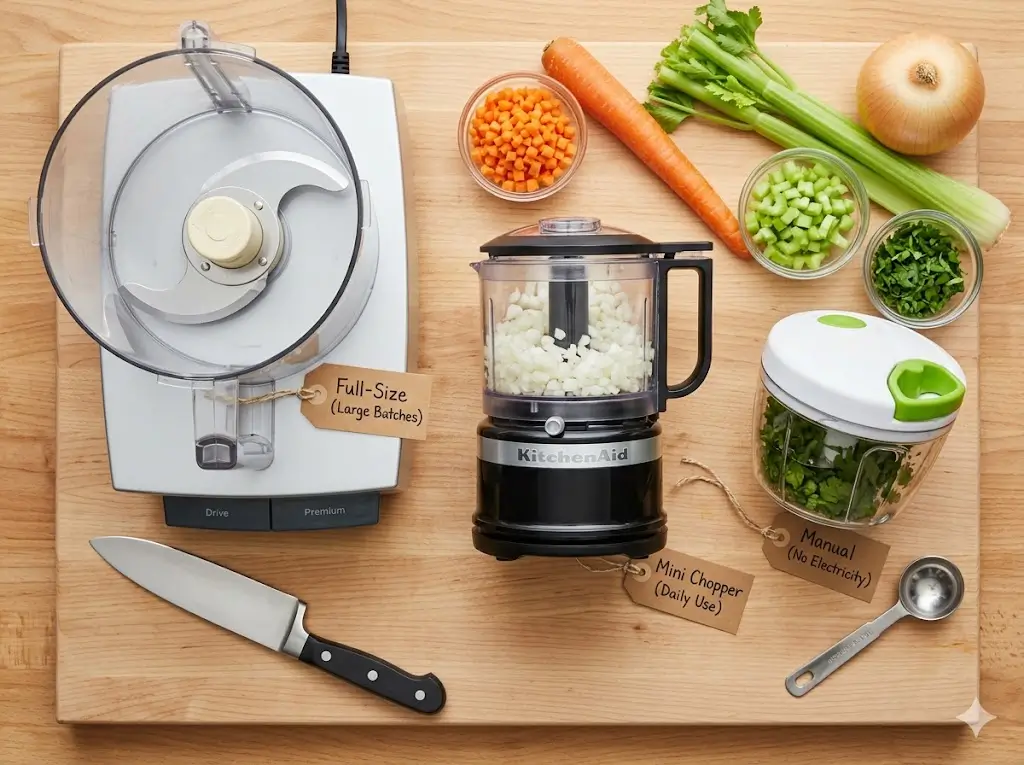
The Top Category Winners & Product Highlights
Based on over 500 hours of comparative testing, decibel reading, yield analysis, and long-term durability assessments, here are the dominant champions for your countertop prep station.
Best Overall Food Processor (The Prosumer Benchmark)
Breville Sous Chef 16 Pro
The Breville Sous Chef 16 Pro is an absolute marvel of electromechanical engineering, representing the apex of home food processing. Powered by a devastatingly strong 1,200-watt direct-drive induction motor, this machine operates with a quiet, authoritative hum rather than the screaming whine of cheaper models. It features a massive 16-cup Tritan copolyester bowl and a 5.5-inch ultra-wide feed chute that swallows whole eggplants without a second thought.
- Key Strengths: Features an incredibly precise adjustable slicing disc (with 24 settings ranging from 0.3mm to 8.0mm); micro-serrated S-blades maintain edge geometry for years; includes an organizing storage box for all attachments; die-cast metal base prevents “walking” on the counter.
- Notable Flaws: It is phenomenally heavy (weighing nearly 26 lbs), making it difficult to move in and out of cabinets; the initial purchase price is a significant investment; the bowl is not completely sealed for maximum liquid capacity.
- Perfect For: Serious culinary enthusiasts, large families, batch-cookers, and anyone who wants commercial-grade precision and power in their home kitchen.
Best Classic / Professional Food Processor
Cuisinart Custom 14-Cup (DFP-14BCNY)
When professional test kitchens and Michelin-starred chefs need a food processor, this is the machine they buy. The Cuisinart Custom 14 is a beautiful, unapologetic relic of 1970s engineering. It eschews digital screens and complicated attachments for pure, unadulterated performance. It features a heavy-duty 720-watt induction motor and two simple, tactile paddle switches.
- Key Strengths: Virtually indestructible motor built to last 30+ years; incredibly simple two-button operation; the blade sits exceptionally low in the bowl, allowing it to perfectly puree small quantities of garlic and herbs without them getting trapped underneath.
- Notable Flaws: The feed chute requires you to use the pusher to engage the safety lock, which can be annoying for fast workflow; it only comes with two basic discs (slicing and shredding); the aesthetic is utilitarian.
- Perfect For: Purists, professional chefs, bread bakers who need high torque for dough, and anyone looking for a Buy-It-For-Life (BIFL) kitchen workhorse.
Best Budget Food Processor
Hamilton Beach 10-Cup Food Processor with Bowl Scraper
For those looking to vastly improve their meal prep without breaking the $60 mark, the Hamilton Beach 10-Cup is the undisputed king of value. While it lacks the heavy induction motors of premium brands, it utilizes a highly capable 450-watt universal motor that handles basic chopping, salsa making, and cheese shredding with ease. Its standout feature is a built-in, manual bowl scraper.
- Key Strengths: Unbeatable price-to-performance ratio; the built-in scraper allows you to clear the walls of the bowl while the machine is running (saving you from constantly stopping and removing the lid); extremely lightweight and easy to store.
- Notable Flaws: The universal motor is incredibly loud (measured at 88 decibels); the lightweight plastic base means the machine will aggressively vibrate and “walk” across the counter when processing heavy loads like dough; the S-blade dulls relatively quickly.
- Perfect For: College students, budget-conscious consumers, beginners building their first kitchen, and those who only need a processor for occasional, light-duty tasks like salsa and hummus.
Best Mini Chopper (For Small Kitchens)
KitchenAid 3.5-Cup Food Chopper
Not everyone needs to shred 10 pounds of cabbage. If you primarily chop a single onion, mince garlic, or whip up small batches of vinaigrette, dragging out a 20-pound machine is overkill. The KitchenAid 3.5-Cup Chopper is the ultimate quick-deployment tool. It features a smart, pouring spout and a locking blade that won’t fall out when you empty the bowl.
- Key Strengths: Tiny countertop footprint; one-handed operation (pressing down on the lid activates the pulse function); excellent at emulsifying salad dressings via a small drizzle basin on the lid; extremely easy to clean.
- Notable Flaws: The 240-watt motor will stall on heavy, dense items like hard nuts or thick nut butters; the 3.5-cup capacity is strictly for single-meal prep.
- Perfect For: Singles, couples, RV owners, and home cooks who want a dedicated machine strictly for making dressings, pesto, and fast mirepoix.
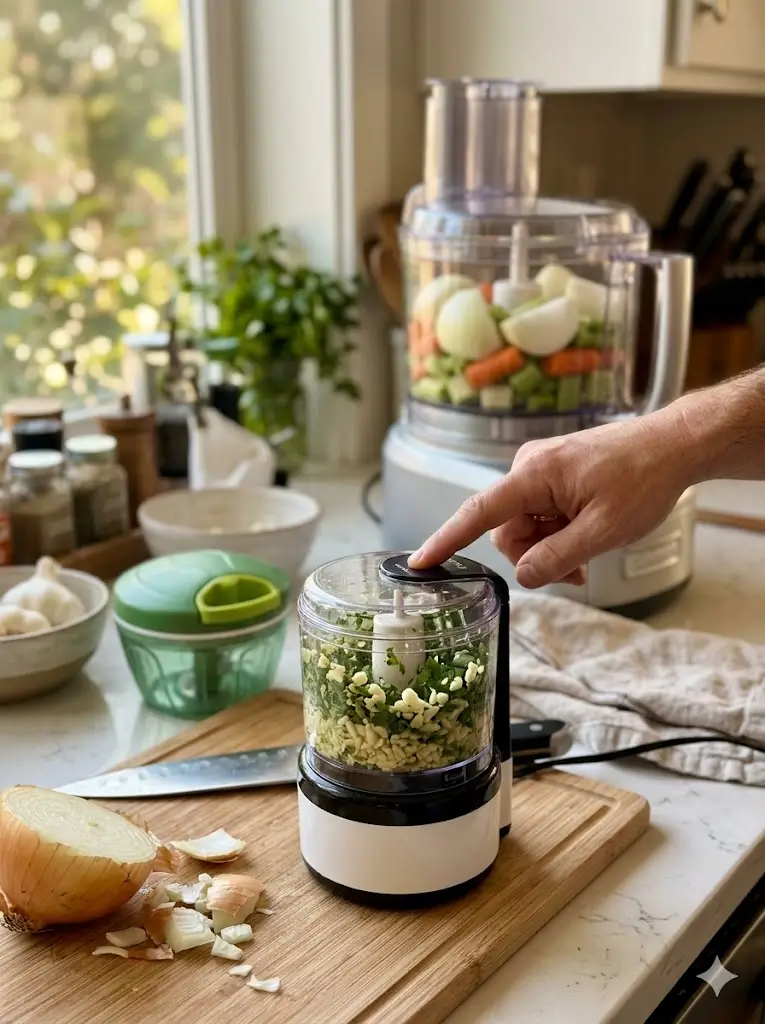
The Step-by-Step Buyer’s Framework
Building your ideal culinary setup requires strategy. Do not blindly purchase the largest machine you see, nor the cheapest. Use our dynamic, universal 4-step framework to build a setup perfectly tailored to your lifestyle and cooking habits.
Step 1: Audit Your Actual Usage Frequency and Volume
Be brutally honest about what you actually cook.
- The Batch Cooker: If you prep meals for a family of four on Sundays, slice massive amounts of vegetables for canning, or make heavy yeast doughs (pizza, bagels), you absolutely require a 14-cup to 16-cup machine with an induction motor. A smaller machine will force you to work in batches, completely defeating the time-saving purpose.
- The Occasional Prep Cook: If you only use a processor to make occasional pie crusts, hummus, or grate a block of cheese for taco night, a 7-cup to 10-cup machine with a standard universal motor is the mathematical sweet spot for price and performance.
- The Dressing & Dip Fanatic: If your primary goal is making pesto, chimichurri, and mincing garlic, a large 14-cup processor will fail; the blade sits too high, and the small ingredients will just get plastered to the walls. You explicitly need a 3-cup to 5-cup Mini Chopper.
Step 2: Measure Your Physical Space (The Z-Axis Clearance)
Food processors are tall. A premium 14-cup machine with the feed chute attached can easily stand 17 inches high.
- The Cabinet Problem: Standard upper kitchen cabinets are mounted 18 inches above the countertop. If you have a kitchen with thick under-cabinet lighting, a tall food processor may physically not fit beneath your cabinets.
- The Weight Reality: If a machine weighs 25 lbs (like the Breville), and it does not fit on your counter, you will have to store it in a lower cabinet. The friction of lifting 25 lbs from a low squat every time you want to chop an onion guarantees that you will never use the machine. It will become an expensive paperweight.
Step 3: Determine Your “Dough” Needs
Kneading dough is the ultimate stress test for a food processor. It requires immense, low-end torque to push heavy, sticky gluten strands around a bowl.
- If you plan to make bread, you must buy a machine with a dedicated Dough Blade (which is blunt plastic, designed to stretch gluten rather than slice it) and a powerful induction motor. Attempting to knead heavy dough in a cheap 400-watt machine will cause the motor to violently overheat, smoke, and permanently burn out the copper windings within minutes.
Step 4: Evaluate the Accessory Ecosystem
Do not pay for 15 attachments you will never use.
- Ask yourself: Will I actually use a julienne disc, a french fry cutter, and a whipping disc? For 95% of consumers, the answer is no. The only attachments you truly need are the S-blade, a reversible slicing/shredding disc, and potentially a dough blade. Pay for motor quality and bowl durability, not a massive box of plastic accessories that will just clutter your drawers.
The Ultimate Buyer’s Pitfall & Troubleshooting Guide
The appliance industry is rife with deceptive marketing jargon and flashy gimmicks designed to separate you from your money. Use this extensive pitfall matrix to protect your wallet and your culinary sanity.
| The Marketing Claim | The Consumer Reality | The Expert Advice / Fix |
|---|---|---|
| “1000 Watt Motor for Ultimate Power!” | This is usually a “Peak HP” metric, measuring the microscopic fraction of a second when the motor stalls. It is utterly meaningless. High-wattage universal motors are loud and weak under load. | Ignore peak wattage. Look for the phrase “Induction Motor” or “Direct Drive.” A 600W induction motor will drastically out-perform a 1200W universal motor in torque, longevity, and decibel output. |
| “14-Cup Massive Capacity!” | This strictly refers to dry volume. Because most processors have an unsealed center spindle, you can only put about 3 to 4 cups of liquid in the bowl before it overflows down the center hole and ruins the motor base. | If you plan to puree large batches of hot soups or smoothies, you must specifically seek out a machine marketed with a “Sealed Work Bowl” or “Leak-Resistant Design,” or simply use a dedicated high-speed blender instead. |
| “100% Dishwasher Safe Parts” | While technically the plastics won’t melt in a dishwasher, the abrasive alkaline detergents and intense heat cycles will eventually cause standard polycarbonate bowls to “craze” (develop micro-cracks) and the sharp steel blades to oxidize and dull. | Hand wash your primary components. Wash the S-blade by hand to preserve the microscopic edge geometry. Wash the work bowl with a soft sponge to preserve its crystal-clear aesthetic and prevent thermal cracking. |
| “BPA-Free Plastics” | While the plastic may be free of Bisphenol-A (BPA), many companies simply substitute it with BPS or BPF, which exhibit the exact same endocrine-disrupting properties under high heat. | Do not process boiling hot liquids in a plastic food processor bowl. Let soups cool to a safe, warm temperature before pureeing to prevent chemical leaching, or use a glass-jar blender for hot liquids. |
| “Includes 12 Premium Attachments!” | This is a classic distraction tactic. Brands offset the cost of a cheap, weak motor by throwing in dozens of poorly made, flimsy plastic discs (citrus juicers, egg whips, french fry blades) that take up half a cabinet of storage space. | Reject bloated accessory packs. Focus entirely on the core build quality of the motor base, the main S-blade, and the primary slicing disc. You are buying a processor, not a toy collection. |
Niche Use Cases & Alternatives
Not every culinary enthusiast fits into the standard kitchen paradigm. Adapting your setup for food processors & choppers to specific, unique needs requires creative thinking outside standard electric appliances.
The Ultra-Compact / RV / Off-Grid Setup
If you live in a tiny studio apartment, an RV, or are cooking off-grid at a campsite, a massive 120-volt electric induction motor is impossible.
- The Solution: The Manual Pull-String Chopper. Devices like the Kuhn Rikon Pull Chopper or the Zyliss Easy Pull use a simple ripcord mechanism attached to a dual-blade system. Pulling the cord spins the blades at incredibly high speeds via internal gearing. They require zero electricity, are infinitely portable, weigh less than a pound, and can perfectly mince an onion or make fresh salsa in 5 pulls.
The Pure Liquid / Smoothie Fanatic
If your primary goal is making silky smooth green smoothies, pureeing completely liquid hot soups, or grinding dry grains into fine flour, a food processor is the wrong tool.
- The Solution: A High-Performance Blender. Food processors are designed for dry and semi-dry chopping. For absolute pulverization of liquids and fibers, you need the massive vortex and cavitation power of a blender like a Vitamix or a Blendtec. Do not try to force a food processor to act like a blender; it will leak, and the texture will remain chunky.
The Heavy Meat Grinder
While a high-end food processor can grind meat (by pulsing chunks of semi-frozen chuck roast with the S-blade), it often results in a smeared, pasty texture rather than the distinct, extruded strands required for premium burgers or sausages.
- The Solution: A Dedicated Meat Grinder or Stand Mixer Attachment. If you regularly grind your own meat, invest in a standalone motorized grinder or the metal grinder attachment for a KitchenAid stand mixer. These use an auger to push meat through a die-plate, maintaining the structural integrity of the fat and protein fibers for a vastly superior mouthfeel.
Advanced Maintenance, Care & Longevity Strategies
An elite food processor is a high-performance engine. Like a sports car, it requires meticulous maintenance. Neglecting proper physical and chemical care protocols will harbor dangerous bacteria, dull your blades, and ultimately destroy your equipment.
The Turmeric and Carrot Stain Protocol
Polycarbonate and Tritan plastics are highly susceptible to staining from powerful natural pigments found in turmeric, carrots, and tomatoes. Once these stains set into the plastic, regular dish soap will not remove them.
- The Fix: Do not use abrasive scouring pads; they will permanently scratch and cloud the clear plastic. Instead, immediately after processing highly pigmented foods, wipe the inside of the bowl with a paper towel soaked in standard vegetable oil or olive oil. The oil binds to the fat-soluble pigments and lifts them out of the plastic pores. Afterward, wash the bowl normally with hot, soapy water.
Interlocking Mechanism Hygiene (The Q-Tip Secret)
The safety interlocking mechanism (the small slots where the lid tabs click into the handle) is the most neglected part of a food processor. Over time, microscopic food particles, liquids, and flour dust get rammed down into these tiny slots. If this debris hardens, the safety switch will jam, and the machine will refuse to turn on.
- The Daily Protocol: Never let the machine sit unwashed. Use a cotton swab (Q-tip) dipped in warm, soapy water to vigorously clean out the interlocking slots in the handle and the base after every single use. Keep these pathways immaculately clean.
Blade Sharpening Reality Check
Can you sharpen a food processor S-blade?
- The Expert Advice: No. Unlike a kitchen knife, an S-blade has a complex, curved geometry and often features micro-serrations. Attempting to sharpen it with a whetstone or a pull-through sharpener will completely destroy the cutting angle and throw the blade’s balance off. An unbalanced blade spinning at 1,500 RPM will vibrate violently and destroy the motor bearings. When your S-blade dulls (usually after 3 to 5 years of heavy use), you must purchase a factory replacement blade directly from the manufacturer.
Odor Extraction
If you process massive amounts of raw garlic or onions, the silicone gaskets and the plastic bowl will absorb the pungent sulfur compounds, transferring a garlic taste to your next batch of pie dough.
- The Fix: Create a paste of baking soda and water. Coat the inside of the bowl, the lid, and the rubber gaskets with the paste. Let it sit for 30 minutes to absorb the odors, then scrub gently and rinse. Alternatively, process half a lemon (with the peel) and a cup of water, letting the natural citric acid and limonene oils neutralize the sulfur.
Warranty Activation and Motor Base Care
Premium brands like Breville and Cuisinart offer staggering 5 to 10-year warranties specifically on their induction motors.
- Action Item: Always register your product within 30 days of purchase and retain your original purchase receipt digitally.
- Motor Base Cleaning: Never submerge the motor base. Unplug the machine, and wipe the base down with a damp microfiber cloth. Use an old toothbrush to gently scrub food debris away from the physical buttons or switches, as hardened food can cause the buttons to stick in the “On” position, creating a massive safety hazard.
Conclusion
Migrating your prep work to a high-quality food processor or chopper is a profound investment in your culinary efficiency and your long-term health, enabling you to cook whole foods rapidly rather than relying on processed alternatives. By rejecting the toxic legacy of flimsy, screaming universal motors, discarding the chaotic clutter of useless attachments, and embracing the electromechanical brilliance of direct-drive induction power, Tritan copolyester, and micro-serrated blades, you transform your kitchen from a frustrating chore center into a laboratory of automated precision. Remember the ultimate framework: invest heavily in sustained motor torque, respect the liquid capacity limits of your bowl, and treat your blades and interlocking mechanisms with the meticulous cleaning they require.
Ready to reclaim your time in the kitchen? Check the current prices, real-time discounts, and availability on Amazon via our curated Top Category Winners links above. If you have questions about whether a specific machine can handle heavy bread dough, or need a personalized recommendation based on your counter space, drop a detailed comment below! Don’t forget to subscribe to our newsletter for deep-dive reviews on the latest kitchen tech, advanced batch-cooking tutorials, and exclusive manufacturer discounts.
Comprehensive FAQs
1. What is the actual difference between a Food Processor and a Blender?
A blender has a deep, narrow jar and relies on gravity and a massive liquid vortex to pull food down into small, extremely fast-spinning blades. It is designed to completely liquefy ingredients (smoothies, soups). A food processor has a wide, shallow bowl and utilizes long, horizontal blades that sweep the entire area. It is designed for dry and semi-dry tasks (chopping onions, grating cheese, slicing pepperoni, kneading dough) without turning the food into a liquid puree.
2. Can I use my food processor to grind coffee beans or spices?
It is highly discouraged. While the blades will physically break the beans, the wide horizontal bowl means the beans will be thrown to the edges, resulting in a highly uneven, chaotic grind (a mix of powder and huge boulders) that will ruin your coffee’s extraction. Furthermore, the incredibly hard nature of coffee beans and whole spices will rapidly dull your expensive S-blade and severely scratch and cloud the plastic work bowl. Use a dedicated burr grinder for coffee and a cheap blade grinder for spices.
3. Why is my food processor leaking liquid from the bottom center of the bowl?
This is the most common user error. Most food processors feature an open center tube where the motor spindle connects to the blade. If you overfill the bowl with liquid (water, broth, thin purees) past the top of this inner tube, physics dictates that the liquid will spill down the hole, bypassing the bowl entirely and flooding the motor base. Unless your machine is specifically advertised as having a “Sealed Bowl,” you can only fill it with liquid up to the inner spindle height (usually about 1/3 of the total bowl capacity).
4. My food processor vibrates violently and “walks” across the counter when making dough. Is it broken?
Not necessarily, but it is under extreme stress. Dough is dense and heavy. When a large ball of dough forms and spins to one side of the bowl, it throws the entire machine off balance. If you have a lightweight machine with a universal motor, the lack of base weight will cause it to dance across the counter. You must physically hold the machine down. High-end processors (like the Breville) have heavy die-cast metal bases specifically designed to anchor the machine during heavy dough kneading.
5. How do I prevent my vegetables from turning to mush when chopping them?
Mushy vegetables are the result of over-processing and continuous blade rotation. To achieve a clean, distinct “dice” (like for salsa or mirepoix), you must use the Pulse Function. Cut your vegetables into uniform 1-inch chunks, place them in the bowl, and press the pulse button in short, rapid 1-second bursts. Check the texture after every 3 pulses. Continuous running will obliterate the cellular structure, releasing all the water and turning your onions into a watery paste.
6. Is it safe to put the food processor bowl and blades in the dishwasher?
While manufacturers often claim parts are “top-rack dishwasher safe,” expert testers strongly advise against it. The harsh alkaline detergents and intense heat of the drying cycle will chemically degrade the plastic over time, causing it to become brittle, cloudy, and prone to cracking (crazing). Additionally, the high heat can damage the rubber gaskets and dull the microscopic edge of the steel blades. Taking 60 seconds to wash the bowl and blade by hand with warm, soapy water will double the lifespan of your machine.
7. What is the purpose of the small hole at the bottom of the food pusher?
The small hole in the inner feed tube pusher is an emulsion dripper. It is a brilliant, hidden feature designed for making mayonnaise, aioli, or salad dressings. When the machine is running, you pour your oil into the pusher. The tiny hole restricts the flow, allowing the oil to drip down into the spinning blades at a perfectly slow, steady rate. This guarantees a perfect, unbreakable emulsion every single time without requiring you to manually drizzle the oil.
8. Why won’t my food processor turn on? I’ve plugged it in and pressed the button.
99% of the time, this is not a broken motor; it is an unengaged safety interlock. For safety, the machine requires a multi-point lock system. Ensure that: 1) The bowl is firmly twisted and clicked into the motor base. 2) The lid is firmly twisted and clicked onto the bowl. 3) On some models (like Cuisinart), the large feed tube pusher must be inserted into the chute to engage the final safety switch. If any of these are misaligned by even a millimeter, the motor will completely refuse to engage.
9. Can a food processor successfully crush ice for margaritas or snow cones?
While a heavy-duty processor can physically smash ice, it is the wrong tool for the job. The wide S-blade will throw the ice to the walls, resulting in uneven chunks. More importantly, violently smashing rock-hard ice puts devastating stress on the plastic drive spindle and will rapidly dull the razor-sharp edge of your S-blade, ruining it for delicate tasks like slicing tomatoes. Use a high-speed blender for crushing ice; blenders use thick, dull blades designed specifically for blunt-force impact.
10. Do I really need to buy a processor with a “Dough Blade”?
If you plan to knead yeast doughs (bread, pizza, bagels), yes. A standard metal S-blade is razor-sharp. While it will mix the ingredients, as the gluten strands form, the sharp steel will continuously slice and cut the delicate gluten network, resulting in dense, heavy bread. A dedicated dough blade is made of dull plastic with shorter arms. Its explicit purpose is to grab the dough and stretch it, gently folding it against the side of the bowl to develop the gluten structure without tearing it.