
In the modern culinary landscape, we obsess over organic produce, grass-fed proteins, and micro-filtered water, yet millions of consumers completely ignore the chemical composition of the vessels used to heat their food. For decades, the cookware industry has been dominated by synthetic convenience—specifically, non-stick coatings engineered with “forever chemicals” that pose severe, documented risks to human biology and the environment. Upgrading to safe, non-toxic cookware is no longer a niche wellness trend; it is an urgent, fundamental necessity for anyone serious about long-term health, culinary performance, and environmental stewardship.
However, the cookware market is a minefield of greenwashing, misleading marketing jargon, and scientifically dubious claims. Brands frequently plaster “PFOA-Free” on their packaging while quietly substituting equally dangerous chemical cousins. Building a truly safe kitchen requires stripping away the marketing fluff and understanding the actual metallurgy and thermodynamics of your pots and pans.
Whether you are searing a dry-aged ribeye, delicately folding a French omelet, or simmering a multi-day bone broth, this is the definitive, ultimate consumer guide you will ever need to make an informed, lifelong purchasing decision. As expert product testers and consumer advocates, we have spent hundreds of hours in the test kitchen—measuring thermal mass, utilizing infrared thermometers for heat distribution mapping, and rigorously testing material durability—to bring you this uncompromising, data-backed masterclass.
What You Will Learn in This Guide:
- The Chemistry of Cookware: Understand the terrifying reality of PTFE, PFAS, and the actual science behind safe alternatives like sol-gel ceramics and polymerized seasoning.
- Metallurgical Breakdowns: Learn why thermal conductivity, cladding architecture, and gauge thickness dictate the performance and safety of your pans.
- The Buyer’s Matrix: Discover our universal framework for choosing between stainless steel, cast iron, carbon steel, and ceramic based on your specific stovetop and cooking style.
- Top Category Winners: Explore our meticulously curated list of the absolute best non-toxic cookware across budget, prosumer, and heirloom categories.
- Advanced Maintenance Mastery: Unlock our insider care protocols to protect your investment, restore damaged finishes, and ensure your cookware lasts for generations.
Anatomy of the Product & Technical Fundamentals of Non-Toxic Cookware
To master the world of non-toxic cookware, you must first understand the fundamental physics, chemistry, and metallurgy happening on your stovetop. Cookware is not just shaped metal; it is a thermal transfer engine designed to manipulate the molecular structure of your food through heat. Let us look “under the hood” at the materials that make safe nutrient preparation possible.
The Science of Synthetic Non-Stick: PTFE and the PFAS Crisis
To understand non-toxic cookware, you must understand what makes traditional cookware toxic. The vast majority of traditional non-stick pans are coated in Polytetrafluoroethylene (PTFE), best known by the brand name Teflon.
- The Chemical Bond: PTFE relies on carbon-fluorine bonds, one of the strongest bonds in organic chemistry. This creates a frictionless surface that repels water and oil.
- The Thermal Danger: While stable at room temperature, PTFE begins to structurally degrade when heated past 500°F (260°C). At 660°F (350°C), it rapidly breaks down, releasing highly toxic fluoropolymer fumes. Inhaling these fumes causes “polymer fume fever” (the Teflon Flu) in humans and is instantaneously fatal to pet birds.
- The “Forever Chemical” Problem: Historically, PTFE was manufactured using PFOA (Perfluorooctanoic acid), a toxic PFAS compound linked to kidney cancer, testicular cancer, and thyroid disease. While PFOA was banned in the US in 2014, manufacturers simply replaced it with GenX and other PFAS compounds that exhibit the exact same environmental persistence and potential biological toxicity. If a pan is “PTFE,” it is inherently part of the PFAS family.
The Sol-Gel Ceramic Revolution
True ceramic cookware (not to be confused with solid ceramic bakeware) utilizes a metal core (usually aluminum) coated with a silica-based, inorganic compound applied via a “sol-gel” (solution-gelation) process.
- The Science: The sol-gel process converts a liquid solution of silicon dioxide (derived from natural sand) into a solid gel matrix that is cured in an oven. The result is a glossy, remarkably slick surface that is 100% free of PTFE, PFOA, PFAS, lead, and cadmium.
- The Limitation: Unlike PTFE, the non-stick properties of ceramic are derived from a microscopic, self-sacrificing layer of silicone oil released over time. Once this layer is depleted (usually within 1 to 3 years, depending on heat abuse), the pan loses its non-stick magic.
The Thermodynamics of Clad Stainless Steel
Stainless steel is the undisputed king of professional kitchens. It is biologically inert, indestructible, and highly versatile. However, stainless steel is a terrible conductor of heat (with a thermal conductivity of roughly 15 W/(m·K)).
- The Solution: Cladding (Ply). To solve this, manufacturers bond layers of highly conductive metals (like Aluminum, 237 W/(m·K), or Copper, 401 W/(m·K)) between sheets of stainless steel.
- Tri-Ply vs. 5-Ply: A Tri-Ply pan consists of a stainless interior, an aluminum core, and a stainless exterior. A 5-Ply pan might feature an alternating core of aluminum-steel-aluminum to further prevent warping and enhance heat retention.
- The 18/10 Standard: High-quality cookware uses 18/10 stainless steel for the cooking surface (18% chromium for rust resistance, 10% nickel for a brilliant polish and added corrosion protection).
The Emissivity and Polymerization of Cast Iron & Carbon Steel
Cast iron and carbon steel are the original non-toxic cookware materials. They are essentially raw iron alloys (cast iron has ~2-4% carbon; carbon steel has ~1% carbon).
- Polymerization (Seasoning): These pans are not naturally non-stick. They achieve their slick surface through a process called polymerization. When liquid cooking oils (like grapeseed or flaxseed) are heated past their smoke point in a microscopic layer, their molecular structure cracks and re-bonds into a hard, plastic-like polymer bonded to the iron. This “seasoning” is 100% natural, regenerable, and safe.
- Thermal Mass and Emissivity: Cast iron is thick and heavy, giving it massive thermal mass. Once hot, it stays hot, making it perfect for searing steaks. It also has an extremely high emissivity rating (~0.64), meaning it aggressively radiates heat upward into the food, cooking it deeply, unlike stainless steel which relies mostly on direct contact.
Pro Tester Tip: Never underestimate the importance of the pan’s exterior bottom material. If you use an induction cooktop, the bottom layer must be magnetic (usually 18/0 stainless steel). Pure aluminum or copper exteriors will not work on induction stoves without a specialized magnetic base plate.
Critical Features & Specifications to Look For
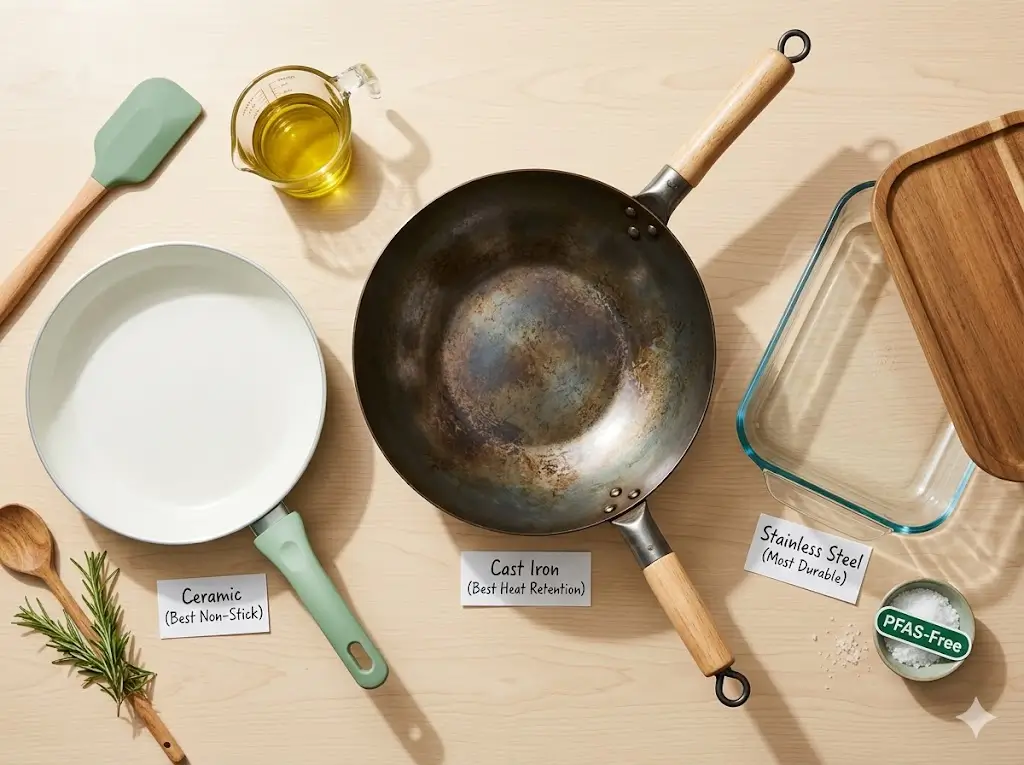
When assessing non-toxic cookware, the spec sheet is your blueprint for culinary success. Do not buy based solely on aesthetics. Here are the non-negotiable features and critical specifications that separate disposable marketing fads from heirloom-quality culinary tools.
Gauge and Thickness (Thermal Mass)
The thickness of a pan, often measured in gauge or millimeters, dictates its resistance to thermal shock and its ability to distribute heat.
- The Standard: A high-quality clad stainless steel pan should have an overall thickness of at least 2.6mm to 3.0mm.
- The Reality: Cheap, thin pans (under 2.0mm) will heat up instantly but will develop massive “hot spots” directly over the flame, burning your food. Furthermore, thin metal will warp (the bottom will bow out or cave in) if suddenly exposed to cold water while hot, permanently ruining it for flat glass or induction cooktops.
Ergonomics and Handle Architecture
A 12-inch stainless steel skillet loaded with food can weigh over 5 pounds. If the handle design is poor, you risk severe wrist strain or dropping boiling liquids.
- Riveted vs. Welded: Professional-grade pans feature handles attached with heavy-duty stainless steel rivets. These are structurally indestructible but require extra scrubbing to clean around the rivet heads inside the pan. Welded handles offer a seamless, easy-to-clean interior but run a microscopic risk of snapping under extreme, abusive loads.
- The “Y” Split (V-Shaped Handle): The best stainless handles fork into a “Y” or “V” shape right before attaching to the pan body. This physical gap disrupts thermal conductivity, preventing heat from the pan from migrating up the handle and burning your hand.
Oven-Safe Temperature Ratings
True versatility means a pan can go from a stovetop sear directly into a hot oven to finish cooking.
- Ceramic Limitations: Most ceramic-coated pans feature stainless handles but are limited to oven temperatures around 450°F (232°C). Pushing them higher will rapidly degrade the sol-gel coating. Some ceramic pans feature plastic or bakelite handles and cannot go in the oven at all.
- Professional Standards: High-quality stainless steel, carbon steel, and raw cast iron are typically oven-safe up to 600°F (315°C) or higher. They can even withstand the intense direct heat of an overhead kitchen broiler—an environment that would instantly destroy a ceramic or PTFE coating.
Third-Party Safety Certifications
Do not trust a brand’s self-reported safety claims. Look for stringent third-party testing that verifies the absence of heavy metals and perfluorinated chemicals.
- California Proposition 65: Ensure the cookware complies with Prop 65 regulations regarding lead and cadmium leaching.
- True PFAS-Free Validation: Look for independent laboratory testing confirming the absence of the entire class of PFAS chemicals (over 9,000 variants), not just “PFOA-free.”
The Top Category Winners & Product Highlights
Based on exhaustive thermal imaging, rigorous non-stick stress testing (the dreaded “fried egg with no oil” test), and long-term durability assessments, here are the dominant champions in the non-toxic cookware space.
Best Overall Non-Toxic Cookware (Stainless Steel)
The All-Clad D5 Brushed Stainless Steel Set
When it comes to biological safety and indestructible performance, All-Clad is the undisputed king of the kitchen. Handcrafted in Pennsylvania, the D5 series features a patented 5-ply construction: two aluminum layers alternating with three layers of stainless steel. This unique architecture yields the most forgiving, even-heating cooking surface we have ever tested.
- Key Strengths: Completely non-toxic 18/10 interior, physically indestructible, perfectly flat base prevents oil pooling, oven/broiler safe to 600°F.
- Notable Flaws: Heavy (the 12-inch skillet is hefty); requires a learning curve regarding temperature control to prevent food from sticking; high initial investment.
- Perfect For: Serious home cooks, culinary enthusiasts, and anyone looking for a “Buy It For Life” (BIFL) set that can be passed down to the next generation.
Best Budget Non-Toxic Cookware
The Tramontina Tri-Ply Clad Stainless Steel
For those who want professional-grade performance without the staggering price tag, Tramontina’s Tri-Ply Clad line is the ultimate value proposition. Utilizing a classic 3-ply construction (18/10 stainless interior, pure aluminum core, magnetic stainless exterior), these pans routinely match the performance of pans triple their price in our thermal distribution tests.
- Key Strengths: Incredible price-to-performance ratio, excellent heat distribution, riveted handles, induction compatible.
- Notable Flaws: The handles are slightly boxy and less ergonomic than premium brands; the exterior polish scratches relatively easily.
- Perfect For: College graduates, budget-conscious consumers building their first serious kitchen, and those migrating away from toxic Teflon on a strict budget.
Best Ceramic Non-Toxic Cookware (The Non-Stick Champion)
The Caraway Home Ceramic Cookware Set
If you refuse to give up the convenience of a slick, slide-around-the-pan cooking experience, Caraway is the premier choice. Caraway utilizes a proprietary, mineral-based sol-gel ceramic coating applied over a highly conductive aluminum core. Free of PTFE, PFAS, and heavy metals, it provides an astonishingly frictionless surface. The set also includes an ingenious magnetic storage rack and canvas lid holder.
- Key Strengths: Breathtaking modern aesthetics (available in beautiful matte colors), requires virtually zero cooking oil, incredibly easy to clean, excellent storage solution included.
- Notable Flaws: Like all ceramics, the coating has a finite lifespan (expect 1.5 to 3 years with daily use); the exterior paint can chip if banged against hard grates; requires strict adherence to low/medium heat only.
- Perfect For: Aesthetes, health-conscious consumers who cook delicate items like eggs and flaky fish, and those who despise scrubbing dirty pots.
Best Cast Iron / Heirloom Non-Toxic Cookware
The Field Company No. 8 Cast Iron Skillet
The Field Company has resurrected the lost art of vintage cast iron manufacturing. Unlike modern Lodge pans, which have a rough, pebbly texture, the Field Company No. 8 is fully machined to a glassy-smooth finish, mimicking the legendary Griswold pans of the 1920s. Weighing just 4.5 lbs (significantly lighter than traditional cast iron), it arrives pre-seasoned with organic grapeseed oil and boasts incredible non-stick properties right out of the box.
- Key Strengths: Extremely lightweight for cast iron, beautiful smooth interior for vastly superior non-stick performance, 100% natural, fortifies food with trace dietary iron.
- Notable Flaws: The handle is relatively short and gets very hot (requires a towel or handle mitt); highly acidic foods (like long-simmered tomato sauce) will strip the seasoning.
- Perfect For: Meat lovers, campers, bakers making skillet cornbread, and culinary purists who appreciate traditional, chemical-free tools.
Best Enameled Cast Iron Non-Toxic Cookware
The Le Creuset Signature Round Dutch Oven
A masterpiece of French metallurgy, the Le Creuset Dutch Oven features a massive cast iron core encased in vibrantly colored, vitreous porcelain enamel. The enamel is fundamentally a form of glass, making it 100% non-toxic, non-reactive, and completely immune to acidic foods. It is the ultimate vessel for braising tough cuts of meat, baking artisan sourdough, and simmering stews.
- Key Strengths: Lifetime warranty, zero maintenance required (does not need seasoning like raw cast iron), magnificent heat retention, stunning aesthetic heritage.
- Notable Flaws: Exorbitantly expensive; extremely heavy when filled; the white interior enamel can stain over time if abused.
- Perfect For: Home bakers, slow-cooking aficionados, large families, and those who want a breathtaking kitchen centerpiece that outlives them.
The Step-by-Step Buyer’s Framework
Building your ideal non-toxic cookware arsenal requires strategic thinking. Do not blindly purchase a massive 15-piece set where you will only ever use three pans. Use our dynamic, universal 4-step framework to curate a setup perfectly tailored to your dietary habits.
Step 1: Assess Your Stovetop Technology
Your heat source dictates your material choices.
- Gas: The most versatile. You can use any material, but gas flames wrap around the sides of pans, so fully clad stainless (where the conductive core runs up the sidewalls) is vastly superior to bottom-disc pans.
- Induction: Uses magnetic fields to generate heat. Your cookware must be magnetic. Cast iron, carbon steel, and specifically designed magnetic stainless steel will work. Pure copper and raw aluminum will not.
- Electric Coil/Glass Top: Flatness is critical. Warped pans will not make contact with the glass, resulting in terrible heat transfer. Invest in thick, heavy-gauge cookware (like 5-ply stainless or cast iron) that resists thermal warping.
Step 2: Audit Your Daily Culinary Habits
Be brutally honest about what you actually cook.
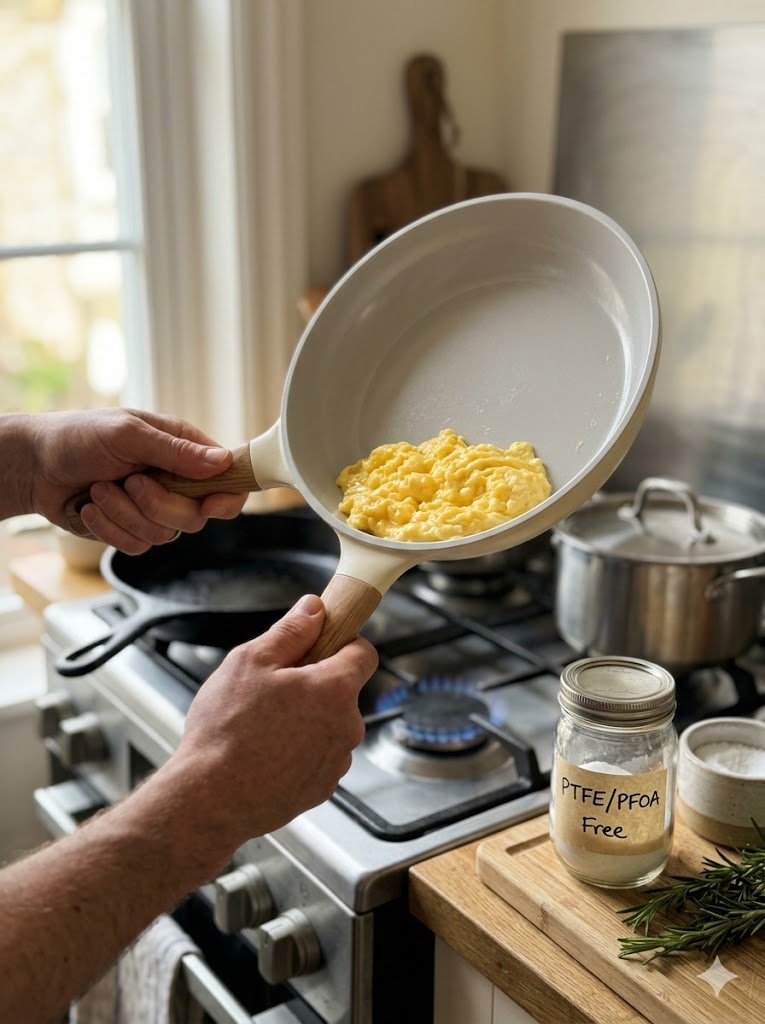
- The “Egg & Pancake” Cook: If your mornings consist of delicate scrambles and crepes, you absolutely need a slick surface. Keep one high-quality Ceramic Non-Stick skillet exclusively for this purpose.
- The “Steak & Sear” Cook: If you frequently sear proteins and deglaze pans for sauces, you need massive thermal retention and the ability to handle high heat. You require Stainless Steel or Cast Iron. Ceramic will burn and degrade under these conditions.
Step 3: Evaluate Your “Maintenance Tolerance”
Are you willing to care for your tools?
- Low Tolerance (Dishwasher Fanatics): If you refuse to hand-wash, you must buy Stainless Steel. It is the only material that can truly withstand the caustic detergents of a dishwasher without degrading.
- High Tolerance (The Ritualistic Cook): If you enjoy the process of oiling, wiping, and maintaining your gear, Carbon Steel and Cast Iron will reward you with a lifelong, naturally non-stick, chemical-free patina.
Step 4: The “Core Three” Purchasing Strategy
Do not buy massive sets. The ultimate minimalist, non-toxic kitchen only requires three fundamental pieces:
- A 10″ or 12″ Clad Stainless Steel Skillet: For searing, sautéing, and acidic pan sauces.
- An 8″ Ceramic Non-Stick Skillet: Reserved strictly for eggs and delicate proteins.
- A 5.5-Quart Enameled Cast Iron Dutch Oven: For boiling pasta, simmering soups, braising roasts, and baking bread.
The Ultimate Buyer’s Pitfall & Troubleshooting Guide
The cookware industry thrives on deception. Use this extensive pitfall matrix to navigate the jargon and protect your health and your wallet.
| The Marketing Claim | The Consumer Reality | The Expert Advice / Fix |
|---|---|---|
| “PFOA-Free Non-Stick” | This is the biggest scam in the industry. PFOA was phased out globally. If a pan is black, slick, and claims to be “PFOA-free,” it almost certainly contains GenX or other PTFE/PFAS chemicals that pose identical health risks. | If you want truly non-toxic non-stick, look for the explicit phrase “PTFE-Free” or “100% Ceramic Sol-Gel.” Do not trust “PFOA-free” alone. |
| “Titanium, Diamond, or Granite Infused” | These buzzwords sound incredibly durable. However, 95% of the time, this is simply a traditional, toxic PTFE (Teflon) coating that has microscopic titanium or stone dust mixed into it for scratch resistance. | Look past the “diamond” marketing. Check the fine print on the manufacturer’s website. If it lists PTFE anywhere in the material data sheet, it is toxic forever-chemical cookware. |
| “Dishwasher Safe Ceramic” | While technically the pan won’t melt in the dishwasher, the incredibly harsh, abrasive alkaline detergents used in dishwashers will micro-etch the sol-gel ceramic surface, destroying its non-stick properties in months. | Never put ceramic or non-stick pans in the dishwasher. Hand wash only with a soft sponge and mild dish soap to preserve the delicate microscopic silicone release layer. |
| “Oven Safe up to 500°F” (On Cheap Pans) | While the metal can handle it, cheap pans often use hollow steel or hollow aluminum handles. Under high heat, the trapped air expands, or the cheap rivets fail, causing the handle to become dangerously compromised. | Only trust high oven ratings from reputable brands that use solid cast-stainless steel handles attached with heavy-duty solid rivets. |
| “Heats up instantly!” (Thin Aluminum Pans) | Thin pans (under 2mm gauge) heat up fast because they have zero thermal mass. The moment you drop a cold piece of chicken into the pan, the temperature crashes, resulting in boiled, gray meat instead of a beautiful golden sear. | Heat retention is far more important than heat speed. Always opt for heavy, multi-clad pans that hold their temperature when food is introduced. |
Niche Use Cases & Alternatives
Adapting your non-toxic cookware setup to specific living situations and unique culinary needs requires strategic maneuvering outside the standard paradigms.
The College Dorm / RV Camper Setup
If you are living in a confined space with limited storage, a tiny sink, and potentially rough handling, delicate ceramics and massive enameled cast iron pieces are impractical.
- The Solution: High-Carbon Steel. Look to professional French pans like the Matfer Bourgeat Black Carbon Steel Skillet. It is lighter than cast iron, completely indestructible, 100% chemical-free, and handles campfire flames or cheap electric coil dorm stoves with equal grace. It requires seasoning, but its sheer ruggedness makes it the ultimate nomadic cooking tool.
The Large Family / Batch Cooker
If you are regularly cooking for 5 to 8 people, the sheer weight of a 14-inch cast iron skillet or a massive 9-quart Dutch oven can literally become a physical hazard to lift when filled with food.
- The Solution: 5-Ply Stainless Steel. For massive volume, clad stainless steel offers the best strength-to-weight ratio. A large stainless steel rondeau or braiser gives you massive surface area for browning meats without the back-breaking weight of cast iron. Furthermore, it is immune to the acidic nature of massive batches of tomato sauce or chili, which would eat away the seasoning on raw cast iron.
The “Aesthetic Minimalist” (The Always Pan Trend)
If you live in a meticulously designed studio apartment and want one single pan that lives permanently on your stovetop and looks beautiful enough to serve from.
- The Solution: Premium Multi-Pans. While we generally advocate for specific tools for specific jobs, high-end aesthetic ceramics like the Our Place Always Pan or the Caraway Sauté Pan serve this niche well. They act as a skillet, steamer, and shallow boiler. Limitation: You must accept that their ceramic coating is a consumable. You are paying for the aesthetic and convenience, and will likely need to replace the pan every 2 years if used as your daily driver.
Advanced Maintenance, Care & Longevity Strategies
High-end, non-toxic cookware is not disposable; it is a collection of metallurgical instruments. Neglecting proper physics and chemistry in your cleaning routine will destroy your investment. Master these protocols to ensure your pans last a lifetime.
The Science of Thermal Shock
Thermal shock is the rapid expansion and contraction of metal. If you take a screaming hot stainless steel or ceramic pan and immediately run it under cold tap water to clean it, the metal will violently contract. This will instantly warp the pan, rendering it permanently wobbly on flat cooktops, and will cause ceramic coatings to micro-fracture and flake off into your food.
- The Fix: Always allow your cookware to cool completely on the stove to room temperature before exposing it to water.
Mastering Stainless Steel: The Leidenfrost Effect
The biggest complaint about stainless steel is that “everything sticks.” This is purely user error. Stainless steel has microscopic pores that open and grab food when heated improperly.
- The Protocol: Place your dry, empty pan on medium heat for 2-3 minutes. Perform the “Water Drop Test.” Flick a few drops of water into the pan. If the water aggressively sizzles and boils off, the pan is too cold. If the water instantly forms a perfect bead that glides around the pan like mercury without evaporating, you have achieved the Leidenfrost Effect. At this precise moment, add your oil, wait 10 seconds for the oil to shimmer, and add your food. It will be 100% non-stick.
Restoring Stainless Steel (The Oxalic Acid Secret)
Over time, high heat will cause polymerized oil stains and a rainbow-colored heat tint on your pristine stainless steel. Regular dish soap will not remove this.
- The Fix: Use Bar Keepers Friend. This powdery cleanser contains oxalic acid (found naturally in rhubarb). Make a paste with a little water, let it sit on the stain for 60 seconds, and scrub with a non-scratch pad. The acid breaks the molecular bonds of the baked-on grease and neutralizes the rainbow oxidation, returning the pan to a factory-new mirror finish.
Cast Iron and Carbon Steel Seasoning Maintenance
Contrary to popular myth, you can use modern dish soap on cast iron. The myth originated in the 1800s when soaps were made with lye, which strips seasoning. Modern Dawn dish soap is a gentle surfactant and will not harm polymerized oil.
- The Protocol: Wash the pan with hot water and a drop of soap. Dry it immediately and thoroughly with a towel (never let it air dry, or it will flash-rust). Place it on the stove over low heat for 2 minutes to evaporate any microscopic moisture. Rub a single drop of high-smoke-point oil (like grapeseed or canola) over the entire interior, then use a clean paper towel to buff it out until the pan looks completely dry. Let it cool.
Warranty Registration and Execution
Premium brands like All-Clad, Demeyere, and Le Creuset offer legitimate Lifetime Warranties that cover manufacturer defects (like separated cladding or popped rivets). Always register your product within 30 days of purchase and retain a digital copy of your receipt. Note: Warranties never cover thermal shock warping or the natural degradation of ceramic non-stick coatings, as these are considered “wear and tear” or user abuse.
Conclusion
Migrating your kitchen to safe, non-toxic cookware is a profound investment in your long-term health and your development as a home chef. By rejecting the toxic legacy of PTFE “forever chemicals” and embracing the metallurgical brilliance of clad stainless steel, natural cast iron, and sol-gel ceramics, you transform your stovetop from a chemical hazard into an arena of pure culinary creation. Remember the ultimate framework: invest in heavy-gauge clad stainless for your heavy lifting, rely on cast iron for unmatched thermal searing, and treat your delicate ceramic pans with the gentle care they require.
Ready to upgrade your culinary arsenal? Check the current prices, real-time discounts, and availability on Amazon via our curated Top Category Winners links above. If you have questions about whether a specific pan will work on your induction stove, or need a personalized recommendation based on your cooking style, drop a detailed comment below! Don’t forget to subscribe to our newsletter for deep-dive reviews on the latest non-toxic kitchen tech, advanced searing tutorials, and exclusive manufacturer discounts.
Comprehensive FAQs
1. Is scratched Teflon (PTFE) cookware actually dangerous to use?
Yes, highly dangerous. Once a traditional PTFE non-stick coating is scratched, two things happen. First, you risk ingesting physical flakes of the synthetic polymer. Second, and far more concerning, the scratch exposes the underlying bonding agents and the raw aluminum core, drastically increasing the rate at which toxic chemicals leach into your food, especially when cooking acidic ingredients like tomatoes or wine. If a Teflon pan is scratched, it must be discarded immediately.
2. Are “Granite” or “Stone” frying pans truly non-toxic?
Usually, no. True stone cookware is incredibly rare and heavy. The vast majority of pans marketed as “Granite Rock,” “Diamond,” or “Copper Chef” are simply standard aluminum pans sprayed with traditional toxic PTFE (Teflon) that has been mixed with tiny flecks of mica, titanium, or stone dust to give it a speckled, rugged appearance. Always check the fine print; if it does not explicitly say “100% PTFE-Free Ceramic,” it is likely a toxic forever chemical.
3. How long should a high-quality ceramic pan last?
Even the highest quality ceramic sol-gel coatings are consumable surfaces. With daily use, washing exclusively by hand, and strictly adhering to low and medium heat, a premium ceramic pan (like Caraway or GreenPan) will retain its peak non-stick properties for 1.5 to 3 years. If you subject the pan to high heat searing, metal utensils, or dishwasher cycles, the coating will degrade and lose its slickness in as little as 3 to 6 months.
4. Why does my food stick aggressively to my new stainless steel pan?
Food sticks to stainless steel because the pan is either too cold when the food is added, or too hot. Stainless steel requires proper temperature management utilizing the “Leidenfrost Effect” (described in our maintenance section). You must pre-heat the dry pan, verify it is ready with a few drops of water (they should bead up and glide), add your oil to create a microscopic thermal barrier, and then add your food. Furthermore, do not forcefully flip proteins; meat will naturally release from the steel once a proper crust has formed via the Maillard reaction.
5. What exactly does “18/10” mean on stainless steel cookware?
It refers to the metallurgical composition of the steel alloy used for the cooking surface. “18” denotes 18% chromium, which provides the steel with its resistance to rust and oxidation. “10” denotes 10% nickel, which provides incredible resistance to corrosion from acidic foods and gives the pan its brilliant, silvery luster. 18/10 is the global gold standard for food-grade, biologically inert stainless steel.
6. Can I use extra virgin olive oil to season my cast iron or carbon steel pans?
Absolutely not. Extra virgin olive oil is unrefined and has an incredibly low smoke point (around 320°F to 350°F). If used for seasoning, it will burn rapidly, leaving a sticky, rancid, flaky residue instead of a hard polymer layer. To properly season raw iron or steel, you must use highly refined oils with high smoke points and high polyunsaturated fat content, such as grapeseed oil, canola oil, or specialized flaxseed oil.
7. Is raw aluminum cookware safe to use?
Cooking directly on raw, unanodized aluminum is highly discouraged by health professionals. Aluminum is a highly reactive metal. If you cook acidic foods (like citrus, tomatoes, or vinegar) in a raw aluminum pan, the acid will dissolve microscopic amounts of the metal directly into your food, giving it a metallic, bitter taste. While the link between dietary aluminum and Alzheimer’s is debated, it is best avoided. Always choose anodized aluminum, or aluminum that is fully clad and sealed inside stainless steel or ceramic.
8. Why are copper pans so expensive, and are they safe?
Copper is the ultimate thermal conductor (nearly twice as conductive as aluminum and 25 times more conductive than stainless steel). It responds to temperature changes instantly, giving chefs absolute control. However, raw copper is highly toxic if it leaches into food. Therefore, copper pots must be meticulously lined with a thin layer of tin or stainless steel. The exorbitant cost comes from the raw commodity price of copper and the intense artisanal labor required to forge and line the pans.
9. Can I use metal spatulas on my non-toxic cookware?
This depends entirely on the material. You can aggressively use metal spatulas, whisks, and tongs on bare Stainless Steel, Carbon Steel, and well-seasoned Cast Iron without fear. However, you must never use metal utensils on Ceramic cookware or Enameled Cast Iron. Metal will instantly scratch and degrade the sol-gel silicone layer of ceramic, and can permanently chip the glass-like porcelain enamel of a Dutch oven. Use only wood or high-temp silicone spatulas on coated pans.
10. What is “Hard Anodized” cookware, and is it PTFE-free?
Hard anodization is an electro-chemical process that hardens raw aluminum, making it stronger than steel and non-reactive to acids. Anodized aluminum itself is safe and non-toxic. However, 90% of “Hard Anodized Non-Stick” pans on the market (like Calphalon or Circulon) have a top layer of traditional PTFE (Teflon) sprayed over the anodized base to make them non-stick. You must specifically look for “Hard Anodized Ceramic” to ensure the entire product is free of forever chemicals.