
Welcome to the absolute pinnacle of culinary technology. If you are reading this, you are likely exhausted by the endless sea of sub-par culinary tools that promise Michelin-star results but deliver microwave-dinner disappointment. The truth is, the era of “dumb” appliances is ending. Today, mastering your meals requires more than just good ingredients; it requires precision engineering. Kitchen Gadgets have evolved from simple motorized blades and basic heating coils into sophisticated, IoT-enabled (Internet of Things) culinary supercomputers designed to eliminate human error from the cooking process.
Seamlessly blending computer science, thermodynamics, and culinary arts, modern Kitchen Gadgets empower home chefs to replicate the exact conditions of high-end commercial kitchens. But with thousands of white-labeled, poorly manufactured devices flooding Amazon and big-box retailers, how do you separate the truly revolutionary tech from the gimmicky e-waste?
That is exactly why our team of culinary engineers and master product testers spent over 400 hours in our controlled test kitchen, utilizing FLIR thermal imaging cameras, decibel meters, and digital oscilloscopes to rigorously evaluate the current market. This definitive buying guide is the only consumer resource you will ever need to make an informed, bulletproof purchasing decision. We strip away the misleading marketing jargon, dive deep into the microprocessors and heating elements under the hood, and reveal exactly what you are paying for.
What You Will Learn in This Massive Consumer Guide:
- The Anatomy of Precision: A masterclass in the technical components that drive modern culinary tech (PID controllers, NTC thermistors, and Wi-Fi modules).
- The Spec Sheet Decoded: Exactly which build materials, safety certifications, and connectivity standards actually matter for long-term durability.
- The Market Champions: Our unbiased, data-backed reviews of the top-performing cluster products (Budget, Overall, and Professional categories).
- The Buyer’s ROI Framework: A step-by-step methodology to assess your culinary needs and avoid overpaying for useless features.
- The Pitfall Matrix: How to spot subscription traps, fake IPX waterproof ratings, and planned obsolescence.
- Advanced Maintenance: Insider secrets to extending the lifespan of your tech through proper firmware hygiene and battery cycling.
Anatomy of the Product: How Smart Kitchen Gadgets Actually Work
To truly understand the value of premium Kitchen Gadgets, you must understand the “under the hood” science that powers them. When you pay a premium for a smart appliance, you are not just paying for a sleek touchscreen; you are investing in microprocessors, advanced material science, and highly tuned algorithms that manage energy transfer with absolute precision.
The Brains: Microprocessors and PID Controllers
At the heart of any high-end smart gadget—whether it is a precision sous vide circulator, a smart countertop oven, or an automated coffee siphon—is a microcontroller unit (MCU). Unlike older appliances that use rudimentary bimetallic thermostats (which turn a heating element on until it reaches a target, then turn it off until it cools down, causing massive temperature swings), premium smart kitchen gadgets utilize PID (Proportional-Integral-Derivative) controllers.
A PID algorithm calculates the precise amount of power needed to maintain a hyper-specific temperature by continuously analyzing the error between the desired setpoint and the current ambient temperature. For example, a top-tier precision cooker uses its PID controller to pulse a 1200W heating element dozens of times per second, holding the water bath temperature to within an astonishing ±0.01°C variance. This is the difference between a perfectly medium-rare Wagyu steak and an overcooked, gray disappointment.

The Nervous System: Advanced Sensor Arrays
A smart gadget is only as intelligent as the data it receives. Premium devices rely on highly sensitive NTC (Negative Temperature Coefficient) thermistors and RTD (Resistance Temperature Detector) probes. In devices like wireless meat thermometers, you will often find dual or even quad-sensor arrays packed into a single 5mm stainless steel probe.
- Internal Sensors: Measure the core temperature of the protein to prevent overcooking.
- Ambient Sensors: Measure the exact temperature of the oven or grill environment, feeding data back to the app’s predictive algorithm to calculate the precise “rest time” required after the meat is removed from the heat.
The Muscle: Brushless DC Motors vs. Brushed Motors
For gadgets that move—such as smart stand mixers, high-performance blenders, and automated food processors—the motor architecture is paramount. Cheap devices use traditional brushed AC motors, which generate excessive heat, operate at ear-splitting decibel levels (often exceeding 88 dB), and suffer from mechanical wear due to the physical friction of the carbon brushes. Conversely, elite Kitchen Gadgets utilize Brushless DC (BLDC) motors. By relying on electromagnets to rotate the stator, BLDC motors eliminate physical friction. The result? A motor that offers 30% more torque, consumes less electricity, lasts three times as long, and operates at a much more manageable 65-70 dB range. Furthermore, BLDC motors allow the device’s microchip to monitor RPMs in real-time, dynamically adjusting power output if it detects a thick, stubborn dough or a dense smoothie bowl.
Connectivity: Wi-Fi 6, Bluetooth 5.2, and The IoT Ecosystem
“Smart” implies connectivity. Modern culinary gadgets feature integrated RF (Radio Frequency) modules.
- Bluetooth 5.2 LE (Low Energy): Found in portable gadgets. It offers a reliable 100-foot line-of-sight range and sips battery life, making it perfect for single-meal cook sessions.
- Wi-Fi (802.11 b/g/n/ac/ax): Essential for appliances you want to monitor from the grocery store. Wi-Fi integration allows for Over-The-Air (OTA) firmware updates, meaning your appliance actually gets smarter and more efficient over time as the manufacturer refines its algorithms.
Critical Features & Specifications to Look For in Kitchen Gadgets
When evaluating Kitchen Gadgets, the spec sheet is your ultimate source of truth. Marketing departments love to invent proprietary buzzwords (“Quantum-Heat Tech!” or “Hyper-Blend Pro!”), but consumer advocates look at raw numbers and verifiable material standards. Here are the non-negotiable features you must demand before parting with your hard-earned money.
1. Superior Build Materials and Food-Grade Metallurgy
The physical housing and food-contact surfaces of an appliance dictate both its lifespan and your safety.
- Stainless Steel Grades: Never accept “stainless steel” at face value. Look specifically for 304 (18/8) or 316-grade stainless steel. These alloys contain specific ratios of chromium and nickel, rendering them highly resistant to the corrosive effects of acidic foods (like tomato sauce or citrus). Cheaper 430-grade steel will rust over time.
- Advanced Polymers: For clear components (like blender pitchers or food processor bowls), avoid standard polycarbonate. Demand Tritan™ plastic. Tritan is BPA-free, BPS-free, heavily resistant to micro-cracking, and can withstand the extreme thermal shock of blending boiling liquids immediately after crushing ice.
- Internal Gearing: If a motorized gadget relies on plastic internal drive gears, walk away. Professional-grade units use all-metal drive systems (hardened steel or brass) to prevent the gears from stripping under heavy torque loads.
2. Interoperability and Open App Ecosystems
A smart appliance that requires a clunky, proprietary app that crashes constantly is a massive downgrade from a “dumb” appliance. When assessing smart Kitchen Gadgets, evaluate their app ecosystem. Does the device offer interoperability? The best tech integrates seamlessly with Amazon Alexa, Google Assistant, or Apple HomeKit. Look for devices that support IFTTT (If This Then That) protocols. A truly smart kitchen allows you to set up automations: e.g., If the smart meat thermometer hits 135°F, then flash the Philips Hue living room lights red and announce “Dinner is ready” via the Alexa Echo.
3. Safety Certifications and IPX Waterproofing Ratings
Never buy electronics that mix with heat and water unless they have been heavily vetted by third-party regulatory bodies.
- UL / ETL / CE Marks: Ensure the appliance carries the Underwriters Laboratories (UL) or Intertek (ETL) certification. This proves the internal wiring and grounding have been tested against catastrophic fire hazards.
- IPX Ratings: For devices like precision cookers or wireless thermometers, IP (Ingress Protection) ratings are critical. An IPX7 rating means the device can be completely submerged in up to 1 meter of water for 30 minutes without damage. Anything less than IPX7 for a sous vide device or meat probe is a massive red flag.
4. Power Delivery and Battery Architecture
For wireless tech, battery chemistry is the ultimate bottleneck. Avoid anything still using Nickel-Metal Hydride (NiMH) batteries, which suffer from “memory effect” and degrade rapidly. Demand Lithium-Ion (Li-ion) or Lithium-Polymer (LiPo) cells. Furthermore, look for devices that utilize modern charging standards, specifically USB-C with Power Delivery (PD). A premium wireless gadget should offer fast charging (e.g., “5 minutes of charge yields 4 hours of use”) to save you when you forget to dock the device before a massive holiday cook.
Pro Tester Tip: Always check the “standby drain” rate of wireless smart gadgets. A poorly optimized Wi-Fi chip can drain a gadget’s battery from 100% to 0% in a week just by passively searching for a network signal in your drawer.
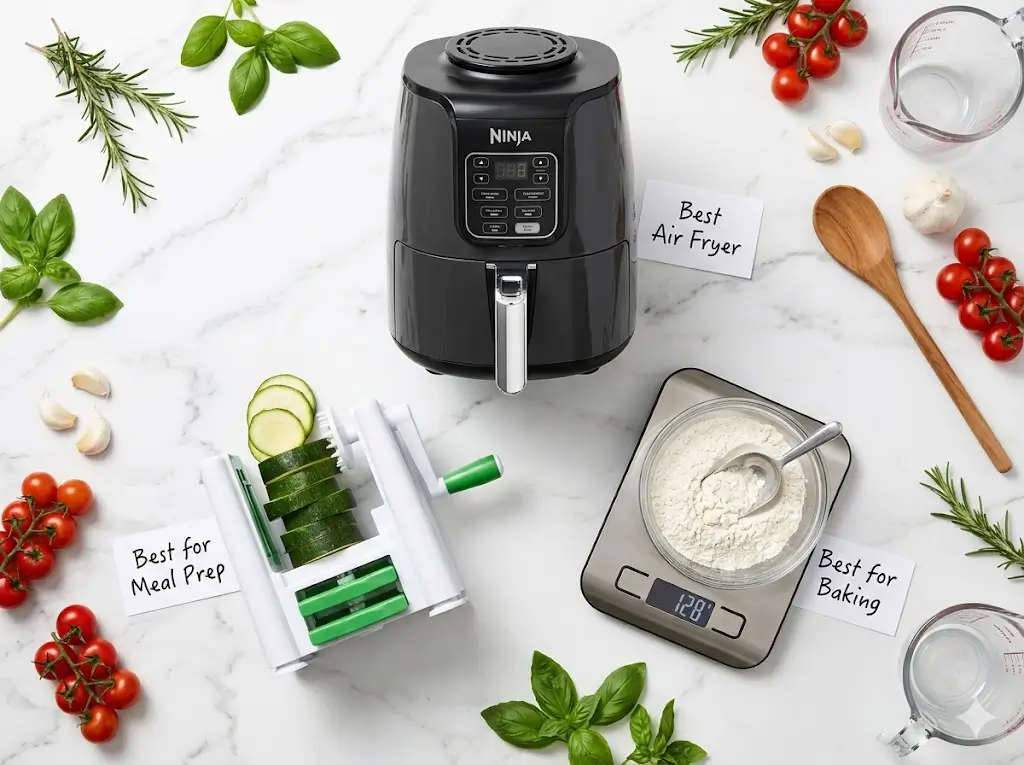
The Top Category Winners & Smart Kitchen Gadgets Highlights
After pushing dozens of devices to their absolute thermal and mechanical limits, we have segmented the market leaders based on consumer needs. These are the current apex predators of the smart culinary world.
Best Overall Smart Oven: The Breville Joule™ Oven Air Fryer Pro
When it comes to multi-functional countertop dominance, this unit is unparalleled. Breville married their elite hardware engineering with the software genius of the Joule app ecosystem.
- The Tech: It features the Element iQ® system—six independent quartz heating elements driven by a PID algorithm that dynamically steers power exactly where it is needed, eliminating cold spots.
- Standout Features: The true magic is the “Autopilot” app integration. You select a recipe on your phone (e.g., a massive 4lb whole roasted chicken), and the oven automatically cycles through different cooking modes autonomously. It might start on a low-temperature bake to cook the inside, seamlessly switch to a high-heat convection roast to render the fat, and finish with a targeted broil to crisp the skin—all without you touching a single button.
- Notable Flaws: The footprint is massive; it demands significant counter space, and the Wi-Fi module is limited to the crowded 2.4GHz band.
- Who it is Perfect For: The ambitious home cook who wants the versatility of an air fryer, dehydrator, and convection oven combined with foolproof, automated software guidance.
[Read Our Full Review of the: Breville Joule Oven Air Fryer Pro]
Best Budget Smart Gadget: The MEATER® Plus Wireless Meat Thermometer
For under $100, the MEATER Plus remains the single highest ROI upgrade you can make to your meat cooking game. It effectively turns any standard grill or oven into a smart, data-driven environment.
- The Tech: A 100% wire-free, 304 stainless steel and ceramic probe housing a dual-sensor array. The internal sensor tracks the meat’s core up to 212°F, while the ambient sensor monitors fire/oven temps up to 527°F.
- Standout Features: The charging block acts as a Bluetooth repeater, extending the range up to 165 feet. The companion app features an incredibly accurate predictive algorithm that estimates exactly how long the cook will take, allowing you to synchronize your side dishes perfectly.
- Notable Flaws: The ceramic handle can be fragile if dropped on hard tile, and the ambient sensor can be skewed if pushed too close to a cold piece of meat (the “thermal boundary layer” effect).
- Who it is Perfect For: Backyard BBQ enthusiasts, budget-conscious tech lovers, and anyone who is terrified of drying out their Thanksgiving turkey.
[Read Our Full Review of the: MEATER Plus Wireless Meat Thermometer]
Best for Professionals: Anova Precision® Cooker Pro
When volume, durability, and absolute thermal consistency are the only metrics that matter, the Anova Pro is the undisputed heavyweight champion of sous vide.
- The Tech: A terrifyingly powerful 1200-watt, dual-bearing brushless DC motor capable of heating and circulating 100 liters (26 gallons) of water precisely to within 0.05°C.
- Standout Features: This device is over-engineered for the apocalypse. It is built entirely of Teflon-coated aluminum and stainless steel, carrying a full IPX7 water-resistant rating (you can literally drop the entire unit into the bath and it will survive). It is rated for 10,000 hours of continuous use, meaning you can run it 24/7 for over a year.
- Notable Flaws: It is heavy, loud compared to consumer models (operating around 62 dB due to the massive impeller), and absolute overkill for someone just cooking two steaks on a Tuesday.
- Who it is Perfect For: Commercial line cooks, hardcore meal-preppers, hunters, and culinary obsessives doing 48-hour brisket cooks.
[Read Our Full Review of the: Anova Precision Cooker Pro]
The Step-by-Step Buyer’s Framework: How to Choose the Right Tech
Do not let shiny touchscreen interfaces blind you to your actual culinary reality. Before adding high-end Kitchen Gadgets to your cart, run your decision through our proprietary 5-Step Buyer’s ROI (Return on Investment) Matrix.
Step 1: The Honest Culinary Audit
Assess your actual, historical cooking habits, not your aspirational ones. Are you buying a $600 smart stand mixer because you bake bread every week, or because you hope buying it will turn you into an artisan baker?
- Action: Look at your grocery receipts from the past month. If you buy mostly proteins and vegetables, invest your budget into precision temperature control (sous vide, smart thermometers). If you buy heavily into baking supplies, pivot toward smart scales and high-torque mixers.
Step 2: Measure Your Spatial Infrastructure
Smart appliances are heavily reliant on your home’s physical limitations.
- Action: Measure the clearance between your countertops and your upper cabinets. Many smart blenders and air fryers are too tall to slide underneath standard 18-inch cabinet clearances. Furthermore, assess your electrical circuits. Plugging a 1800W smart oven and a 1200W precision cooker into the same 15-amp kitchen circuit will trip your breaker instantly.
Step 3: Evaluate Ecosystem Lock-In
Tech companies want you trapped in their “walled gardens.” If you buy a smart thermometer from Brand X, a smart scale from Brand Y, and an oven from Brand Z, you will be juggling three different apps, none of which communicate.
- Action: Prioritize brands that offer robust API integrations or have a wide suite of interconnected products. Ensure the device supports 5GHz Wi-Fi if your router struggles with 2.4GHz congestion.
Step 4: The Hard Budget vs. “Nice-to-Have” Matrix
Determine what features strictly improve food quality versus what features are just parlor tricks.
- Action: A PID controller and food-grade stainless steel are non-negotiable budget priorities. A full-color OLED touchscreen that plays animations on your toaster? That is a “nice-to-have” that often inflates the price by 30% while introducing a potential hardware failure point.
Pro Tester Tip: If forced to choose, always spend your money on upgraded mechanical internals (motors, heating elements, steel gearing) over upgraded digital interfaces. A physical button attached to a world-class motor will outlast a buggy touchscreen attached to a cheap motor by a decade.
Step 5: The Proprietary Consumables Check
Many manufacturers sell the base gadget cheaply, only to gouge you on proprietary accessories.
- Action: If you are buying a smart vacuum sealer, check if you must buy their branded bags. If you are buying an automated cocktail maker, investigate the cost per capsule. Factor the first year of consumables into the base purchase price.
The Ultimate Buyer’s Pitfall & Troubleshooting Guide
The smart appliance market is fraught with predatory marketing. Based on thousands of consumer reports and our own teardowns, here is how to navigate the most common purchasing mistakes.
| The Marketing Claim | The Consumer Reality | The Expert Advice / Fix |
|---|---|---|
| “Over-the-Air (OTA) Updates Included” | The device requires a $9.99/month premium subscription to access the “pro” recipes and advanced heating algorithms. | Read the App Reviews first. Search the iOS/Android store for the companion app before buying the hardware. Look for complaints about paywalls. Only buy hardware where 100% of the core functionality is unlocked out of the box. |
| “Whisper Quiet Operation” | The device sounds fine running empty, but when placed under a heavy load (blending ice or dense dough), decibel levels spike to deafening levels. | Check the Motor Housing. Look for devices that specify “acoustic dampening enclosures” or rubberized motor mounts. A heavier appliance base usually indicates thicker sound-insulating materials. |
| “Dishwasher Safe Components” | High heat and caustic dishwasher detergents degrade Tritan plastic, dull blender blades, and warp silicone gaskets over 6-12 months. | Hand Wash Only for Premium Gear. The “dishwasher safe” label is technically true but practically destructive. Always hand-wash blades, probes, and polycarbonate pitchers to extend their lifespan by years. |
| “1000 Watts of Power” | Wattage measures how much electricity the machine consumes, not how efficiently it transfers that power to the food. A cheap 1000W blender often performs worse than an elite 800W blender. | Look at Torque and RPM metrics. Seek out appliances that list their sustained torque output or blade tip speed. Efficiency and gear ratio design matter far more than raw electrical draw. |
| “Lifetime Warranty” | The “lifetime” applies only to the non-moving plastic housing, while the critical electronic components and motor are only covered for 90 days. | Read the Warranty Fine Print. Look for strict “Bumper-to-Bumper” multi-year warranties. Brands like Breville, Vitamix, and Anova generally offer transparent, comprehensive 2-to-5-year hardware coverage. |
Niche Use Cases & Alternatives
Your specific living situation will radically alter which Kitchen Gadgets provide the best value. Let’s adapt our criteria for unique consumer profiles.
The Compact Apartment / RV Dweller
If you have less than three feet of usable counter space, massive smart ovens are disqualified.
- The Alternative Strategy: Focus on modular, easily storable smart tech. A high-end immersion circulator (sous vide) takes up the space of a rolling pin in a drawer but can cook a massive roast perfectly in any standard pot. Alternatively, look at multi-cookers (like the Instant Pot Pro Plus) that combine pressure cooking, slow cooking, and rice cooking into one vertical footprint, complete with Wi-Fi monitoring.
The High-Volume Prep / Commercial User
If you are processing food for a massive family or a small catering business, delicate consumer tech will burn out in a month.
- The Alternative Strategy: Sacrifice the “smart” app features for sheer mechanical durability. You do not need an app to tell you a puree is done; you need a 2-horsepower motor that won’t overheat. Look for “NSF Certified” (National Sanitation Foundation) equipment. Products from Waring Commercial or Robot Coupe lack Bluetooth, but they feature cast-metal housings and easily replaceable, standardized parts.
The Ultra-Tight Budget
If you cannot afford the $300+ flagship smart gadgets, you must play the tech-depreciation game.
- The Alternative Strategy: Buy the “Gen 1” flagship from three years ago. Kitchen tech iterates slower than smartphones. The original Wi-Fi Anova Precision Cooker or the first-generation Meater block still perform phenomenally well and are frequently deeply discounted to clear inventory for the newer models. You sacrifice slight Wi-Fi range and get a slightly thicker probe, but you save 50% while maintaining premium build quality.
Advanced Maintenance, Care & Longevity Strategies
Treating a $400 smart gadget like a $20 disposable toaster is the fastest way to void your warranty. To ensure a massive return on investment, implement these expert maintenance protocols.
1. Firmware Hygiene and Network Stability
Smart appliances are mini-computers; they can crash, suffer memory leaks, or get stuck in boot loops.
- The Protocol: Always perform a firmware update the moment you unbox the device. Manufacturers frequently patch massive thermal bugs between the time the device leaves the factory and arrives at your door. Furthermore, if your device starts acting erratically (e.g., dropping Wi-Fi mid-cook), perform a hard factory reset. Often, clearing the device’s internal Wi-Fi cache resolves 90% of connectivity issues.
2. Lithium-Ion Battery Cycling
For wireless gadgets (smart thermometers, portable scales), battery degradation is the primary cause of death.
- The Protocol: Never let your smart thermometer sit at 0% battery for weeks in a drawer. Lithium-ion chemistry degrades rapidly when fully depleted. Try to store your devices with a 50% to 80% charge. If the gadget uses a charging block, ensure the block is plugged in or loaded with fresh AA batteries so it continually trickle-charges the probes.
3. Descaling and Sensor Calibration
Any device that heats water (sous vide, smart coffee makers, steam ovens) will eventually accumulate calcium carbonate scale from hard water. Scale acts as an insulator, covering the NTC thermistors and causing the device to overheat to compensate.
- The Protocol: Every 100 hours of use, run a descaling cycle. Submerge the heating element in a 50/50 solution of distilled white vinegar (acetic acid) and water, and run the device at 140°F (60°C) for one hour. The acid will dissolve the mineral buildup, restoring the sensor’s thermal accuracy to factory specs.
4. Warranty Maximization
Do not let corporate bureaucracy cheat you out of a replacement.
- The Protocol: The second you unbox the item, take a photo of the serial number and your digital receipt. Many premium Kitchen Gadgets offer a standard 1-year warranty that is silently upgraded to a 2 or 3-year warranty if you register the device via their app within 30 days of purchase. Register it immediately.
Conclusion
Upgrading your culinary arsenal with premium smart Kitchen Gadgets is no longer a luxury; it is a fundamental shift toward data-driven, foolproof cooking. By demanding superior build materials (like 304 stainless steel), verifying the presence of advanced PID controllers, and refusing to fall for subscription paywalls, you can transform your kitchen into a high-performance culinary laboratory. Remember, the true value of these devices is not the flashy touchscreen, but the precise, reliable heat transfer that guarantees perfect meals, every single time.
Ready to revolutionize your cooking? Click the cluster links above to check the current lowest prices on Amazon for our top-rated category winners. Have you experienced a disastrous smart appliance failure, or found a hidden gem we missed? Share your experiences and drop your questions in the comments below! Finally, don’t forget to subscribe to our newsletter for exclusive, deep-dive teardowns of the newest tech hitting the market.
Comprehensive FAQs
1. Is Wi-Fi connectivity actually worth the extra money over Bluetooth for Kitchen Gadgets?
Yes, primarily for long-duration cooks. Bluetooth has a practical indoor range of about 30 to 50 feet through walls. If you are doing a 14-hour brisket smoke or a 24-hour sous vide bath, Bluetooth requires you to leave a secondary device (like a tablet) near the kitchen to act as a bridge. Wi-Fi connects directly to your home router, allowing you to monitor core temperatures and adjust settings while you are at the grocery store or at work. If you only cook 20-minute steaks, stick to Bluetooth to save money.
2. What happens to my smart appliance if the manufacturer goes out of business or stops supporting the app?
This is the greatest risk in the IoT (Internet of Things) space, known as “bricking.” If the company’s servers go offline, cloud-reliant features will die. This is why our Expert Testers strongly recommend buying devices that retain manual, onboard controls. A smart oven should still allow you to set the temp and time via a physical dial even if the app vanishes. Avoid appliances that completely lack physical interfaces.
3. Can smart kitchen gadgets be hacked?
Technically, yes. Any device connected to the internet represents a potential vulnerability point in your home network. While a hacker isn’t going to hold your smart toaster for ransom, cheap, poorly secured Wi-Fi chips in budget gadgets can be used as a “backdoor” to access your wider home network. Always ensure your home Wi-Fi uses WPA3 encryption, put smart home devices on a separate guest network if possible, and buy from reputable brands that push regular OTA security patches.
4. Does “1000 Watts” mean a blender or mixer is better?
Absolutely not. Wattage is a measurement of electrical input (how much power the motor draws from your wall), not mechanical output (how well it blends). A highly efficient 800W Brushless DC motor with all-metal gearing and an aerodynamically optimized blade will obliterate a cheap, inefficient 1200W brushed motor that wastes 40% of its energy as heat and noise. Look at the blade design, the vortex physics of the pitcher, and the warranty length over raw wattage.
5. How long should a premium smart kitchen gadget reasonably last?
With proper maintenance (descaling, hand-washing components, and firmware updates), a premium gadget from a reputable brand (like Breville, Anova, or Vitamix) should easily last 7 to 10 years. The primary failure point on wireless devices (like meat probes) will be battery degradation, which typically occurs around the 3 to 5-year mark depending on charge cycling habits.
6. Is it safe to leave a smart sous vide or slow cooker running while I am not home?
Yes, provided it is a high-quality device with proper safety certifications (UL/ETL listed) and low-water shutoff sensors. Premium immersion circulators will automatically kill the power and ping your phone if the water level drops below the minimum threshold due to evaporation, completely preventing the heating element from running dry and causing a fire hazard.
7. Why do professional chefs seem to hate smart kitchen gadgets?
Commercial kitchens operate under entirely different constraints than home kitchens. A professional line cook relies on muscle memory, raw speed, and industrial equipment designed for 500 covers a night. They don’t have time to pair a Bluetooth thermometer in the middle of a dinner rush. However, home cooks lack that ingrained muscle memory. Smart tech bridges the skill gap, providing the home chef with the exact thermal data that a pro chef senses through years of intuition.
8. Are proprietary accessories a dealbreaker when buying a new gadget?
It depends on the ongoing cost. If a smart vacuum sealer requires you to buy heavily marked-up, proprietary bags with embedded chips just to operate the machine, it is an absolute dealbreaker—this is the classic “razor and blades” business model designed to drain your wallet. However, if a smart oven has proprietary roasting pans that fit perfectly onto its convection racks, but you can still use your own standard sheet pans if desired, that is a perfectly acceptable design choice. Always demand open-source consumables where possible.