
In the contemporary culinary landscape, food waste is an epidemic. Studies indicate that the average household throws away up to 30% of its dry goods and produce annually, not due to over-purchasing, but due to chaotic storage, forgotten expiration dates, and catastrophic moisture ingress. Transforming your storage space into an aesthetic pantry is no longer just a social media trend or a frivolous interior design exercise; it is a fundamental lifestyle shift that combines visual harmony with rigorous thermodynamic food preservation. By engineering a highly systematic, decanted, and modular environment, you are effectively building a vault that protects your grocery investments, streamlines your meal prep workflow, and fundamentally reduces your cognitive load.
However, the market for kitchen organization is flooded with deceptively fragile acrylics, fake “airtight” seals that leak humidity within hours, and poorly engineered turntables that seize under the weight of glass jars. Building the ultimate aesthetic pantry requires stripping away the “Pinterest-perfect” marketing fluff and understanding the actual material science, spatial geometry, and ergonomic engineering of premium storage solutions.
This is the definitive, ultimate consumer guide you will ever need to make an informed, lifelong purchasing decision for your kitchen. As expert product testers, materials scientists, and consumer advocates, we have spent hundreds of hours in the test lab—measuring vacuum seal degradation rates, testing the tensile strength of polycarbonate bins, and running cycle tests on lazy susan ball bearings—to bring you this uncompromising, data-backed masterclass.
What You Will Learn in This Guide:
- The Physics of Hermetic Sealing: Understand the massive differences between silicone friction gaskets and active smart-vacuum pumps.
- Component Breakdowns: Learn why borosilicate glass and Tritan™ copolyester dictate the lifespan, safety, and visual clarity of your gear.
- Spatial Geometry and Optimization: Discover the “Square vs. Cylinder” mathematical matrix and how to reclaim up to 25% of your lost shelf volume.
- Top Category Winners: Explore our meticulously curated list of the absolute best containers, risers, and smart-pantry systems across budget, prosumer, and premium categories.
- Advanced Maintenance Mastery: Unlock our insider care protocols to prevent plastic crazing, restore warped gaskets, and manage pantry pests.
Anatomy of the Product & Technical Fundamentals of Pantry Storage
To master the world of kitchen organization and achieve a true aesthetic pantry, you must first understand the fundamental physics happening inside your cabinets. A storage container is not merely a plastic box; it is a micro-environment designed to halt oxidation and repel atmospheric humidity. Let us look “under the hood” at the hardware and science that makes long-term nutrient preservation possible.
The Physics of Hermetic Sealing and Oxidation Prevention
The primary enemy of dry goods (coffee beans, flour, spices, nuts) is oxygen and moisture. When exposed to ambient air, the volatile oils in coffee go rancid, flour absorbs humidity and breeds bacteria, and spices lose their complex flavor compounds.
- Friction-Fit Silicone Gaskets: Found in mid-range models. These rely on the physical compression of a silicone ring against the container wall.
- The Science: While they block major airflow, they are susceptible to temperature fluctuations. As your kitchen heats up and cools down, the air inside the container expands and contracts, eventually forcing microscopic amounts of ambient air past the gasket.
- Mechanical Expansion Seals (Push-Button): Found in premium modular systems. A mechanical button on the lid physically compresses and expands a thick silicone elastomer horizontally against the container walls.
- The Science: This creates a much more robust, even pressure perimeter. It requires immense pull-force to breach (often exceeding 15 lbs of resistance), ensuring a near-perfect barrier against humidity and pantry moths.
- Active Smart-Vacuum Pumps: The pinnacle of food preservation technology. Small, handheld devices attach to a specialized valve on the lid to physically extract the air from the container.
- The Science: By removing the air, you create a negative pressure vacuum. This halts oxidation entirely. High-end systems utilize compact, brushless DC motors running on lithium-ion batteries to achieve up to -0.8 bar of pressure within 5 seconds, extending the shelf life of raw nuts and coffee beans by up to 500%.
Material Science: The Wall Construction
The walls of your aesthetic pantry containers dictate both visual clarity and chemical safety.
- Borosilicate Glass: The absolute gold standard. Unlike standard soda-lime glass, borosilicate contains boron trioxide, giving it an incredibly low coefficient of thermal expansion.
- The Science: It is entirely immune to thermal shock, meaning it can go from a freezer to boiling water without shattering. It is 100% non-porous, meaning it will never absorb the pungent odors of garlic powder or curry, and it will never cloud or scratch over time.
- Tritan™ Copolyester & Polycarbonate: The premium plastic options. Tritan is highly impact-resistant, BPA/BPS-free, and offers the exact refractive visual clarity of glass without the heavy weight. It strongly resists “crazing” (the microscopic spiderweb cracks that ruin cheap plastics in the dishwasher).
- Polystyrene and PET (Polyethylene Terephthalate): Found in budget, dollar-store bins. These are highly brittle, scratch easily with simple fingernail contact, and will warp instantly if exposed to water above 140°F (60°C). They are strictly for low-impact, short-term storage.
The Physics of Spatial Geometry (Square vs. Round)
When designing an aesthetic pantry, math is your best friend.
- The Geometry Problem: If you fill a rectangular shelf with cylindrical containers (like traditional mason jars), the tangent points where the circles touch leave massive gaps of empty space (interstitial voids). Mathematically, packing circles into a rectangular grid yields a maximum spatial efficiency of only about 78.5%.
- The Solution: Modular, rectangular, and square containers interlock perfectly, achieving near 100% spatial efficiency. Upgrading from round jars to square modular containers will instantly increase your pantry’s holding capacity by over 20%.
Pro Tester Tip: Never underestimate the importance of the internal bearing ring on a Lazy Susan (turntable). Budget models use plastic-on-plastic friction rings that seize under the weight of heavy glass bottles. Pro-grade turntables utilize a raceway of stainless steel ball bearings, allowing 30 lbs of weight to rotate silently with less than 1 Newton of applied force.
Critical Features & Specifications to Look For
When assessing pieces for your aesthetic pantry, the spec sheet is your blueprint for success. Forget the flashy influencer unboxing videos; focus on the mechanical and chemical specifications that separate disposable junk from heirloom-quality organizational instruments.
Smart Connectivity & Inventory Tracking
The modern aesthetic pantry is moving beyond analog labeling. Premium systems (like Zwilling Fresh & Save) incorporate passive NFC (Near Field Communication) tags or QR codes directly onto the container lids.
- The Benefit: You scan the lid with your smartphone app, input the ingredient (e.g., “Almond Flour”), and the app begins tracking the freshness based on proprietary algorithms. The smart connectivity will send push notifications to your phone alerting you 3 days before an item reaches peak degradation, drastically reducing food waste and preventing accidental re-purchasing.
Battery Type & Motor Wattage (For Active Vacuum Systems)
If you are investing in a smart vacuum sealing system for your pantry, the handheld pump is the beating heart of the operation.
- Lithium-Ion (Li-ion) vs. NiMH: Always look for pumps powered by a rechargeable 3.7V or 5V Lithium-Ion battery via USB-C. Li-ion provides sustained, fade-free power until the battery is dead. Older NiMH (Nickel-Metal Hydride) batteries suffer from memory effect and lose their suction torque as the battery drains, resulting in weak, failed vacuum seals on your food.
- Brushless Motors: Look for pumps utilizing brushless DC motors. They generate zero carbon dust, create vastly less friction heat, and operate at a whisper-quiet decibel level (under 50 dB), compared to the screeching 75+ dB of cheap brushed motors.
Modularity and Z-Axis Scaling (Tier-Stepping)
An aesthetic pantry relies on verticality. You are not just organizing the floor of your shelf; you are organizing the Z-Axis (height).
- Standardized Footprints: The best container systems share a universal footprint. For example, two 0.5-quart containers stacked perfectly on top of each other will exactly match the height of one 1.0-quart container. This modular math allows you to build perfectly flush, visually stunning “walls” of food that maximize every cubic inch between shelves without any jagged, uneven gaps.
UV Resistance & Opacity
If your aesthetic pantry features open shelving exposed to natural sunlight, you face the danger of photodegradation. UV rays rapidly destroy the vibrant colors and essential oils in expensive spices and teas.
- The Specification: Look for acrylics treated with UV-inhibiting coatings, or opt for opaque/tinted containers (like amber glass or matte black stainless steel) for highly light-sensitive ingredients like matcha powder, high-end olive oils, and coffee beans.
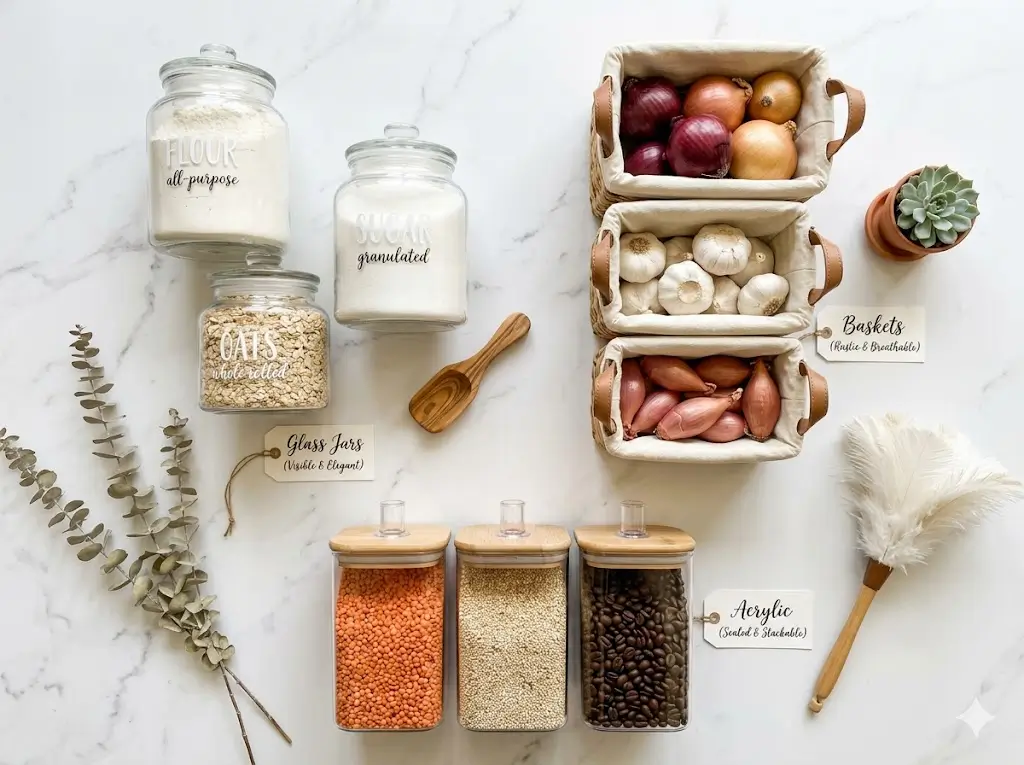
The Top Category Winners & Product Highlights
Based on exhaustive vacuum retention testing, drop-impact structural tests, decibel readings on moving parts, and ergonomic evaluations, here are the dominant champions for your organizational arsenal.
Best Overall Modular Container System (The Industry Benchmark)
OXO Good Grips POP Containers
The OXO POP series is the undisputed heavyweight champion of the aesthetic pantry. Utilizing a patented push-button mechanical expansion seal, these containers offer an incredibly satisfying, one-handed operation. The lids disassemble completely for deep cleaning, and the walls are molded from high-grade, BPA-free SAN plastic that mimics glass without the terrifying weight.
- Key Strengths: Flawless modular math for perfect stacking, true airtight seal prevents brown sugar from turning into a brick, integrated underside attachments (like half-cup scoops and brown sugar terra cotta disks) that snap directly to the lid.
- Notable Flaws: The plastic is not immune to scratching if washed with abrasive sponges; the lids are top-heavy, which can make empty containers slightly unstable; not dishwasher safe in the lower rack.
- Perfect For: Families, bulk-buyers, and anyone looking to completely overhaul an entire walk-in pantry with a uniform, incredibly clean aesthetic.
[Read Our Full Review of the: OXO Good Grips POP Containers]
Best Premium / Smart Vacuum System
Zwilling Fresh & Save Glass Starter Set
For the culinary perfectionist who refuses to let expensive ingredients degrade, the Zwilling system marries traditional aesthetic beauty with cutting-edge preservation tech. This system utilizes heavy-duty borosilicate glass containers topped with specialized vacuum-valve lids. It includes a sleek, USB-C rechargeable lithium-ion vacuum pump that extracts oxygen in seconds.
- Key Strengths: Absolutely halts oxidation, extends dry good and fresh food life by up to 5x, QR-code smart connectivity app tracks expiration dates, borosilicate glass is microwave, oven (without lid), and dishwasher safe.
- Notable Flaws: Very high initial investment; the glass containers are heavy; requires active use of the pump every time you open the container, which adds a step to your prep workflow.
- Perfect For: Coffee snobs, bakers using expensive nut flours, tech-forward homes, and users who buy premium raw ingredients that are highly susceptible to rancidity.
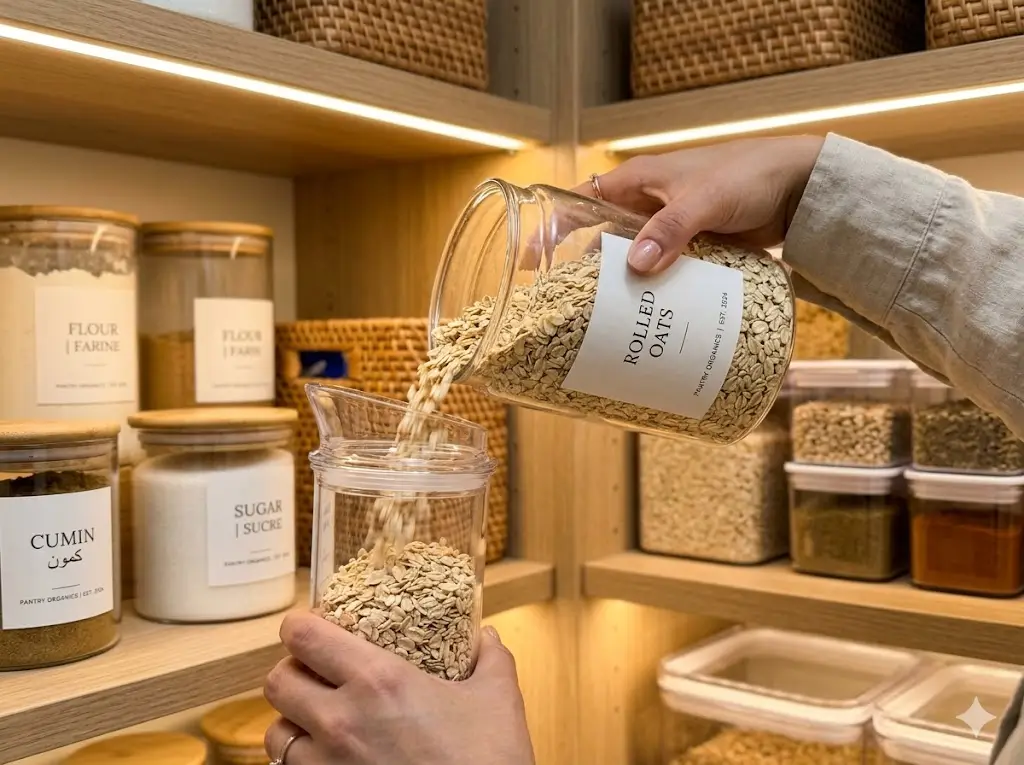
Best for Spices and Micro-Organization
Marie Kondo x The Container Store Bamboo Spice Jars
An aesthetic pantry often lives or dies by its spice rack. These specific jars elevate the visual harmony of any kitchen. Made from thin, highly transparent borosilicate glass, they feature an inner plastic shaker fitment and a stunning, sustainable bamboo lid fitted with a deep-channel silicone gasket for superb moisture protection.
- Key Strengths: Breathtaking minimalist aesthetic, perfectly uniform, the bamboo provides a warm organic contrast to clinical kitchens, excellent airtight seal prevents spice clumping.
- Notable Flaws: Must be hand-washed to prevent the bamboo from warping; you have to invest in a secondary labeling system (like custom vinyl decals) as they arrive blank.
- Perfect For: Aesthetes, professional organizers, and home chefs who want their spice drawer to look like a high-end apothecary.
Best Budget Pantry Bins (For Deep Storage)
mDesign Plastic Open Front Storage Bins
Decanting flour into POP containers is great, but what about bagged snacks, protein bars, and rogue bags of chips? The mDesign open-front bins are the ultimate solution for “ugly” packaging. Molded from shatter-resistant PET plastic, these deep bins act like sliding drawers on your shelves.
- Key Strengths: Unbeatable price-to-performance ratio, the open-front dip allows you to grab a snack without pulling the whole bin down, incredibly sturdy, perfect depth for standard 12-inch and 16-inch pantry shelving.
- Notable Flaws: PET plastic is not dishwasher safe (it will warp violently under high heat); they are strictly organizational and offer zero airtight food preservation.
- Perfect For: College dorms, families with children who need easy-access snack zones, and organizing the chaotic “bottom shelf” of deep cabinets.
The Step-by-Step Buyer’s Framework
Building your ideal aesthetic pantry requires intense strategic planning. Do not blindly purchase a massive 30-piece container set online; these sets are marketing traps filled with useless, tiny 0.2-quart containers you will never use. Use our dynamic, universal 4-step framework to curate a setup perfectly tailored to your biomechanics and culinary habits.
Step 1: The Purge and Volumetric Audit
You cannot organize clutter. Before buying a single container, you must empty your entire pantry onto your kitchen island. Throw away everything expired. Then, group your remaining items into macro-categories (Baking, Pastas, Snacks, Breakfast).
- The Rule of True Volume: Look at the bags you buy. A standard 5 lb bag of flour requires a container with at least a 4.0-quart (3.8 Liter) capacity. A 1 lb bag of coffee beans requires a 1.5-quart container. Write down the exact fluid-quart volume you need for your top 10 staple ingredients.
Step 2: Measure Your Spatial Z-Axis (The Clearance Problem)
The most devastating mistake an organizer can make is buying beautiful modular containers that physically do not fit between their shelves.
- The Measurement Rule: Measure the exact depth of your shelves, but more importantly, measure the vertical clearance (the Z-axis) minus one inch. You must leave at least an inch of clearance above the top container so you can actually tilt and lift it off the shelf without scraping the ceiling. If you have adjustable shelves, remove the pegs and re-configure them to perfectly hug the height of your chosen modular containers.
Step 3: Determine Your “Decanting Budget” vs. “Bin Budget”
Allocate your funds where they mathematically matter the most.
- Invest Heavily in Decanting (Airtight): Spend the bulk of your budget on high-quality, gasket-sealed containers for items that spoil (Flour, Sugar, Coffee, Nuts, Spices). If your $15/lb almond flour goes rancid because of a cheap dollar-store container, you are losing money.
- Save on Macro-Bins: For items that are already sealed in plastic wrappers (granola bars, chip bags, pasta boxes), you do not need airtight containers. Buy cheaper, open-top acrylic or woven hyacinth bins to group these items visually.
Step 4: The Labeling Protocol (The Final Aesthetic Polish)
An unlabelled pantry is a chaotic pantry. You must commit to a uniform labeling system.
- The Expert Secret: Use custom-cut matte vinyl decals or a Bluetooth thermal label maker (like the Niimbot D11). Place labels exactly 1 inch from the bottom of every container to create a perfect, visually soothing horizontal line across your entire pantry shelf. Always write the expiration date in chalk marker on the back or bottom of the container to keep the front pristine.
The Ultimate Buyer’s Pitfall & Troubleshooting Guide
The kitchen organization industry thrives on selling pure aesthetics over functional thermodynamics. Use this extensive pitfall matrix to navigate the misleading marketing jargon and protect your dry goods and your wallet.
| The Marketing Claim | The Consumer Reality | The Expert Advice / Fix |
|---|---|---|
| “100% Dishwasher Safe Acrylic” | While the plastic won’t melt immediately, the incredibly harsh, alkaline detergents used in dishwashers undergo a chemical reaction with rigid acrylics and PET plastics. After 10 cycles, the container will develop “crazing” (micro-cracks) and turn a cloudy, ugly gray. | Always hand-wash your clear plastic containers. Use warm soapy water and a non-abrasive sponge. Only heavy borosilicate glass or Tritan copolyester can truly survive the dishwasher unharmed. |
| “Complete 30-Piece Starter Set!” | Pre-packaged sets are a psychological trap. They artificially inflate the piece count by giving you 15 microscopic 0.2-quart containers that barely hold a handful of almonds, leaving you without enough large containers for flour and cereal. | Build your toolkit piece by piece. Buy exactly what you need based on your volumetric audit. Buy individual large containers, or sets that explicitly state they include 4-quart sizes. |
| “Airtight Clamp Lids” (Cheap Wire Bails) | Cheap knock-offs of Fido jars use thin wire bails and hard rubber gaskets. The wire bends under pressure, and the rubber doesn’t compress, resulting in a fake seal that lets humidity pour in, turning your brown sugar into a literal rock. | Test the seal. If you can easily snap the wire clamp down with one finger, it is not airtight. A true hermetic clamp lid requires significant palm pressure to close, compressing a thick, flexible silicone ring. |
| “Perfectly Round Glass Storage Jars” | They look incredibly cute on TikTok, but round jars waste massive amounts of valuable shelf real estate due to interstitial voids. If you have a small apartment pantry, round jars are spatial suicide. | Switch completely to square or rectangular modular containers. They sit flush against each other and the back wall of your cabinet, reclaiming up to 25% more storage volume. |
| “Decant Everything for the Aesthetic!” | Social media encourages people to decant everything, including items that go stale within days, or items with complex cooking instructions (like specialized grains or baking mixes). | Stop over-decanting. Only decant high-volume staples. If you must decant a specialized mix, cut the cooking instructions off the cardboard box and tape it to the back of the aesthetic container. |
Niche Use Cases & Alternatives
Adapting your aesthetic pantry to specific living situations, physical constraints, and unique culinary needs requires strategic maneuvering outside the standard paradigms.
The Renter / Tiny Apartment (No-Drill Setup)
If you live in a tiny studio apartment with microscopic cabinets and you cannot drill into the walls to install heavy-duty Elfa shelving, you must maximize dead space.
- The Solution: Over-The-Door and Undershelf Mechanics. Utilize the back of your pantry door with a no-drill, tension-mounted wire rack system (like the Container Store’s Elfa Door Rack). This instantly creates 6 tiers of storage for spices, cans, and oils. Inside the cabinets, use undershelf sliding wire baskets that clip onto the existing shelves, utilizing the dead air space above your short cans.
The Deep, Blind-Corner Cabinet (The Black Hole)
Many kitchens have lower cabinets that extend deep into a corner, creating a dark abyss where expired cans go to die.
- The Solution: Heavy-Duty Turntables and Pull-Out Glides. Never put individual items in a deep cabinet. Install a massive, 18-inch lazy susan with high walls to rotate items to the front. For deeper straight cabinets, install industrial, ball-bearing wooden pull-out drawers. If you are on a budget, buy ultra-long (16-inch) clear acrylic bins with handles, acting as manual, removable drawers.
The Walk-In / Commercial Prep Pantry
If you have the luxury of a massive walk-in pantry or run a cottage-law baking business from home, consumer-grade plastic shelves will bow and collapse under the weight of 50 lb flour sacks and massive canned goods.
- The Solution: NSF-Certified Wire Shelving. Abandon the MDF wood shelves. Invest in chrome-plated, NSF-certified commercial wire shelving (like Metro Racks). They can hold up to 800 lbs per shelf, allow for massive airflow (preventing dust buildup and moisture trapping), and allow you to scale up to massive, commercial-grade Cambro containers for your bulk ingredients.
Advanced Maintenance, Care & Longevity Strategies
High-end kitchen organization gear is a collection of mechanical and chemical instruments. Neglecting proper physics and chemistry in your cleaning routine will destroy your investment. Master these protocols to ensure your containers and smart systems last a lifetime.
Restoring Degraded Silicone Gaskets (The Boiling Secret)
Over time, the silicone gaskets on your POP containers or clamp jars will compress, lose their elasticity, and fail to hold an airtight seal. They may also absorb the pungent odors of garlic or smoked paprika.
- The Protocol: Do not throw the gasket away. Remove the silicone ring from the plastic lid. Create a boiling bath on your stove with water and 1/4 cup of baking soda. Boil the silicone ring for exactly 5 minutes. The extreme heat forces the highly stable silicone elastomer matrix to expand and return to its original, uncompressed factory shape, while the baking soda acts as a powerful deodorizer, stripping out the trapped volatile scent oils.
Scratch and Crazing Prevention
Clear plastics (SAN, PET, and Acrylic) are prone to micro-scratches just from sliding against each other or being wiped with a rough towel.
- The Protocol: Never use a Scotch-Brite pad or the rough side of a sponge on your aesthetic containers. Wash them exclusively with a soft microfiber cloth and mild dish soap. When drying, do not rub them vigorously with a terrycloth towel; instead, let them air dry upside down on a silicone mat to maintain their flawless, glass-like clarity.
Smart Pump Battery Lifecycle Management
If you utilize a smart vacuum system like Zwilling with a lithium-ion brushless motor pump, you must manage the battery chemistry to prevent premature death.
- The Protocol: Never leave the vacuum pump permanently plugged into the charger. Keeping a lithium-ion battery at 100% voltage constantly will degrade the internal cells. Charge it fully, then unplug it and use it until the LED indicator flashes red (usually 3-4 months of normal use) before recharging. Keep the pump base away from the stovetop; extreme heat degrades lithium batteries rapidly.
Pantry Pest Annihilation (The Diatomaceous Earth Defense)
Even in an aesthetic pantry, microscopic eggs from flour beetles or pantry moths can arrive completely hidden inside your newly purchased bags of flour or rice.
- The Fix: If an outbreak occurs, an airtight container actually acts as a quarantine cell, preventing the bugs from spreading to other bins. Immediately throw the infested container’s contents away. Wash the container in scalding water. As a preventative measure, place a dry Bay Leaf inside your flour and rice containers; the natural eucalyptol oils act as a powerful insect repellent without altering the flavor of your baking. For severe shelf infestations, sprinkle food-grade Diatomaceous Earth in the corners of your shelves to mechanically destroy crawling insects.
Conclusion
Building your Aesthetic Pantry is a profound investment in your culinary efficiency, your home’s visual serenity, and your financial bottom line. By rejecting the chaotic, packaging-heavy clutter of a disorganized cabinet, discarding the mathematically flawed geometry of round jars, and embracing the electromechanical brilliance of smart vacuum pumps, perfectly modular Tritan copolyester, and heavy-duty ball-bearing turntables, you transform your kitchen from a frustrating labyrinth into a laboratory of automated precision. Remember the ultimate framework: audit your true volumetric needs before buying, invest heavily in hermetic seals for your perishable dry goods, and treat your clear acrylics with the gentle hand-washing they require to remain pristine.
Ready to reclaim your space and halt food waste? Check the current prices, real-time discounts, and availability on Amazon via our curated Top Category Winners links above. If you have questions about whether a specific modular set will fit your narrow cabinet depth, or need a personalized recommendation for spice drawer inserts, drop a detailed comment below! Don’t forget to subscribe to our newsletter for deep-dive reviews on the latest smart kitchen tech, advanced label-making tutorials, and exclusive manufacturer discounts.
Comprehensive FAQs
1. Is it actually worth the money to decant all my food into plastic containers?
Financially, yes. If you are throwing away stale cereal, rock-hard brown sugar, and rancid nuts, you are literally throwing away cash. A high-quality airtight container system pays for itself within 12 to 18 months by extending the shelf life of your food by up to 300%. Psychologically, the visual uniformity drastically reduces decision fatigue and allows you to instantly see your inventory levels before grocery shopping, preventing costly over-purchasing.
2. Why did my brown sugar turn into a solid brick even though it was in an “airtight” container?
Brown sugar is simply white sugar coated in liquid molasses. It turns hard not because air got in, but because the existing moisture in the molasses evaporated. Even in a perfectly airtight container, the dry air trapped inside the headspace can slowly draw the moisture out. To fix this, you must re-introduce moisture. Soak a terracotta brown sugar disk (or a slice of sandwich bread) in water, pat it dry, and place it in the container. The sugar will soften back to its original state overnight.
3. What is the difference between Borosilicate Glass and normal glass?
Standard soda-lime glass (what drinking glasses and cheap jars are made of) has a high coefficient of thermal expansion, meaning it expands and contracts rapidly with temperature changes, causing it to shatter easily if moved from cold to hot. Borosilicate glass is infused with boron trioxide, which makes it highly resistant to thermal shock. It is stronger, lighter, more durable, and completely immune to shattering from temperature swings, making it the superior (and more expensive) choice for high-end pantry storage.
4. Can I store coffee beans in clear aesthetic containers on my shelf?
It is highly discouraged if your pantry receives natural sunlight. Coffee beans are rich in delicate, volatile oils that give them their flavor. When exposed to Ultraviolet (UV) light, these oils undergo rapid photodegradation, turning the coffee stale, bitter, and rancid in a matter of days. Coffee should always be stored in an opaque, airtight container (like matte black stainless steel or tinted amber glass) in a cool, dark environment.
5. How do I stop my lazy susan (turntable) from wobbling and scraping the shelf?
A wobbling turntable is a sign of poor bearing distribution or severe overloading. Budget lazy susans use a single, small ring of plastic bearings in the center. When you put a heavy bottle of oil on the edge, the torque causes the plastic to warp and scrape. You must upgrade to a turntable with a wide raceway of stainless steel ball bearings. Furthermore, always distribute the weight evenly; place the heaviest bottles of oil or vinegar directly in the center, and lighter spices around the outer rim.
6. I dropped my acrylic container and it cracked. Can I glue it back together?
No. Once the structural integrity of a food-storage container is breached, it must be discarded. Glue (even food-safe epoxies) will eventually degrade, and the crack creates a microscopic canyon where bacteria will breed, completely isolated from your dish sponge. Furthermore, the container is no longer hermetically sealed, rendering it useless for preserving food. If you are prone to dropping items, you must invest in impact-resistant Tritan plastic or PET, rather than brittle acrylics.
7. Do active vacuum sealers (like Zwilling) really make a difference compared to regular airtight lids?
Yes, a staggering difference. A regular airtight lid (like OXO) traps the existing ambient oxygen inside the container with the food. While it prevents new oxygen from entering, the trapped oxygen will still slowly oxidize the food. An active vacuum pump physically extracts all the oxygen molecules from the container, creating a negative pressure void. This completely arrests the oxidation process, making it essential for highly perishable, high-cost items like raw nuts, specialized flours, and coffee.
8. Why are my plastic pantry bins turning cloudy and white after washing?
You have “crazed” the plastic. This is irreversible damage caused by extreme heat and harsh chemicals. When you place rigid acrylic, SAN, or polycarbonate in a dishwasher, the high-temperature water (often exceeding 160°F) causes the plastic to expand, while the caustic alkaline detergents etch the surface. As it cools rapidly, thousands of microscopic fractures form inside the plastic wall, appearing as a cloudy, white haze. You must strictly hand-wash clear pantry containers to maintain their pristine aesthetic.
9. What is the best way to label containers without ruining them with sticky residue?
Never use standard paper stickers or masking tape; the adhesive will polymerize over time and leave a permanent, sticky mess that ruins the aesthetic. Use custom matte-vinyl decals, which are waterproof and peel off cleanly. If you prefer writing, use a liquid chalk marker. Liquid chalk dries hard, won’t rub off when you touch it with dry hands, but wipes away instantly and completely with a damp cloth, allowing you to re-label containers effortlessly as your inventory changes.
10. How do I organize the deep, dead space at the back of my lower pantry cabinets?
Never place loose items in deep lower cabinets; they will inevitably be pushed to the back, expire, and waste money. The fundamental rule of deep storage is to create “drawers.” If you cannot install mechanical pull-out wooden drawers, you must use ultra-long, clear plastic bins with handles. Group items by category (e.g., “Baking Supplies” or “Salty Snacks”) into one long bin. When you need flour, you simply pull the entire bin out like a drawer, instantly accessing the items at the very back.